What's your big idea?
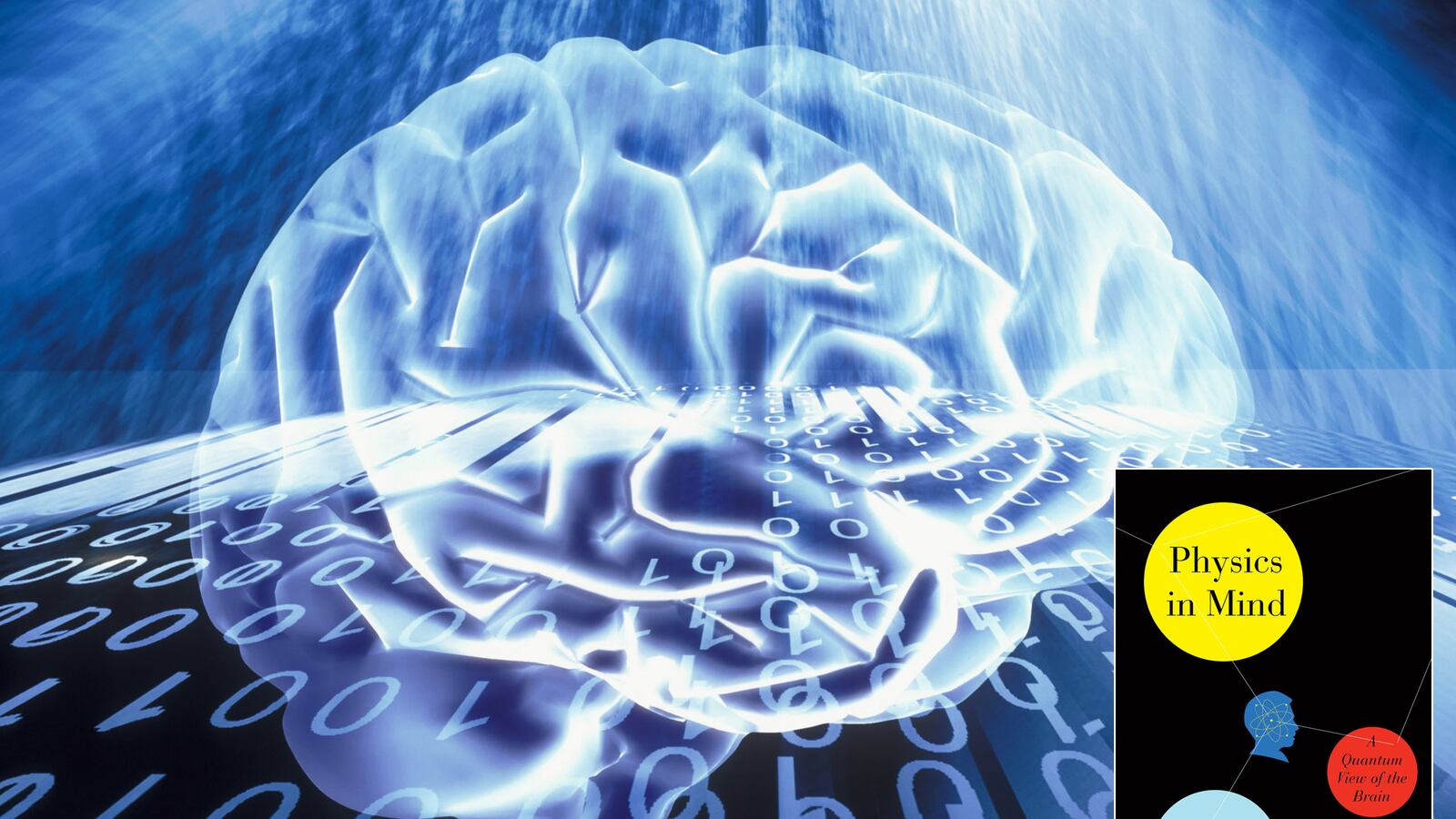
How cells in our body transfer information to each other has been an old fixation of mine. Here, in Physics in Mind, I address the question of how information is transferred inside our most complex organ, the brain. I present an amazing set of molecules which achieve what the avant-garde of our computer scientists is only now hoping to: quantum computing. These molecules have been at it for eons—they were engineered in the oldest workshop on earth: evolution. And they wield unheard of computing power; they manage to harness the immense amounts of information inherent in quantum waves.

Quantum particles can behave like particles or like waves—all elementary particles will behave that way, including small atomic nuclei. And as waves, they will produce characteristic interference patterns caused by waves arriving out of step or in lockstep. It’s in the latter state, when their peaks and troughs all coincide, that these waves hold immense information amounts.
And this is the state—a unique state of energy and matter quantum physicists call quantum coherence—that those remarkable molecules exploit. Strategically located in sensors of the brain, they extract information from the environment and run it through round after round of quantum computations—they are the brain’s windows to the world.
Against that backdrop, I put forth the hypothesis that quantum coherence is at the heart of the parallel information processing that goes on in the upper reaches of the brain and allows our minds to almost instantaneously deal with the staggering information amounts coming in through our senses. A quantum computer is a natural for that: by virtue of its very mathematical structure, it is a parallel information processor—a processor that is ultrafast and, given a sufficient information supply, virtually indefatigable.
Up in the cerebral cortex, the neuron networks typically have multiple inputs, and the information coming from many different sensory channels gets processed in parallel. That part of the brain’s hard-wiring has been known for some time through the elegant work of neurophysiologists, probing the cortex and other brain regions with microelectrodes. It is this parallel information processing that the hypothesis addresses. A quantum-computing neuronal web will do this hands down. Rather than going through the tedious processing of information one piece at a time as ordinary digital computers do, a web exploiting quantum coherence will handle myriads of pieces simultaneously, saving precious time and brain space—in principle, one processing unit operating in the parallel quantum-computing mode is capable of doing what would require myriads of units operating in the sequential mode of standard digital computers.

So the name of the game in the brain is quantum coherence. The state of coherence is short-lived—it is rapidly destroyed under the onslaught of countless quantum particles in the environment. In the quantum-computing molecules I mentioned, it lasts only a 10th of a trillionth of a second. But in the minute quantum world that’s enough. It is thanks to that instant of grace that we can see even the faintest glimmer of light.
In what direction is our theory of mind going and will physics play a crucial role in it? In other words, what does the future of neuroscience look like?
The question—What is the mind?—has for centuries been lying uneasily at the border of philosophy and science. But recast in modern times as the brain-mind problem, it has become more and more scientists’ territory, and these days, it is a natural meeting ground for biologists and physicists—it is the ultimate science frontier. And as I look at things from the common ground floor, the quantum bottom, I see the traditional boundaries between the two sciences vanishing into thin air.
But I also am reminded of what Chairman Mao once said in the 1960s when asked what he thought of the French Revolution: “It's too soon to tell.”