
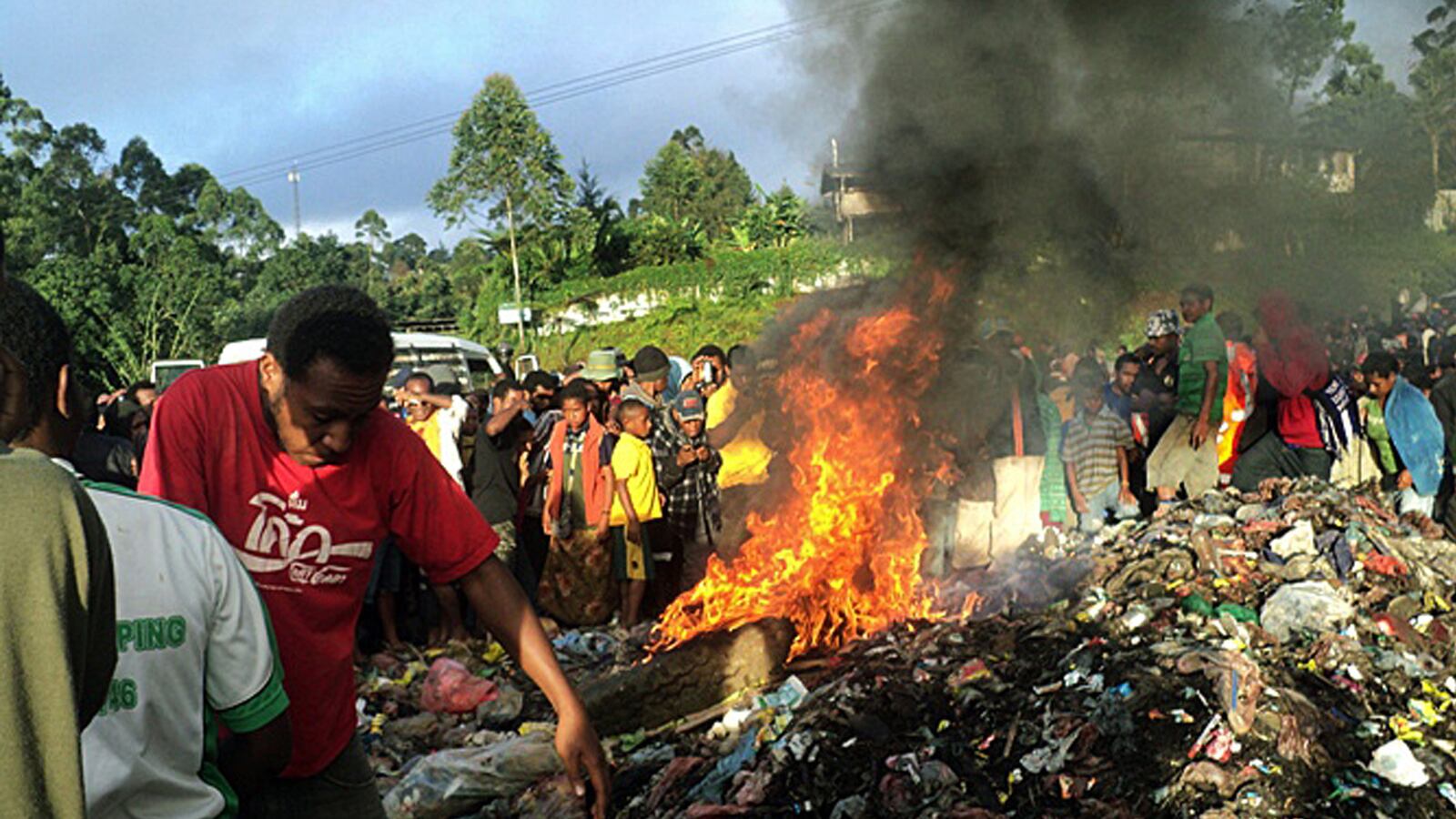
Just days after last week’s fatal “witch burning” on a rubbish dump in Papua New Guinea, which provoked international condemnation, an 8-year-old girl was gang-raped and murdered in the same highlands town, and two innocent elderly women also accused of witchcraft narrowly escaped being burned at the stake in a vengeance attack.

The 8-year-old girl died at the hands of two known suspects, according to local divisional Commander Teddy Tei. But the girl’s grieving family was persuaded by a “glassman,” a kind of witch-doctor, that the two old women were responsible for the girl’s death.
Captured by a mob and tied at a stake near Mount Hagen airport, they were rescued after a tip-off to local police, according to The National newspaper.
Tei said the men preparing to torch the women included the “glassman” and the two suspects for the girl’s death. Details of her post mortem—which revealed evidence the girl had been raped and strangled—were later released to try to quell talk of another sorcery payback.
About 20 suspects have reportedly been rounded up in relation to the two attacks, but police were continuing to look for the killers of 20-year-old Kepari Lanieta, the mother of a young baby who was tortured and set alight before a large crowd after being accused of using magic to cause the death of a child in the Mount Hagen Hospital. Spectators took photographs of the pyre on their mobile phones.
The passivity of the watching crowd, as much as the viciousness of the attack, has horrified and embarrassed many Papua New Guineans, who “recoil in fear and disgust” at such lawlessness, the editor of the national daily Post Courier, Alexander Rheeney, observed.
“They stood idly by as she screamed and burned, writhing in blinding pain,” observed one commentator on the popular Sharp Talk Facebook page. “No one cared to save her. No one.”
Belief in sorcery and witchcraft is still widespread in Papua New Guinea, where 80 percent of the 7 million-plus population lives in rural and remote communities. Enduring tradition widely resists the notion that natural causes, disease, accident, or recklessness might be responsible for a death. Rather, bad magic is the certain culprit.
“When people die, especially men, people start asking ‘Who’s behind it?’ not ‘What’s behind it?’” Dr. Philip Gibbs, an anthropologist, sorcery specialist, and Catholic priest, told The Global Mail.
Payback against those accused of practicing sorcery is a deep-set custom in some parts of the ethnically diverse nation. Ritual attacks on accused sorcerers—historically brutal in some parts of the country, notoriously so in the highlands—appear to have broken out of traditional boundaries. “This public stuff, with the kids watching, it becomes a spectacle. It’s often associated with marijuana or alcohol,” said Gibbs.
It’s also strongly linked with opportunism and theft. Sorcery accusations are commonly used to deprive women of their land, Rashida Manjoo, the U.N. special rapporteur on violence against women, reported last year.
Australian National University anthropologist Dr. Richard Eves, who is convening a conference on the issue in Canberra in June, says that, unlike in Europe and America, where stories of sorcery and witchcraft waned with the onset of modernity, that doesn’t seem to have been the case in Melanesia or in Papa New Guinea in particular.
A recently completed two-year investigation by the Constitutional and Law Reform Commission in Papua New Guinea—due to be presented to Parliament in the next few weeks—found that sorcery-related violence has been increasing since the 1980s, and estimates that as many as 150 cases a year are occurring in one volatile highlands province, Simbu, alone. The review will recommend the repeal of the 1971 Sorcery Act, which human-rights agencies say has provided legal refuge for murderers and vigilantes to argue sorcery as a mitigating factor.
After collecting first-hand testimony in the highlands last year, the U.N. special rapporteur said she was “shocked to witness the brutality of the assaults perpetrated on suspected sorcerers, which in many cases include torture, rape, mutilations, and murder.”
Manjoo’s investigation indicated “extremely high levels of violence against women throughout the country” in both the social and domestic spheres. Although good data is scarce, according to a 1992 report by the Constitutional Law Reform Commission, two-thirds of married women in PNG had been hit by their husbands. An academic study in 2009 shared similar findings, noting that 65.3 percent of the interviewed women were survivors of domestic violence.