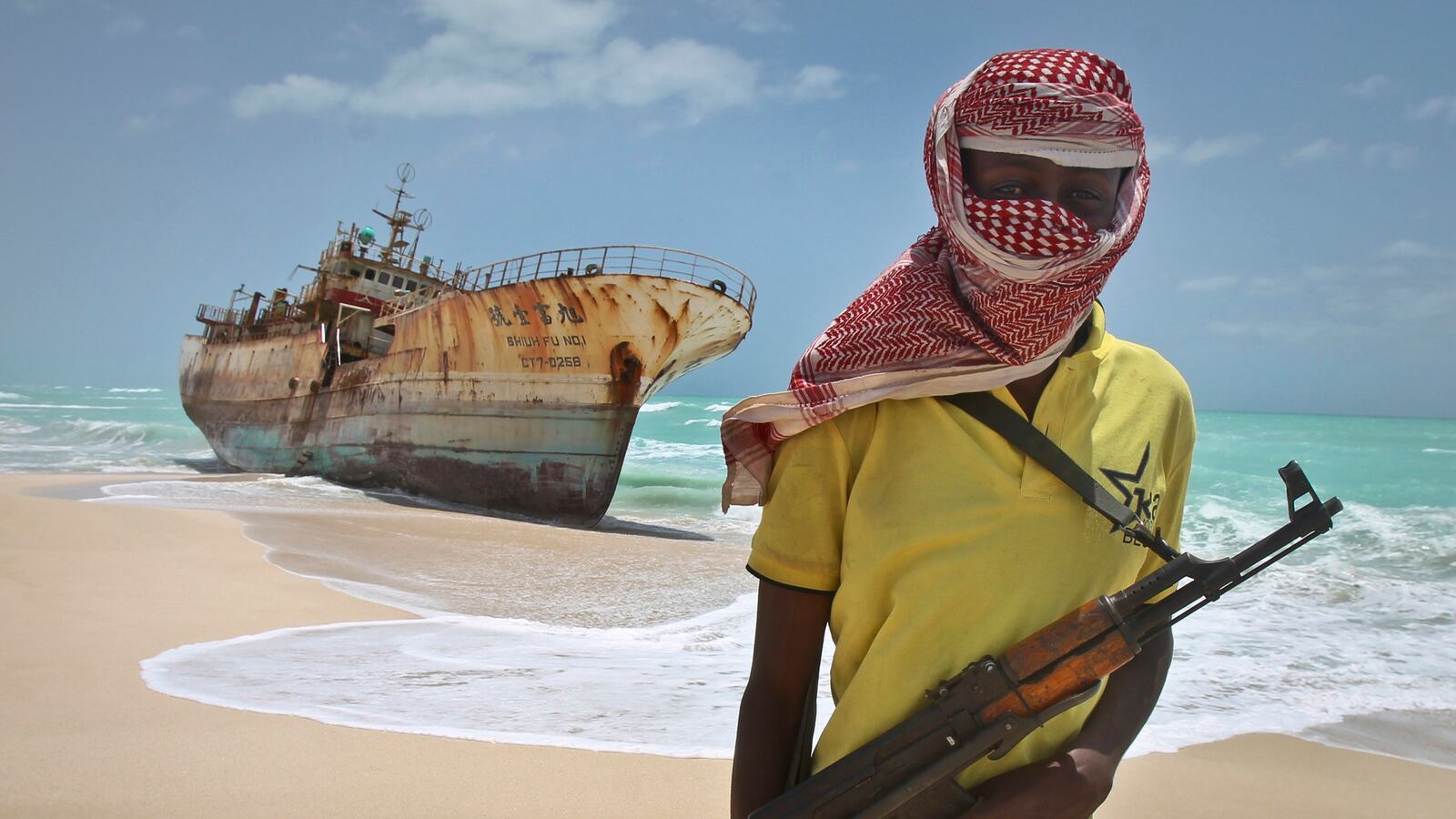
Somalia’s federal government is offering amnesty to junior pirates in an attempt to end the hijackings of merchant vessels that have plagued international shipping lanes off the coast of the East African nation, according to Somali President Hassan Sheik Mohamud.
Although the amnesty offer supposedly does not extend to top pirate bosses, The Daily Beast has learned that two pirate leaders—including Mohamed Abdi Hassan Afweyne, one of the founding fathers of Somali piracy—met with Somali Prime Minister Abdi Farah Shirdon in early February to discuss amnesty conditions. Afweyne is one of three pirate bosses whose assets the U.S. Treasury has targeted for freezing.
“Somalia has been plagued by piracy for many years now and these criminals have badly affected global shipping. Piracy has to end,” said President Mohamud in a press statement on February 28.
Somali elders were mediating ongoing talks with pirates, the president said, in the hope of reaching a lasting deal to rehabilitate the young men involved, while at the same time holding the top leaders to account.
“We must emphasize that this is just a partial amnesty and does not apply to the pirate kingpins, who take most of the money,” he said.
The president added that the negotiations were still at an early stage, and details of the amnesty program had not been finalized.
The closed-door meeting between the pirates and Prime Minister Shirdon—which took place the second week of February— was brokered by Mohamed Abdullahi Tiiceey, president of the self-declared autonomous region of Himan and Heeb, a recruiting ground for many of Somalia’s pirates.
Tiiceey and Somali Minister of the Interior Abdikarim Hussein Guled were also present, as well as Afweyne and fellow pirate kingpin Mohamed Garfanji.
Afweyne and Garfanji were even granted special permits to carry their firearms in the city, according to a source close to the men.
Garfanji, a pirate responsible for at least six high-profile hijackings, once commanded a militia, hundreds strong and armed with 80 heavy machine guns and six flatbed 4x4s, according to The New York Times.
Mohamed Abdi Hassan, known by the sobriquet “Afweyne” (“Big Mouth”), was a civil servant from the central coastal town of Harardheere before he founded the infamous Somali Marines, a pioneering pirate organization that exceeded all others in sophistication and operational success.
In 2005 the Somali Marines began hijacking World Food Programme (WFP) transports carrying aid into Somalia, seizing the MV Semlow and her 850-ton rice cargo in June of that year.
The kidnapping-at-sea model pioneered by Afweyne quickly spread to other nascent pirate organizations in northern Somalia, culminating in a 2008 outbreak that saw the headline-grabbing hijackings of the Ukrainian tank transport MV Faina and the supertanker MV Sirius Star, ferrying $100 million of oil, late in the year.
Former president Sheik Sharif Ahmed drew international criticism last year when it was revealed that he had awarded a diplomatic passport to Afweyne, having appointed him a “counterpiracy” officer for the Himan and Heeb region.
Afweyne publicly “retired” from piracy in January, in a highly publicized press conference at which he announced an end to an eight-year career, though in actuality he had handed over the day-to-day operations of his organization to his son Abdikadir some years prior.
Abdikadir Abdi Afweyne confirmed that his father had met with Prime Minister Shirdon, and was optimistic about the outcome.
“Perhaps more meetings are still to come,” Afweyne told The Daily Beast. He seemed unaware that President Mohamud’s amnesty did not officially extend to him or his father.
“We welcome the recent amnesty offered by Somali President Hassan Sheik Mohamud,” Afweyne said. “What motivated us to become pirates was illegal fishing in our seas by foreign ships, which destroyed our fishing equipment. Now we are ready to shut it down if the world and the Somali government handle things correctly.”
Sources close to the pirate leaders also said that a meeting with Prime Minister Shirdon had taken place and that the men had been offered amnesty from prosecution if they cooperated with government efforts to end piracy.
Himan and Heeb President Tiiceey, who brokered the meeting, was adamant that Afweyne was acting in an official government capacity.
“Afweyne gave up piracy six years ago,” he told The Daily Beast. “He is the head of our anti-piracy agency. He’s the one negotiating for the pirates to give up their activities.”
“Mohamed Garfanji gave up piracy two months ago,” he added. “Whether or not the amnesty applies to him, time will tell.”
“They’ve given up their technicals [battle wagons] and their weapons, and also the human beings they’ve kidnapped,” he said, referring to three Syrian hostages whose release was negotiated by Himan and Heeb authorities in January.
According to Tiiceey, the amnesty will cover 949 young pirates that his government has persuaded to give up the trade. Tiiceey clearly expected quid pro quo from the central government in exchange for his efforts, in the form of assistance to his region’s impoverished residents.
“The government has to come up with a plan to change the lives of these people, to train them. Otherwise the work we’ve done is going to be fruitless.”
The mass exodus from the piracy trade may have more to do with a broken business model than a sudden change of heart. According to International Maritime Bureau (IMB) figures, in 2012 pirate attacks reached a record low since 2008, with only 14 vessels hijacked—half the number of the previous year. Attacks dropped off drastically in the second half of 2012, and there is yet to be a hijacking this year.
The decline has been largely attributed to the increased presence of armed-guard detachments on board merchant vessels. It is currently estimated that 30 percent to 40 percent of commercial vessels traveling through the Gulf of Aden employ private security, a response to skyrocketing ransom demands and increasingly lengthy captivity periods for hijacked crews.
When approached for comment, officials within Prime Minister Shirdon’s office stated that no such meeting with the pirate leaders had occurred.
“That meeting never happened, and we have no further comment on this subject,” Ahmed Adan, communications director at the prime minister’s office, told The Daily Beast. “We have no idea if these pirate leaders are in Mogadishu.”
Spokesmen from the president’s office also said that no meeting had taken place.
Somalia observers say an official amnesty from the weak central government may be a largely symbolic gesture. The internationally recognized federal government, which is largely confined to administering the capital, Mogadishu, lacks effective control of the central and northern regions out of which the pirates operate.
Furthermore, pirate leaders from the Sa’ad clan, who also operate out of central Somalia, were not included in the amnesty talks.
Seven vessels and 113 hostages remain in captivity off Somalia, according to the IMB.
Mohamed Odowa in Mogadishu contributed to this report.