As Benedict XVI departs Saint Peter’s to begin his tenure as pope emeritus in Castel Gandolfo, the speculation over whom the College of Cardinals will pick as his successor has started to heat up. Speculation in the most literal sense—if you’re wondering who will come out after the white smoke, it might be best to follow the green.
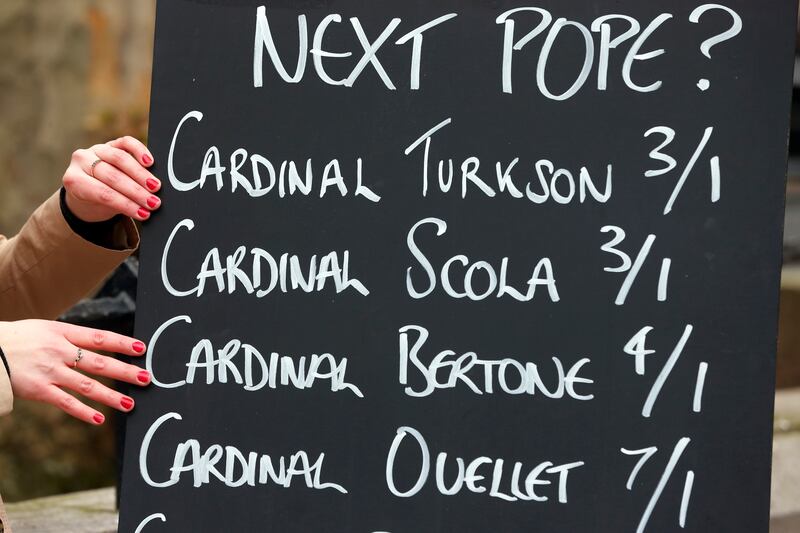
Betting on who will take up residence in Saint Peter’s is nearly as old as the papcy itself. In 1503 it was already being referred to as “an old practice.” By 1591 Pope Gregory XIV threatened papal speculators with excommunication. This didn’t stop Italians from betting on il papa. In 1903 the Italian government lottery let citizens bet on when Pope Leo XIII would expire.
Today, the online brokers, bookies, and prediction markets are at it again. Paddy Power, the Irish online bookmaker, has already taken in over $500,000 in bets relating to the papal succession and expects “that figure to run as high as several million,” according to a Paddy Power spokesman.
In 2005 Paddy Power took in over $1 million and had Cardinal Ratzinger at 3–1 odds before the white smoke rose from the Sistine Chapel and Pope Benedict XVI addressed the crowd in Saint Peter’s Square. The last papal election, the first in which online gamblers were active, was a noteworthy success for bookies like Paddy Power and Ladbrokes and for the then-newfangled Intrade, the Dublin-based prediction market that allows users to buy or sell contracts on whether future events will occur.
This time however, Intrade is not as active. Following the Commodity Futures Trading Commission’s suit against Intrade, Intrade banned Americans from the site, and traffic and trading volume has since plummeted. Whether this will affect the accuracy of Intrade’s predictions—the market gave Obama a 71 percent chance of winning on the morning of Election Day—remains to be seen. “We don't really know how much the CFTC actions have hurt the predictive accuracy of Intrade. Even though Intrade is now off-limits for Americans, remember that non-Americans are still allowed to trade there,” said Justin Wolfers, an economist at the University of Michigan who has studied prediction markets.
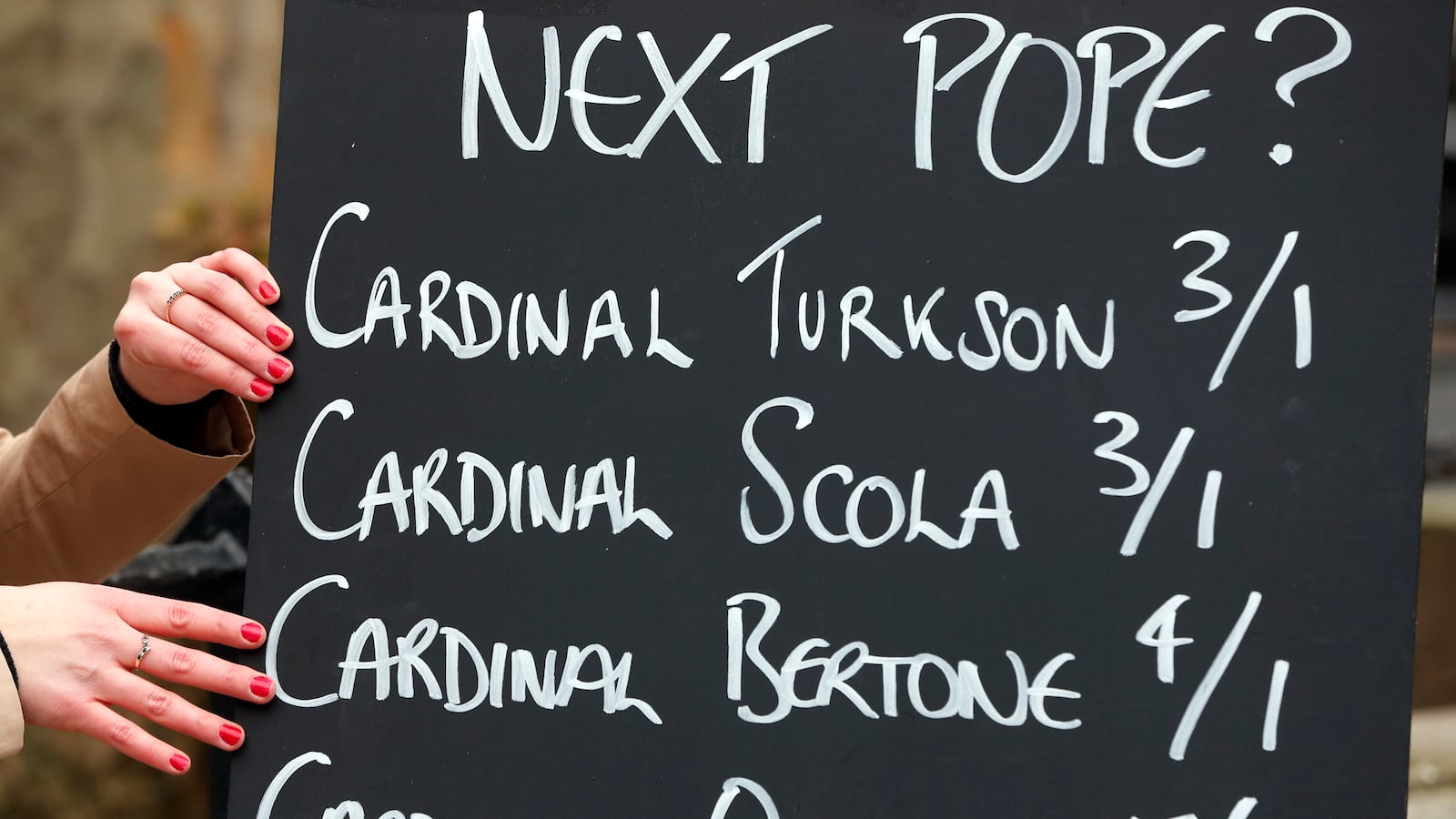
So who are the favorites? Intrade, Ladbrokes, and Paddy Power each give Archbishop of Milan Cardinal Angelo Scola a 25 percent chance of winning,, while Peter Turkson of Ghana is a 28 percent bet on Intrade, 25 percent on Paddy Power, and 26.67 percent on Ladbrokes. Although Intrade doesn’t differ too much from the deeper markets, there are only 163 shares of “Archbishop Angelo Scola to succeed Benedict XVI.” Other leading candidates are Vatican Secretary of State Tarcisio Bertone, given a 14.5 percent chance on Intrade and 20 percent on Ladbrokes and Paddy Power, and Canadian Cardinal Marc Ouellet, who is at 15 percent on Intrade and 12.5 percent on Ladbrokes and Paddy Power.
“Leighton Vaughan Williams, a professor at Nottingham Business School and director of its political forecasting unit, says that the papal betting markets are one of the better examples of the usefulness of prediction markets. That’s because big players in online betting, like Ladbrokes and Paddy Power, allow bettors to make large bets (Paddy Power allows payouts of up to £25,000 and £10,000 for political events), and so those participants with real, useful information actually have something to gain from placing bets.
This is different from the U.S. election, where Intrade speculators and the general public have access to almost all the same information. So Intrade largely followed the work of smart polling aggregators like Nate Silver (even though Silver was more confident in Obama’s reelection odds than Intrade was).
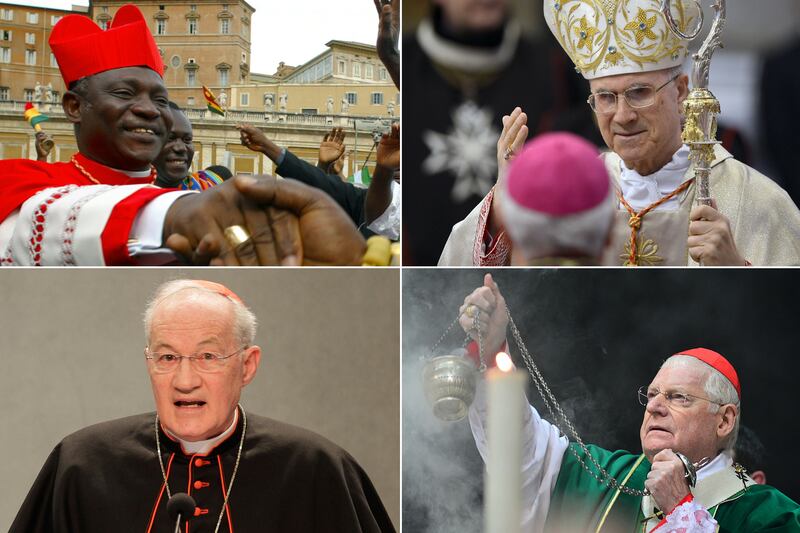
With the papal election, however, vastly fewer people have any real information. And even though the cardinals themselves are under lockdown during the conclave, which hasn’t yet been scheduled, individual cardinals’ thoughts may leak out over the coming weeks. That information could then be reflected in the betting markets. And since the markets all tend to move together, a few big bets in any one of them could affect all of them. “If you see a 100 to 1 come into 10 to 1, then you need to think about that, just like you would with a horse,” says Vaughan Williams.
Wolfers is a bit more skeptical. “There's not really much reason to track any of these markets closely: markets aggregate information, and it’s not clear that there's useful information out there to aggregate.” Wolfers also thinks that because of the paucity of information, the betting activity will be extremely volatile, because “everyone fears that the person betting against them knows more than they do. So expect volatility, but don’t expect it to be particularly insightful.”
But if you’re a potential bettor with no insight into the thought process of any cardinal, look out for “favorite-long-shot bias.” This is the phenomenon where long shots are given better odds than they ought to and favorites are given worse odds. So, Cardinal Dolan, archbishop of New York, who is currently a 33–1 long shot on Paddy Power, is probably less likely to win the papacy than that, while an established favorite like Scola or Turkson is probably a better bet than his current odds indicate. A similar phenomena was at play in the 2012 Republican primary election, where long shots like Herman Cain and Ron Paul were sometimes given significantly better odds than the fundamentals indicated and Mitt Romney was underweighted by the Intrade community.
“I expect that these markets are the best indication we’re going to get. However weak they are, they’re stronger than anything else,” says Vaughan Williams.