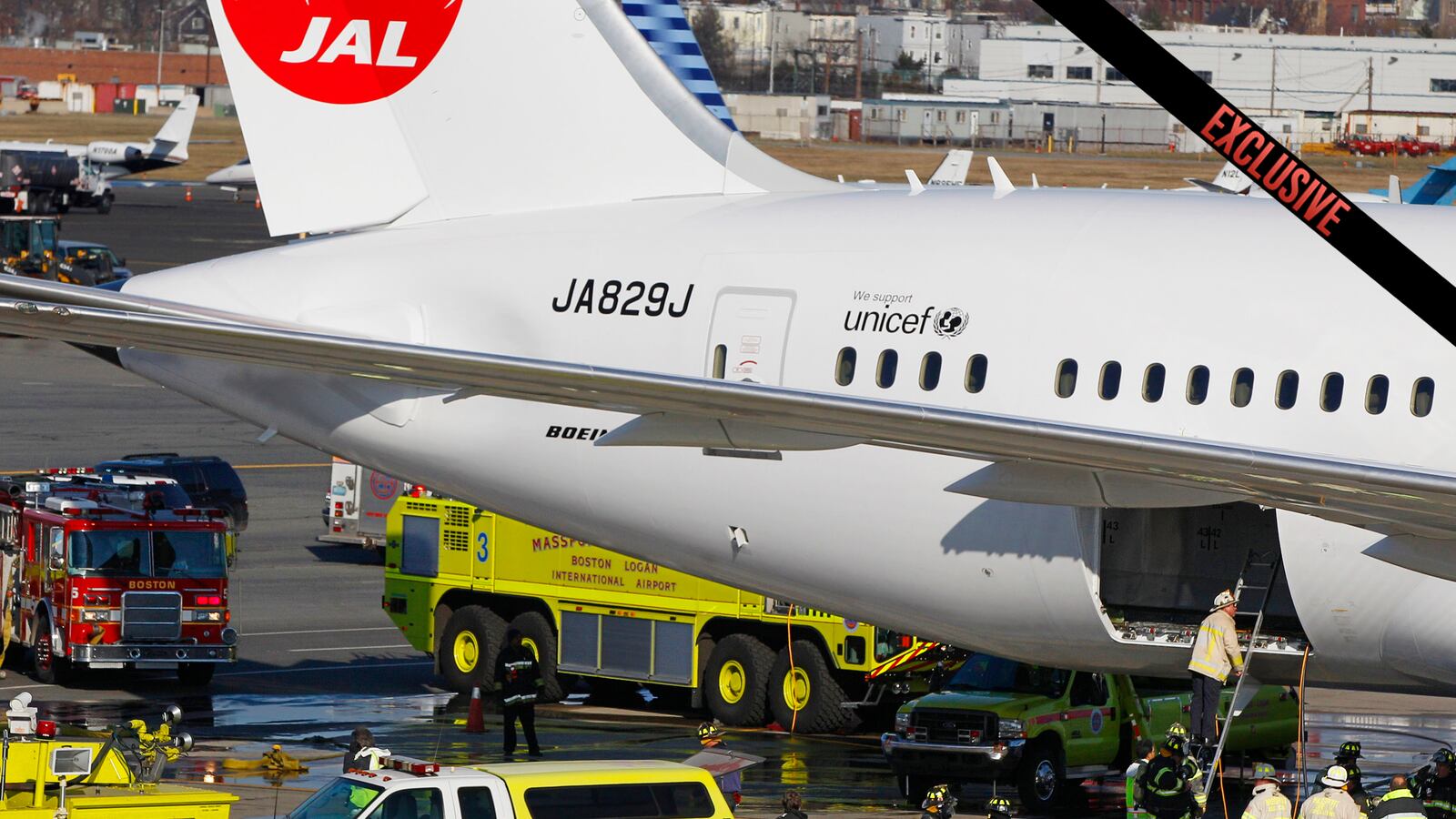
Firefighters called to deal with smoke detected on a Japan Airlines Boeing 787 parked at a gate at Boston’s Logan International Airport in January faced a more dangerous situation than was disclosed at the time. A report on the emergency released by the National Transportation Safety Board today not only reveals this but also shows that the cause of the emergency has still not been detected and that the risks posed by the use of lithium-ion batteries in an airliner were seriously underestimated.
When a Japan Airlines station manager, responding to an emergency call, boarded the 787 through the gate from which arriving passengers had disembarked half an hour earlier, he found that intense and caustic-smelling smoke was billowing through the floor into the rear of the cabin from a battery compartment in a bay below.
In that bay, the report reveals, members of the airport’s aircraft rescue and firefighting team were struggling to understand what was happening. They saw that the source of the smoke was a battery unit and that, in addition to the smoke, there were two separate spurts of flame and a white glow about the size of a softball.
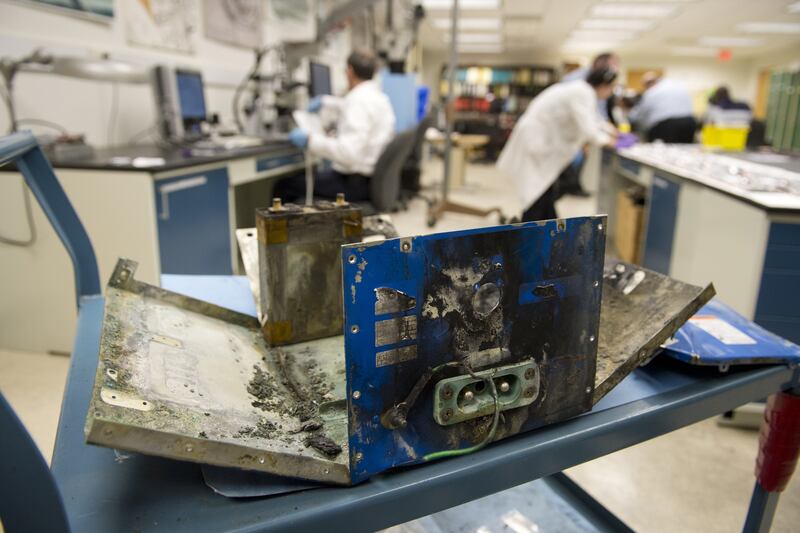
For five minutes the fire captain applied shots of a chemical designed to deal with battery fires, but then the battery exploded, and the captain received a burn to his neck. Efforts to shut down the battery failed, because the knob used to disconnect it from the rest of the system was already charred and melted. In the end, they had to remove the battery and its casing from the electronics bay tosave the airplane. It turns out that what was going was a thermal runaway, when a battery begins a chain reaction resulting in smoke and fire. The NTSB report says that as the battery was being certified, Boeing had estimated that this kind of failure was remote: once in every 10 million flight hours. The trouble is, the plane had come nowhere near that number of hours. As the NTSB points out, the Boston emergency occurred when the entire 787 fleet had flown for fewer than 52,000 hours before it was grounded.
In recent days there have been reports that Boeing is close to gettingclearance from the FAA to make test flights aimed at having the 787certified again as safe to fly once the airplanes have been retrofitted with what Boeing claims are changes that will eliminate any recurrence of the battery fire in Boston. However, the timing and graphic nature of the NTSB report shows that Boeing will have to work hard to assuage continuing worries about its chosen battery technology.
And the NTSB report makes very clear that it intends to document andevaluate the toxicity of combustion byproducts that accompany lithion-ion battery fires as part of its deeper investigation into how the 787’s battery system was certified.
Moreover, the report records that when the FAA was first looking at the certification of lithium-iion batteries on the 787 during early development, it was aware that the batteries were significantly more susceptible to internal failures and that the existing regulations did not contain adequate or appropriate safety standards for lithium-ion batteries.
Boeing itself had identified as part of a functional hazard assessment that in these batteries, the venting of smoke and fire would be catastrophic. Boeing then set out to satisfy regulators that its battery installation and protection systems would ensure that this condition did not happen.
NTSB chairman Deborah Hersman is reinforcing her reputation as a safety zealot who wants to bring more transparency to the board’s investigations. In addition to publishing the new details of the Boston emergency, she announced that in April the board will hold public hearings on the risks and benefits associated with lithium batteries and that the hearings will be webcast live.