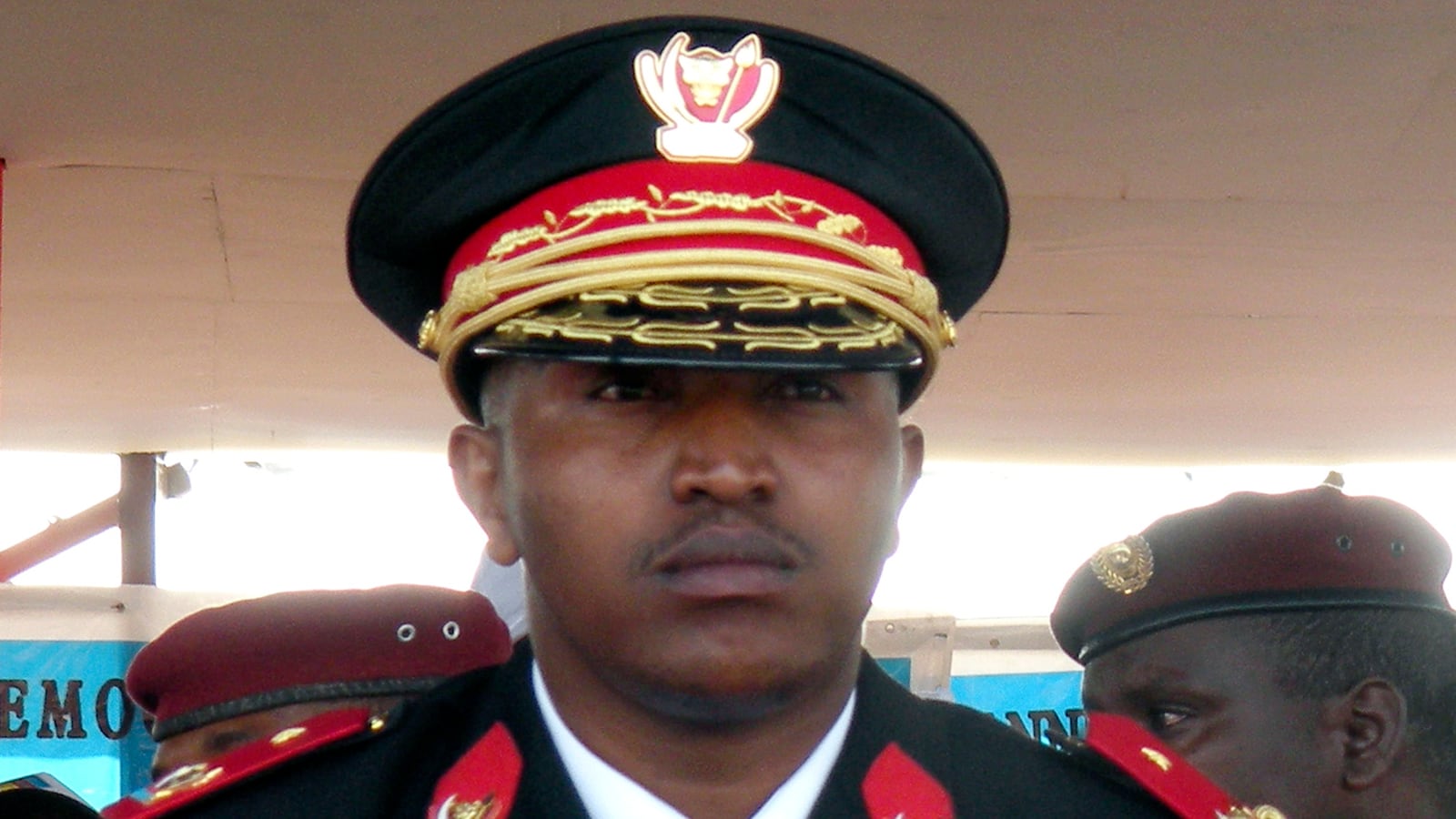

For the past three days, Bosco Ntaganda, also known as “The Terminator,” has been holed up at the American embassy in Rwanda. One of Africa’s most wanted war criminals, Ntaganda was a leader of the M23 in eastern Congo, until he apparently lost control of the notorious rebel group, and began fearing for his own life.
The International Criminal Court (ICC) has had a warrant out for Ntaganda for years on charges of recruiting child soldiers as well as for murder, rape, and sexual slavery. But despite being on this international black list since 2006, Ntaganda’s fall has been relatively swift and the circumstances of his surrender remain a mystery.
But as Tony Gambino, former head of USAID in the Democratic Republic of Congo, put it: “There was never a good endgame for Bosco.” Gambino, now an adjunct professor at Georgetown University, says that Ntaganda “went from being a senior commander in very good graces—at least as far as the Congolese Army was concerned—to being a hunted man with a bull’s eye between his eyes. How does that happen?”
U.S. officials in Washington said that Ntaganda asked to be transferred to the ICC and that they will let him speak for himself about his motives for turning himself in.
For years, the international community tacitly accepted the formula that Congolese authorities stated publicly: that stability should be given priority over justice—which meant working with Ntaganda, an opportunistic soldier-for-hire.
Ntaganda was famous for flaunting his freedom, in spite of the arrest warrant, by frequenting bars in Goma and playing tennis at a lakeside hotel. But he rarely spoke to international media, and relatively little is known about his past other than that, at some point, he joined forces with Paul Kagame, now president of Rwanda, beginning a years-long relationship that took economic and strategic advantage of the instability on the border between eastern Congo and Rwanda.
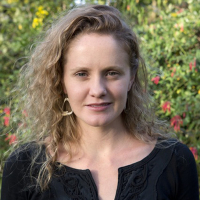
Financial Times journalist Katrina Manson was the last Western journalist to interview Ntaganda. Her piece, published in 2010 when she was working for Reuters, reveals a confident commander eager to highlight his centrality in U.N.-backed military operations. He brushed off the charge of recruiting child soldiers and the allegations of rape. “’Look at me,” Manson wrote, quoting Ntaganda in her piece, “’You think I'm a man who can't get a woman without raping? Lots of women want me.”
Manson said the interview, which took place under armed guard at a secret location, was “slow and careful.”
“It seemed that his relations with his troops and his battle successes were the source of his pride,” Manson told The Daily Beast. “I remember him saying, ‘How do you know who I am?’ And I said, ‘Everyone knows who you are,’ And he seemed quite pleased to hear that.”
He also appeared to show a sense of invincibility and disdain for the ICC, dismissing the court’s case against rebel leader Thomas Lubanga Dyilo, by then a year into trial. Ntaganda “had very little respect for [the court], and that’s what he told me: ‘There’s no justice there. If there were justice I would go.’”
In March 2012, the ICC completed its first ever trial and convicted Dyilo for some of the same atrocities for which Ntaganda has been wanted.
Last weekend, clashes with the rival faction sent Ntaganda and his men fleeing over the border into Rwanda, where his men are now detained, according to the Rwandan foreign minister. Ntaganda, however, made a dash for the American Embassy, asking to be transferred to The Hague for his ICC trial, rather than face his erstwhile partner, Kagame.
“He might not have had any other solution. It was that or getting shot, and after all, Dutch jails are fairly comfortable,” says Gérard Prunier, a French academic and author of Africa’s World War: Congo, the Rwandan Genocide, and the Making of a Continental Catastrophe.
Prunier and others believe that the Rwandan government would rather assassinate Ntaganda than let him stand trial at The Hague.
“Eventually I think Kagame …decided to put his money on [rival faction leader] Sultani Makenga, thinking we’ll just get rid of Bosco.”
In a region where the relationships between warlords and those they serve continually changes, it is a familiar story of shifting allegiances, betrayal, and fear.
“Bosco has a lot of information based on years of collaboration with the Rwandan government,” Gambino says. “That cannot be a story that Rwanda wants to hear told publicly. That will not be a story that presents Rwanda as the golden boy of the progressive world. It will be a very ugly story about warlords and dark deals.”