
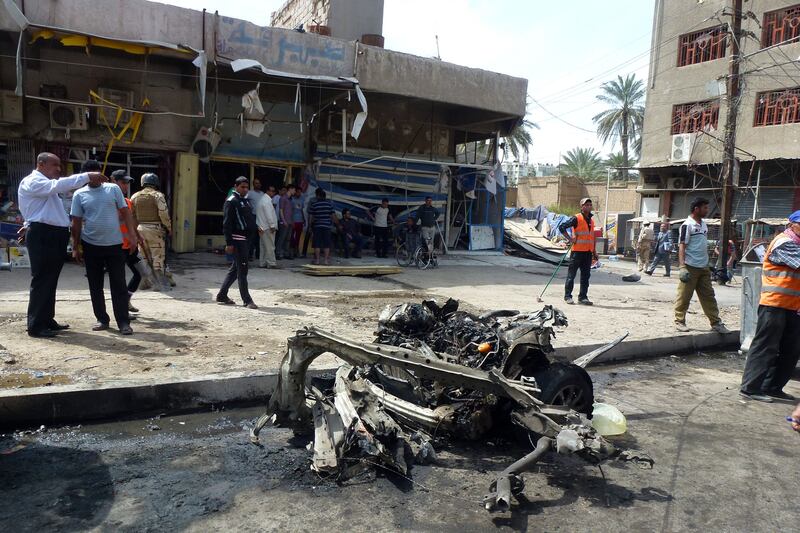
Last Friday in Baghdad, in between the bombings that punctuate everyday life in the city, there was a brief moment of celebration—the power had somehow stayed on for two straight days.

“Electricity cuts off more than once a day, sometimes every few hours,” says Zainab Salbi, who escaped from Saddam Hussein’s Iraq when she was 19 and returns every year to visit her family. You have to maintain your own generator if you want uninterrupted power, she explains, and that means paying for fuel on top of electricity and other shoddy public services. “The big complaint is that it now costs more to maintain a worse lifestyle.”
On the 10th anniversary of the U.S.-led invasion, its legacy is mixed at best. The complaints heard around Baghdad are variations on a theme: the breakdown of public order since the U.S. military leveled most of Iraq’s institutions and turned the capital into a perpetual war zone. Two of Iraq’s worst post-U.S. problems—the daily danger foisted on civilians by warring tribal factions and the unreliable public-works programs provided by the country’s weak government—come together to create an atmosphere where life is constantly interrupted by fear and inconvenience.
“There are bombs constantly,” Salbi said over a shaky phone connection from Baghdad. “It’s all people talk about in their daily conversations. Yesterday there were eight bombs. The day before it was nine. It never stops.”
Salbi went to college in the U.S. and eventually founded Women for Women International, a nonprofit humanitarian organization. Though she has lived outside of Iraq for two decades, she has experienced through her visits the contours of life there, from the days of Hussein to the American soldiers and the uncomfortable void they have now left behind.
“Before we at least had the security to go anywhere,” Salbi said. “We go out like normal, but we don’t have the security of knowing we will come back. If someone is running even a half an hour late, you start worrying about bombs.” Security measures come primarily in the form of checkpoints for vehicles, and that only compounds the frustration. “What used to take 15 minutes—to go from my uncle’s house to my family’s house—now takes two and a half hours. The checkpoints are literally every other block, and literally they check every single car.”
The one bright spot on the grim Baghdad skyline, Salbi says, is Iraq’s blossoming political culture, which, even if debate and elections have a limited ability to improve daily life, have opened a new world of political expression. “There’s an upcoming municipal election, and flyers are everywhere.” Political debate is open and vigorous, and families discuss politics again. “That is something that we didn’t think about all our lives—that we could live in a society with freedom of expression.”
But mixed up with Iraq’s newly open politics is the return of religious extremism, which, no longer suppressed by Saddam, has taken over society and wields immense power in the Iraqi government. It’s one of the facts of contemporary Iraq that Salbi denounces most passionately.
“It’s absolute bullshit, and you can quote me on that,” she said. “Religious zealots from both sides [Sunni and Shiite] have taken over. It has become a far, far, far more conservative, reserved society.” Salbi said that, as a woman who doesn’t wear a headscarf, she feels “naked” on the streets, and that she hasn’t met an Iraqi woman who prefers the current climate to the more permissive society they remember from the 1970s and ’80s, before economic sanctions against Saddam and the first Gulf War weakened the secular government and shifted power to religious leaders.
“Iraqi society didn’t only change in 2003,” Salbi said. “When you ask Iraqis, the comparison is between the ’80s and now. Back then, my mother used to go to any party she wanted at any time of the night, sometimes with her friends or with family members. That was normal.” Now, many women wear headscarves, and religious political parties impose their conservatism through state ministries, like mandatory sex segregation in schools and hospitals.
Salbi certainly doesn’t miss Saddam—”he was a horrible, horrible dictator”—but believes that with him perished every other achievement that had made life in Iraq relatively secure and stable. For Iraqis, some of the most infamous U.S. strategic blunders, like disbanding the Iraqi Army, created a daily life where they are constantly exposed to chaos. “They got rid of Saddam and destroyed the country in the process, and that is not what we wanted.”