
When it comes to religion and erotica, you could be forgiven for thinking that the two are mutually exclusive. When Christian clergy talk about sex it’s almost always to tell people what they shouldn’t be doing (almost everything) and when they shouldn’t be doing it (outside of marriage, with the lights on). But the caricature of repressed pilgrims masks the fact that for much of human history, and among non-monotheistic religions in particular, sexually explicit artwork was so common it was hum-drum.
Of course, everyone knows about India. Arguably the most famous examples of religious erotica come from the carved reliefs that adorn the Khajuraho temples. These sculptures feature group sex and some extremely limber participants engaged in what some scholars have hypothesized is tantric sex. The fact that it’s a UNESCO site means that you can pass the visit off as high culture to your relatives.
But it would be a mistake—an orientalist one at that—to think that erotica features in the religious life only of the Indian subcontinent. Some 1,500 years before the Kama Sutra was written, Mesopotamian artwork was putting the fertile in the Fertile Crescent.
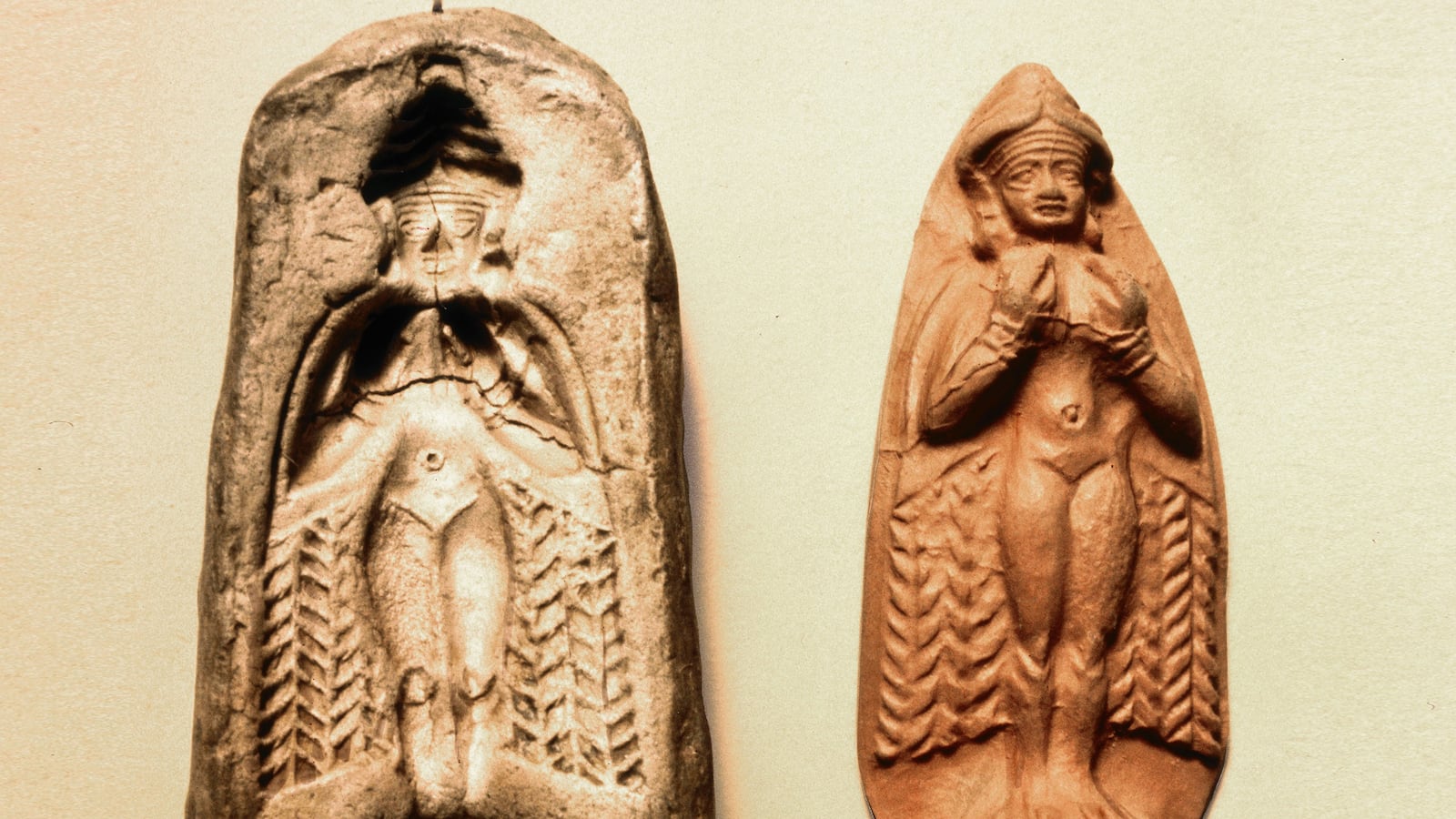
As reported in the Times of Israel, the Israel Museum’s Archeology Section is exhibiting some very NSFW artwork. The two Old Babylonian terra cotta plaques depict a variety of different kinds of sexual encounter, but most of it is rather racy. Laura A. Peri, curator of Antiquities at the museum, told the Times, “It’s not all, you know, missionary and that’s it.”
On the contrary, the most common scene is coitus a tergo (“from behind”—everything sounds less exciting in Latin). This might reflect ancient practice: coitus a tergo might be to Mesopotamian pornography what the mistakenly ordered pizza is to its modern counterpart. But it also might be a sly reference to contraception. For ancient couples, anal sex was a common means of avoiding pregnancy. Even supposedly celibate priestesses were known to indulge—you know, for the sake of preserving their priestly virtue.
What’s most striking about the clay images is where they were found. They have been uncovered in temples and graves as well as in private homes. This makes it difficult to generalize about their use. Are these palm-sized objects religious artifacts or the world’s first smut rags? What we do know is that they were popular, cheap to produce, and displayed publicly in places where women and children congregated. Get a time machine and you’ll see that porn wasn’t always available only to the Internet-savvy male.
While erotic art did not find its way into the Jerusalem temple, the Hebrew Bible is riddled with imagery and language pertaining to human sexuality. Dr. Robert Cargill of the University of Iowa told me that “the first thing you realize as you learn Hebrew is just how much sex, sexual innuendo, and sexual euphemisms are employed in the Bible.” Male genitalia are commonly referred to as “feet,” and some stories can hardly be understood without reference to this kind of innuendo. When, in the Book of Ruth, the heroine sneaks into Boaz’s tent and uncovers his “feet,” we shouldn’t assume that she’s giving him a foot rub. And this all seems relatively tame in comparison to the highly specific descriptions of romantic love found in the Song of Songs.
These intricate depictions and discussions of sex seem shocking to the modern eye, especially when they’re found in religious contexts. After all, we tend to send our children to church so that they’ll hold off on having sex, not so they’ll pick up some pointers. But in a culture where whole families shared sleeping quarters, slaves and servants slept in the same bedroom as their masters, and prostitution was often conducted out in the open, it’s unlikely that these images in particular were responsible for corrupting the youth. Sexual violence was a bigger threat than erotic art—as attested by the absence in the Bible of rules outlawing pornography, but the presence of multiple stories of and laws about rape.
Moreover, rather than reveling in the tawdry and the taboo, ancient religious erotica was about celebrating a fundamental aspect of human life. Dr. Julia Assante, a Near Eastern social historian, has said that the Babylonians held “an exalted cultural view of sex as inducing an altered state of wonder.” They seemed to recognize that religion and sex, rather than being at odds with each other, might both be perfectly acceptable ways to reach nirvana.