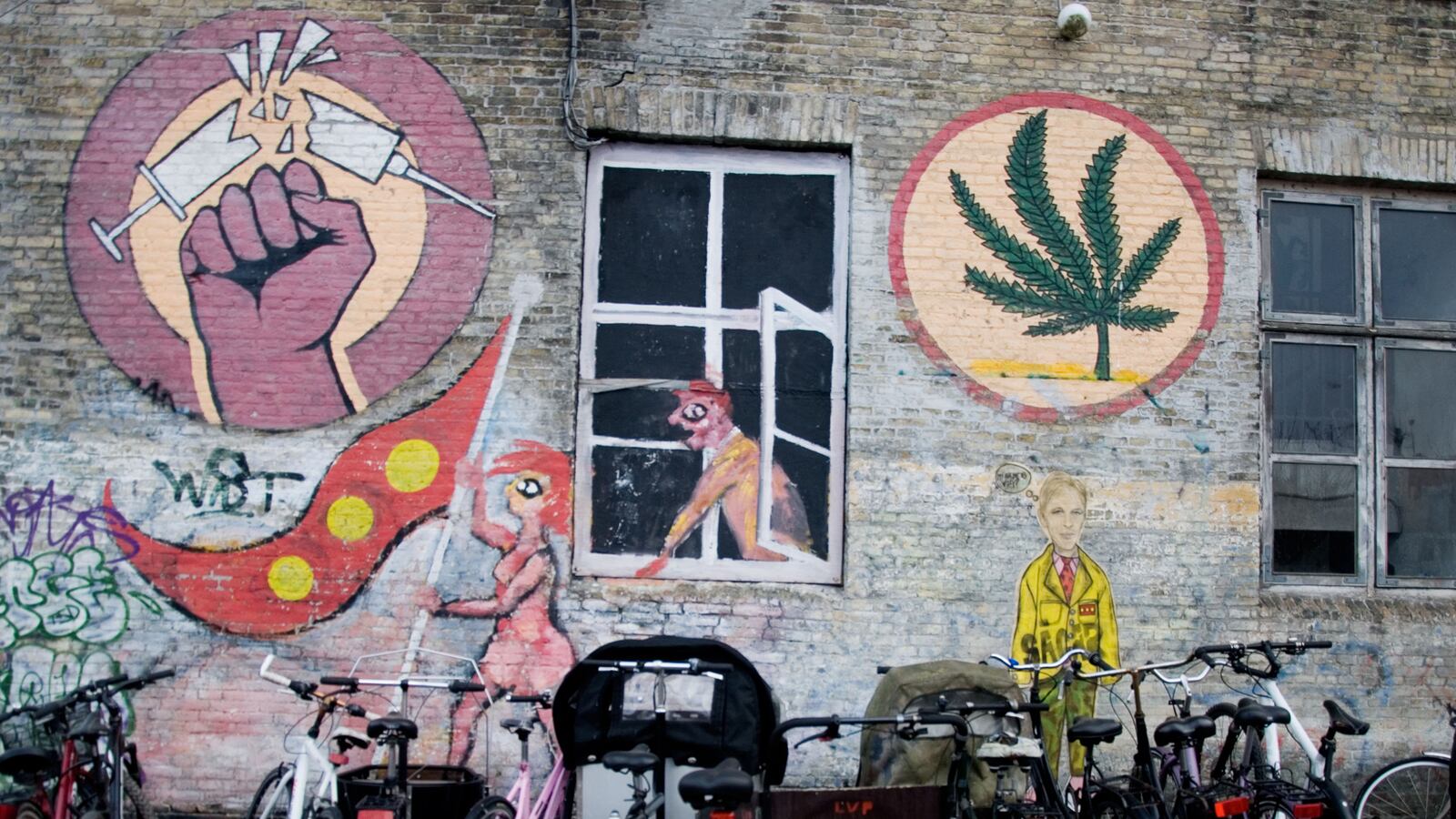
Just a 10-minute walk from the Danish parliament exists a hippie utopia of colorful houses, plentiful marijuana, and communal living.
Cars are banned, along with weapons, “hard drugs,” and talking on cellphones.
In 1971, a group of 700 citizens entered an abandoned military base in Copenhagen, settled in the old barracks, and proclaimed it as an autonomous city of their own.
Freetown Christiania, as it came to be known, was given its own flag (three yellow circles, rumored to stand for the o’s in “Love, Love, Love”), unique currency, and decision-making power over the 85 acres it inhabits.
Nearly half a century later, some 1,000 people still live in Christiania.
In front of the entrance, a totem pole displays the name and a sign announces visitors are making a border crossing: “You are now leaving the European Union,” it says.
The commune boasts an array of organic restaurants, bike rental shops, the Gay House for LGBT culture, and music halls.
It hosts jazz festivals, concerts, and other events. Eclectic homes are covered in murals and quirky accoutrements.
Some are made entirely of old windows, gypsy wagons, and even a repurposed bathhouse. A canal at the end hosts the houseboat-dwelling residents.
Photographer and Christiania native Charlotte Oestervang collected stories and portraits of its residents for a project on her hometown.
One photo of an older man sweeping the streets is captioned: “The Woodtroll Niels lives on the Rabbit Mountain in an old military shed where he has put up a sign saying he is looking for a wife. Niels is keeping the area around the vegetable store clean.”
There are no technical owners of these homes because no one owns or controls anything in Christiania. There are no elected positions—rather, every adult votes on decisions and the majority wins.
Neither is there a clear way to become a resident. Aspiring Christianians must watch the weekly newsletter, which announces any vacancies, and then come in for an interview. Rent is in the form of a monthly fee to cover the settlement’s upkeep.
The government made various attempts to displace the residents, but the community quickly gained the endearment of Danes and visitors alike.
The late 1970s was particularly contentious, with the rise of drugs like heroin and gang activity.
After years of treaties and a number of lawsuits, the Danish government decided to turn over the land to its residents in 2011.
In order to avoid the private ownership it long railed against, Christiania formed a foundation and purchased most of the land they’d been using from the Danish government for 13 million euros—much less than its true worth.
Supporters of the community can buy symbolic shares for around $20.
One of the commune’s main revenues is from growing marijuana and hash, which is illegal elsewhere in Denmark, but apparently tolerated in the autonomous area, save for the occasional police raid.
The cannabis shops operate all day and night, selling dozens of types of hashish. The main drag, “Pusher Street,” is so-named for its signature industry.
“The fact that the state doesn’t want us here gives an additional sense of unity,” a resident named Ane told the blog Messy Nessy Chic. “Keeping our autonomous status requires a lot of effort of all of us.”
The Copenhagen tourism board offers a word of warning to visitors. “Christiania has always been controversial and is still a very hotly-discussed area, not least because of problems with the trading of hash,” it writes. “The police have recently stated that they do not have free and open access to Christiania, which may cause problems for visitors. Some visitors may find Christiania, particularly the area around Pusher Street, to be rough.”
Just because Christiania is autonomous doesn’t mean there are no rules. Taking photographs and filming is banned on Pusher Street. So is running—because it signals a police raid—and talking on cellphones.
But even so, it’s one of Copenhagen’s most popular tourist attractions, with more than 1 million visitors each year.
Vanity Fair writer Tom Freston, who was there soon after its conception, wrote of the enclave’s transcendent power after a visit in 2013.
“I could not imagine it lasting,” Freston wrote. “I had underestimated the work ethic and the diligence of the Danes. They have built an entire settlement of spare, humble, Hobbit-like homes that surrounds a lake and runs along gravel paths and cobblestone roads that wind through woods to the seaside…the residents have gone 42 years without eviction. This says a lot about Denmark’s respect for community and individual freedom, and its tolerance for the quirky.”