Jeb! Puts Himself Out Of His Misery
Jeb Bush was suppose to be the candidate to beat in 2016—but his campaign never planned on an eccentric billionaire turned schoolyard bully as an opponent.
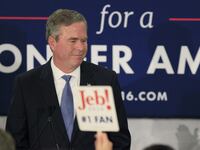
Randall Hill/Reuters
COLUMBIA, S.C. — It ended without an exclamation point.
On a mild Saturday night in South Carolina, Jeb Bush took to the stage at his victory party (using those two words in the least literal sense) and told supporters that he was out.
It wasn’t supposed to be this way. When Jeb jumped in, Tea Partiers panicked and grassroots conservatives lit their hair on fire. He carried an air of inevitability after all—at its onset, his campaign practically drowned in shock-and-awe money and big-name endorsements.
But from its inception, there were cracks. When he spoke at CPAC a few months before his announcement, his backers had to bus in Bush fans from K Street and Capitol Hill so he’d have some fans in the audience. Then he had the hardest time answering the easiest question: Was invading Iraq a good idea?
The gravity of his situation became wholly evident at the first debate, when he was still polling well enough to stand center-stage.
Get the best of The Beast delivered right to your inbox
By clicking “SUBSCRIBE” you agree to our Terms of Use and Privacy Policy.
“It’s like you go out to run for president of the United States—leader of the free world!—you go to the podium at the first debate, and Clarabell the Clown is standing next to you,” Mac Stipanovich, a longtime Bush ally and Tallahassee lobbyist, told The Daily Beast. “Every time you say something meaningful about public policy, he honks his horn.”
And that’s what happened. Every time Bush said something coherent about immigration or health-care reform or foreign policy, Donald Trump called him low energy.
And the label stuck.
Despite that, Bush kept his campaign focused on his sunny optimism and policy smarts. Things were great, he told early-state voters, and with a few tweaks, they could be awesome! He talked up extended life expectancies and boundless promise. He tried mightily to make good on his commitment that he would only run if he could do so joyfully.
But by the end, the joy was gone. And his words shifted—from language of wide-eyed wonder to those of a man suffering under the crush of predestination.
“I feel like I’m in some sort of play,” he said at one of his final campaign stops in South Carolina.
“We’re all part of a ‘narrative,’” he continued. “I always thought narratives were part of a play, you know, where you just kind of play out your part. The ‘narrative’ is that there’s an ‘establishment lane’ and then there’s the ‘outsider lane’ and I’m in the establishment lane because I am the son of George H.W. Bush and the brother of George W. Bush. I got that. I’m proud of it. It doesn’t bother me a bit.”
But it bothered voters.
All told, he and his backers sunk $150 million into boosting his chances, according to Politico.
And it wasn’t remotely enough.
He and his super PAC spent more than $36 million in New Hampshire, where he finished in fourth place. The most damning number? He and his backers spent $1,200 per vote—and for Trump, votes were just $40 a pop.
By the end of it, Bush’s campaign had become inspiring in the worst possible way.
“There is something magnetic about a desolate soul,” wrote Bethy Squires for Vice’s women’s-interest vertical, Broadly. “A centeredness that only comes with the knowledge that everything is terrible and always will be.”
“[I]f I get the sense that nobody likes me, not even my own mother, and my life has become a desperate plea for attention, I’m going to let the world know,” she added. “Because that’s what Jeb would do.”
In his last address as a candidate, that sadness was clear and bright.
“The people of Iowa, New Hampshire, and South Carolina have spoken and I really respect their decision,” he said, voice thick with sincerity. “So tonight, I am suspending my campaign.”
The crowd murmured “No!”
He looked up, smiled, and said, “Yeah, yeah!”
Then he coughed, seemingly choking back the emotion his campaign had yearned for all along.
See more of our coverage in your search results.

Got a tip? Send it to The Daily Beast here.
Register below to read this article for free or subscribe
to unlock unlimited access to The Daily Beast.
Monthly
$1
First month then $5.99/month
Annual
$35
First year then $59.99/year
Premium
$79
First year then $119.99/year
*Substack access provided by the next business day, using your subscription email. Choosing the Premium plan constitutes your permission to share your subscription email with Substack and your agreement to Substack’s Privacy Policy.
Already have an account? Sign In
Looks like you already have a subscription!
You're all set!
Thanks for subscribing.