
If Amy Chua lived in China, she would be the most laid-back mother around, she said Friday afternoon at the Women in the World summit. The Chinese education system is “still incredibly oppressive” and “authoritarian,” said the Yale law professor and author of Battle Hymn of the Tiger Mother. “It’s miserable.” She added, “When I went to China over the summer, it clearly struck me that if I were raising my kids in China against that background, I would not be strict at all. I would say go out and run.”
She also poked fun at American education, saying that with the “self-esteem movement” in this country, “you win a prize for everything.” China and the West have “polar-opposite-extreme problems” when it comes to education, she said. “I think, in that sense, we’re oceans apart.” She laughed when she said she found herself advising parents in China recently that “the best thing you can give your kids is some sleepovers.” No one knew what sleepovers were, she said.
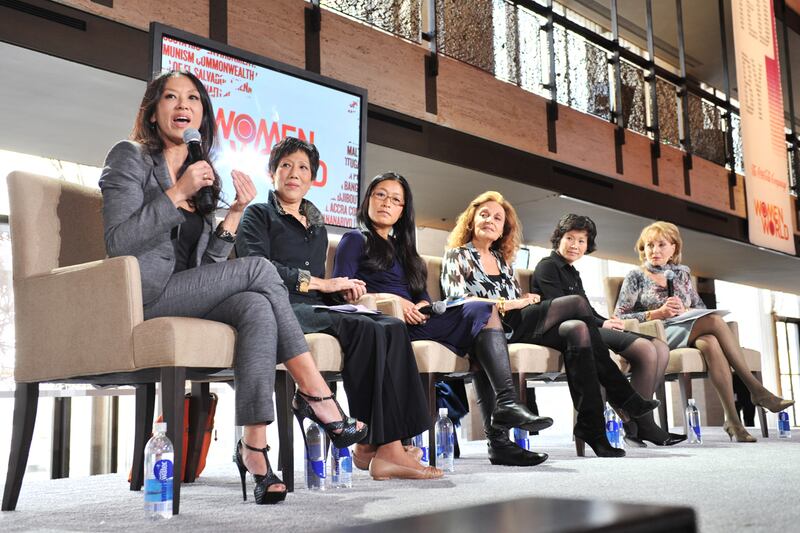
Chua, who wrote Newsweek’s cover story this week on female Chinese tycoons, joined moderator Barbara Walters and three other women for a panel on how women are smashing stereotypes in China, with the group tackling topics ranging from fashion to the gap between rich and poor.
Among the panelists, fashion designer Diane von Furstenberg—who said she had her own “tiger mother”—talked about the six boutiques she runs in China, praising the strength of Chinese women. “What inspires me is their strength—if you talk about a Chinese woman, it’s a woman whose strength is on steroids.”
She continued, “I always say, I empower women. When I was about to go to the Chinese market, though, I thought, they’re already empowered. They are so strong. But when I was getting to know them, I found, they very much want to be women. You get to know them better and you realize they’re little girls. They want to be seduced.”
The remark prompted Walters to crack that von Furstenberg host a future panel on seduction.
Von Furstenberg noted that her iconic wrap dress is a best-seller in China, and that her clients are women with jobs, as opposed to men buying luxury goods for their “wives and mistresses.”Walters immediately wanted to know more about Chinese mistresses.Von Furstenberg replied, “I’m not the most expensive luxury brand, so I deal with women who buy for themselves. But there’s a whole culture—the men will buy this bag for the mistress and this one for the wife. It’s completely against my belief of everything.”
Melinda Liu, the Beijing bureau chief for Newsweek & The Daily Beast, noted the “large and disturbing” gap between rich and poor in the country, saying China has become “schizophrenic” with its rural poor and urban rich. She said there are 58 million “left-behind kids” whose parents leave their rural villages to work in factories in the city. “They only come back occasionally,” she said. “They might come back every 12 months or 24 months. The kids are left in care of relatives.”
Tian X. Hou, founder and chief executive of T.H. Capital LLC, where she helps Americans invest in Chinese stocks, noted that this is the price China has paid for its high-rise buildings and luxury goods.
The remark spurred von Furstenberg to joke, “Don’t look at me.”
Liu said women are faring better in cities than in rural areas, but are still battling issues such as sexual harassment and discrimination. She noted a recent “Occupy Men’s Toilets” movement, sparked by the general lack of public toilets for women. “College students were forcing themselves into men’s toilets and occupying them,” she said.
She added, “That pales in comparison to issues facing rural women. One stat you may find sobering is that China is unique in the world in that the female suicide rate is much higher for women than for men, especially in rural areas. There’s still forced marriage. There’s still trafficking.”
Mei Zhang, the founder of travel company WildChina, talked about how she grew up in a modest working-class family in China, but “got lucky” by scoring a scholarship to Harvard. “I’m very grateful to my dad, who instilled in me the idea that women hold up half the sky and you can go as far as you want,” she said.
The women also discussed China’s one-child policy and the “one billion spoiled brats,” as Liu put it, that could result. “It used to be that the older people, the grandparents, were catered to and revered,” she said. “Now there’s this little spoiled one child at the bottom.”