10 Money-Saving Hacks for European Travel
Yes, you can have upscale experiences on a backpacker budget in Europe.

Getty
Imagine it’s 2010 and you’re planning a multi-city trip to Europe. Strapped for cash, you settle for no-frills hostels in nothingburger neighborhoods. The bulk of your budget inevitably goes to trains and flights, the only practical way to get from, say, Berlin to Munich or Madrid to Barcelona. Need internet? That’ll be 200 bucks for less than a gigabyte of data. And with whatever loose change is left, well, you’ve got to eat—probably a sandwich or a burger or whatever’s cheap and filling.
Luckily, the last few years have ushered in a new era of budget travel in Europe. But unless you’ve been palling around with backpackers and Erasmus students, chances are you aren’t up on the latest ways travelers are saving big bucks across the pond. Here, our top tips for doing Europe in style—without liquidating your savings account.
Go beyond the usual suspects
Paris, Rome, London, Barcelona—Europe’s bucket-list mainstays are popular for a reason, but price-conscious travelers should look elsewhere for the best deals. As a rule, countries that aren’t in the euro (barring the United Kingdom) are the most affordable: Instead of visiting Berlin, where nightclub covers can set you back $20 and a single U-Bahn ticket can cost $3, head 350 miles west to Warsaw, whose $1.80 pints and $1.15 subway rides are a godsend. Beyond the Polish capital, Krakow, Belgrade, Zagreb, Budapest, Tbilisi, and Istanbul are Backpacker Index stalwarts as well, to name a few.

he Yeni Camii, The New Mosque or Mosque of the Valide Sultan is an Ottoman imperial mosque located in the Eminonu district of Istanbul, Turkey.
Salvator Barki/Getty
Share a ride
Until recently, intercity travel in Europe meant either splurging on flights, rental cars, and bullet trains or resigning oneself to the mind-numbing boredom of slow local trains and coach buses. That was before Blablacar—the world’s most popular ride-sharing service—came along. Headquartered in France, the free mobile app serves 22 countries and 65 million members worldwide (for comparison’s sake, that’s 23 million more users than Uber has in the U.S.). Blablacar is easy on your wallet as drivers aren’t allowed to make a profit (they can only offset the price of gas and tolls); of course, it’s easy on the environment, too. Hitching a ride with a local has other perks as well, like inadvertently getting ear-to-the-ground tips on where to eat, explore, and party.
Get the best of The Beast delivered right to your inbox
By clicking “SUBSCRIBE” you agree to our Terms of Use and Privacy Policy.
Gain free entry into museums
We’ve all been there—in the foyer of a world-famous museum dithering about whether to fork over €10 (or €15 or €20) for entry. The good news is, if you know when to go, you often don’t have to pay to visit Europe’s museums at all. In Paris, the Louvre’s permanent collection is free to visit on Sundays from October to March; in Madrid, marvel at the world’s best Goyas and Velázquezes—on the house—at the Prado every day (except Sunday) between 6 p.m. and 8 p.m. Wherever you wind up, check the local museums’ websites for discounts and free days. Of course, there are trade-offs: You might have to line up early or settle for a less-than-zen museum experience, but at these prices, it’s hard to complain.
Stay in a luxury hostel
There’s a new type of accommodation for budget travelers in Europe: the luxury hostel. Hitting the sweet spot between a design-driven hotel and a budget hostel, this fast-growing category is distinguished by stylish décor, comfy multi-person digs, and modest prices. Prime examples include Slo Living Hostel in Lyon, with spacious wallpapered rooms arranged around a grassy courtyard; The Hat in Madrid, with a see-and-be-seen rooftop bar overlooking the Plaza Mayor; and Fabrika in Tbilisi, with a buzzy co-working space and antique Soviet furniture.
Pay zero international transaction fees
If your credit card company still charges a fee every time you swipe abroad, it’s probably time to ditch it. Designed to go unnoticed by customers—a euro here, a few pence there—these unjustifiable administrative charges add up over the course of a vacation, and more and more credit cards are doing away with them. Enticing offers for international fee-free cards abound, from the Capital One Venture Rewards card, which gives you two miles for every dollar spent, to the Chase Sapphire Reserve card, which awards you $750 worth in travel points if you spend $4,000 within the first three months.
Eat street food
Even in the age of TripAdvisor and Yelp, there’s no better barometer for good food in Europe than a line of locals snaking out from a cart, food truck, or hole-in-the-wall—and the best part is, whatever’s cooking is usually cheap. In Naples, I’ll take a gooey pizza fritta and ice-cold Nastro Azzurro (total: €4, tops) over a white-tablecloth “Italian fusion” meal any day. In Warsaw, I always crave oscypek farmer’s cheese, grilled roadside and slathered with lingonberry preserves, while in Munich, I’m all about the butter-and-chive-stuffed pretzels. And don’t forget the humble picnic, a street-food experience that doubles as a taste tour of heavenly local breads, meats, and cheeses.
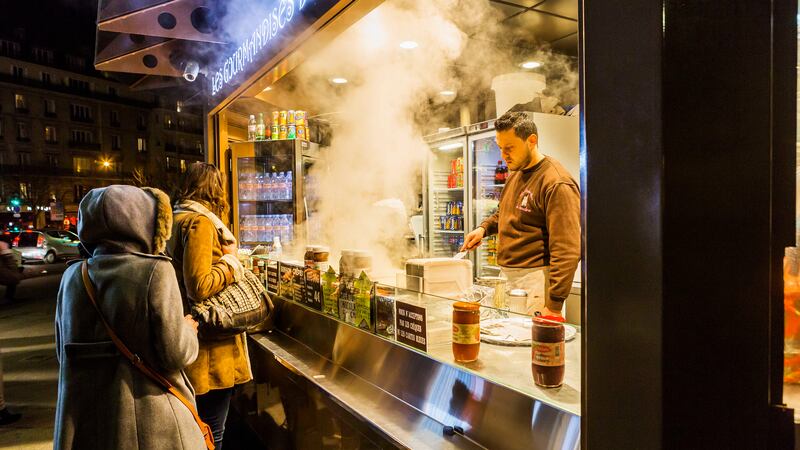
Street food at Les Gourmandises du Trocadéro, Paris.
Atlantide Phototravel/Getty
Dig up your student ID
Student discounts—on everything from public transportation to museum tickets to concerts—are far more common in Europe than in the U.S., so if you happen to be (or can pass for) a college kid, it pays to keep your student ID in your wallet.
Go in the off-season
The most punishing expense of almost any trip to Europe is, without a doubt, the transatlantic flight. In high season, which runs from mid-June through the end of August, airlines jack up prices well over the $1,000 mark. (Last summer, I begrudgingly coughed up $1,300 for a New York–Madrid return with a layover.) But in the off-season (winter) and so-called shoulder season (spring and fall), deals abound, most noticeably since Wow Air and Norwegian, European budget airlines, began a fare war by announcing a bevy of new routes earlier this year. Barring ski chalets and igloo hotels, the same logic applies to accommodations as well.
Consider Eurail
For an epic, once-in-a-lifetime Eurotrip, it’s hard to compete with Eurail, the choose-your-own-adventure train pass that lets you travel freely between 28 countries for up to three months. Prices range from approximately €300 to €1,000 with discounts for travelers under 28. Start in Berlin, for instance, and weave your way southwest to Lisbon, stopping in Paris, Toulouse, and Madrid along the way. Or depart from Istanbul and head north through Bulgaria, Romania, and Hungary before ending up on Croatia’s Dalmatian coast—the options are endless.
See more of our coverage in your search results.

Got a tip? Send it to The Daily Beast here.
Register below to read this article for free or subscribe
to unlock unlimited access to The Daily Beast.
Monthly
$1
First month then $5.99/month
Annual
$35
First year then $59.99/year
Premium
$79
First year then $119.99/year
*Substack access provided by the next business day, using your subscription email. Choosing the Premium plan constitutes your permission to share your subscription email with Substack and your agreement to Substack’s Privacy Policy.
Already have an account? Sign In
Looks like you already have a subscription!
You're all set!
Thanks for subscribing.