Abu Ghraib Photo Exhibit Causes Outrage at Berlin Biennale
Artists do not want their work displayed near Jean-Jacques Lebel’s installation “Poison Soluble” at the Biennale—while a letter in support of Iraqi artists has 340 signatories.
Bertrand Rindoff Petroff/Getty Images
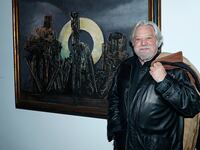
In late July, artist Rijin Sahakian published an open letter in Artforum decrying the Berlin Biennale’s decision to exhibit Poison Soluble, an installation by artist Jean-Jacques Lebel (pictured above), in the latest Biennale exhibition.
Lebel’s maze-like setup, Sahakian writes, surrounds viewers with images of detainees being degraded—“the charred skin, limbs, and hooded faces of the Iraqi men abused and murdered at Abu Ghraib” prison in Iraq.

In response to Sahakian’s letter, the Biennale issued an apologetic statement on Monday, Artnews reports.
Soluble Poison, a room-sized labyrinth installation by Jean-Jacques Lebel, is one of the most controversial pieces of the Berlin Biennial. The artwork is a giant blowup of photographs that American soldiers took while abusing Iraqi prisoners at the Abu Ghraib jail. #politics #art pic.twitter.com/vvtoSju19u
— Zarastro Art (@zarastro_art) August 6, 2022
“I see the white female soldier grinning over the arrangement of bodies piled together, and I am eye-level with a faceless person forced to hold his genitals,” Sahakian, who also funded an Iraqi art initiative called Sada, wrote of the installation in Artforum. “I see a corpse, the dead still waiting. Still waiting to give their permission the first time, the thousandth time, and this time is no exception. I’m forced to see them once again simply to view the second half of Abbas’s splintered work.” The Daily Beast reached out to Sahikian for comment.
In response to Sahakian’s letter, more than 340 people signed a letter in support of Iraqi artists, among them Sajjad Abbas, Raed Mutar and Layth Kareem, who requested that their art not be shown nearby the offending installation at the Biennale. Kareem’s 2014 video is called The City Limits and Mutar’s painting is called Untitled (2012).
Sign Up for Our Beast Digest Newsletter
By clicking “SUBSCRIBE” you agree to our Terms of Use and Privacy Policy.
Sahakian is referring to Abbas’ I Can See You, a 2013 photograph of the artist’s eye on the “Turkish Building” in Baghdad that faced the Green Zone, which served as the governmental center for the Coalition Provisional Authority during the American occupation of Iraq. The photo was also on display at the Biennale next to Lebel’s installation. The Daily Beast reached out to Abbas for comment via the Berlin Biennale.
The Biennale confirmed in their statement that the aforementioned artists works are now being shown at a different location at the Biennale, as is the photograph by Sajjad Abbas, whose work Sahakian also mentions in his letter.
“We apologize that the placement of the affected Iraqi artists’ works in close proximity to Jean-Jacques Lebel’s work caused them great pain,” the Biennial's statement reads in part. “We underestimated the sensitivity of the situation. We also apologize for failing to discuss the placement with them in advance in this special case.”
The Daily Beast reached out to the Berlin Biennale for comment and were directed towards the quoted statement.
See more of our coverage in your search results.

Got a tip? Send it to The Daily Beast here.
Register below to read this article for free or subscribe
to unlock unlimited access to The Daily Beast.
Monthly
$1
First month then $5.99/month
Annual
$35
First year then $59.99/year
Premium
$79
First year then $119.99/year
*Substack access provided by the next business day, using your subscription email. Choosing the Premium plan constitutes your permission to share your subscription email with Substack and your agreement to Substack’s Privacy Policy.
Already have an account? Sign In
Looks like you already have a subscription!
- Account (completed)
- Payment (completed)
- Confirmation (completed)
You're all set!
Thanks for subscribing.
- 1Account
- 2Payment
- 3Confirmation