Afghanistan's Women Fight for Their Rights, Nobel Peace Prize Is Their Battle Cry
Afghanistan's women are struggling for their rights. Let the Nobel Peace Prize to women struggling for democracy be their battle cry.
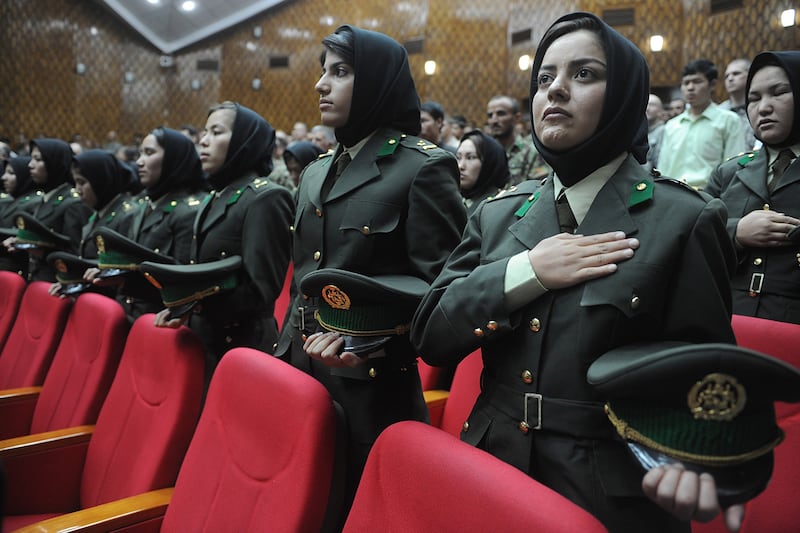
Punit Paranjpe, AFP / Getty Images
Get the Beast Digest newsletter delivered straight to your inbox
By clicking “SIGN UP” you agree to our Terms of Use and Privacy Policy.
In its statement to the world, the Norwegian Nobel Committee honored women warriors battling for peace and said it hoped the Peace Prize would help to ”realise the great potential for democracy and peace that women can represent.”
Now comes a test of the world’s resolve to achieve that potential.
Afghanistan.
On the way into war in 2001, U.S. leaders spoke often of the plight of Afghan women, who were banned from work and education under the Taliban. President George W. Bush said that “a central goal of the terrorists is the brutal oppression of women, and not only the women of Afghanistan.” And then-Senator Hillary Clinton wrote that “the mistreatment of women in Afghanistan was like an early warning signal of the kind of terrorism that culminated in the attacks of September 11. Similarly, the proper treatment of women in post-Taliban Afghanistan can be a harbinger of a more peaceful, prosperous, and democratic future for that war-torn nation.”
After a decade of wrenching loss and a trillion dollars in public expense, the focus has shifted to a peace deal with the Taliban. Women are rarely mentioned as President Obama’s administration hunts for a respectable way out of the country’s longest-ever war. Secretary Clinton has vowed to Afghan women that “we will not abandon you,” but with her announced 2013 departure imminent, women leaders have worried that their rights could be negotiated away with public hand-wringing but scant opposition from the international community.
Now, buoyed by a Nobel Peace Prize that argued there could be no “lasting peace in the world unless women obtain the same opportunities as men to influence developments at all levels of society,” Afghan women activists say they will hold the world’s leaders accountable for their promises.
“What we are doing here is to keep ourselves on the agenda,” said Palwasha Hassan, part of the Afghan Women’s Network, a national umbrella group of women’s organizations. “We will call on everyone constantly because women are more ready than ever to be part of the process of peace in this country.”
U.S. officials focused on women’s issues say the Nobel Prize sends a message that Afghan women’s involvement in any peace and reconciliation agreement is in the world’s best interest.
“If the women there are marginalized in the process, it is unlikely that any potential for peace will be sustained,” said U.S. Ambassador-at-Large for Global Women’s Issues Melanne Verveer, “That—it seems to me—is the message of the announcement acknowledging women's leadership.”
To date women have accounted for fewer than 3 percent of all peace deal signatories, according to U.N. Women. Only rarely have they participated in peace processes in any formal way at all, despite the 2000 passage of U.N. Resolution 1325 that stressed the “need to increase [women’s] role in decision-making with regard to conflict prevention and resolution.”
Afghan women were nearly shut out of several recent high-wattage international summits on Afghanistan’s future. The night before last summer’s Kabul Conference, women were still battling for a speaking slot.
In response, women banded together and began putting pressure on policy makers in their own government and the U.S. and Europe to win a greater role in the peace process. The have called for greater representation for women in the High Peace Council—currently women hold nine of 70 seats—and a substantive, formal role in the upcoming Bonn II Conference and Loya Jirga, which will decide the future of Afghanistan. Thus far their battle has been nearly all uphill.
Civil-society advocates say that they hope the Peace Prize’s glittery media spotlight changes that and attracts more support for women’s fight for a peace that protects their rights.
“The Nobel will remind the Afghan and international policymakers that including women leaders into these negotiations is not a ‘sideshow’ PR campaign, nor is it only about women's rights,” said Ambassador Swanee Hunt, chair of the Institute for Inclusive Security. “This is a wake-up call to the policy community that they can no longer ignore women leaders.”
Afghan women, for their part, say that even if the world ignores their struggle for a substantive say in their country’s future, they will push forward. They say the Taliban and other antigovernment forces must respect the current Afghan constitution guaranteeing women’s rights, otherwise there cannot be a peace deal.
“They cannot take us back to the zero century again,” says civil-society activist Hasina Safina, who heads the Afghan Women’s Education Center. “You show a very beautiful dream to someone, and then you just take the light and put them back in the darkness. It will be a failure of the whole world.”
Safi says Afghan women can learn from other women’s experiences elbowing their way uninvited into peace talks, including the women of Liberia led by Nobel Peace Prize winner Leymah Gbowee. Whether or not the world supports their cause with more than rhetoric, they will not give up.
“What happens if women do not get a role? We will fight,” Safi says. “We will keep on with this struggle, starting from the grassroots. We will not stop.”
See more of our coverage in your search results.

Got a tip? Send it to The Daily Beast here.
Unlock a year of full access to The Daily Beast for $35.
Monthly
$1
First month then $5.99/month
Annual
$35
First year then $59.99/year
Premium
$79
First year then $119.99/year
*Substack access provided by the next business day, using your subscription email. Choosing the Premium plan constitutes your permission to share your subscription email with Substack and your agreement to Substack’s Privacy Policy.
Looks like you already have a subscription!
- Account (completed)
- Payment (completed)
- Confirmation (completed)
You're all set!
Thanks for subscribing.
- 1Account
- 2Payment
- 3Confirmation
Sign in or create an account
Register below to read this article for free or subscribe
to unlock unlimited access to The Daily Beast.
Monthly
$1
First month then $5.99/month
Annual
$35
First year then $59.99/year
Premium
$79
First year then $119.99/year
*Substack access provided by the next business day, using your subscription email. Choosing the Premium plan constitutes your permission to share your subscription email with Substack and your agreement to Substack’s Privacy Policy.
Already have an account? Sign In
Looks like you already have a subscription!
- Account (completed)
- Payment (completed)
- Confirmation (completed)
You're all set!
Thanks for subscribing.
- 1Account
- 2Payment
- 3Confirmation