This New Tool Predicts COVID Survival From a Blood Sample
We could have a head start of several weeks to plan treatments for the worst COVID cases.
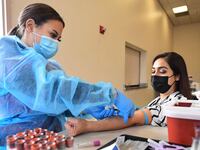
Frederic J. Brown/AFP via Getty Images
As the Omicron variant rages across the U.S. and the rest of the globe, we’re seeing hospitals everywhere maxing out their capacity to treat critically ill COVID-19 patients—not all of whom have an obvious risk factor. In the ICU, it’s often difficult to determine who might survive and beat the infection, and who might end up succumbing to the disease.
That could change very soon thanks to a new AI tool that can predict the survival outcome of severe cases of COVID weeks in advance—all from a single blood sample. The new model, described in a peer-reviewed paper published in PLOS Digital Health on Tuesday, could help doctors make more informed treatment plans for COVID patients during initial hospitalization, to minimize the odds of mortality and improve patient care down the road.
“The clinical picture of COVID-19 is exceptionally diverse, ranging from asymptomatic infection to very severe disease and death,” Florian Kurth, a clinical researcher at Charity-University Medicine in Berlin and a lead author of the new study, said in a statement. “For physicians, it is difficult to estimate the individual risk for a patient of deterioration and/or death from COVID-19.” The new AI model “can fairly well predict the probability that an individual patient will die or survive COVID-19.”
The new study can be split into two parts. First, the researchers studied hundreds of blood samples from 50 critically ill COVID patients treated in Germany and Austria, to learn how the levels of 321 different proteins changed over the course of infection. All patients were in intensive care, requiring ventilation and additional organ replacement therapy. Fifteen patients died and 35 survived.

The researchers learned that there were 14 proteins that were most strongly associated with either COVID survival or death, and that these protein levels were altered early by the disease. The most important were proteins involved in blood coagulation and antibody function.
In the second part, the new AI model was built and trained to make prognoses of COVID patients based on the levels of these 14 proteins in a single blood sample. Kurth and his colleagues tested this model on samples from a new cohort of 24 critically ill patients. Of that cohort, 19 patients survived and five died—and the model was able to accurately predict the outcomes for all but one of these patients. These prognoses were “far better” than ones used in current clinical care risk assessments, said Kurth.
Get the best of The Beast delivered right to your inbox
By clicking “SUBSCRIBE” you agree to our Terms of Use and Privacy Policy.
The current study is based on an extremely small sample size, so the authors want to run the model through much wider testing to prove it could be a valuable predictor of COVID-19 outcomes in real-world hospital settings.
That will take quite a bit of time, but they also hope the findings of the paper can help other researchers better understand the mechanisms behind COVID and what kinds of treatments should be advanced to halt disease progression in general. Kurth said there’s a hope the lessons here could throw the doors open to a new future for medicine, where we make early predictions of an illness based solely on a blood test.
See more of our coverage in your search results.

Got a tip? Send it to The Daily Beast here.
Register below to read this article for free or subscribe
to unlock unlimited access to The Daily Beast.
Monthly
$1
First month then $5.99/month
Annual
$35
First year then $59.99/year
Premium
$79
First year then $119.99/year
*Substack access provided by the next business day, using your subscription email. Choosing the Premium plan constitutes your permission to share your subscription email with Substack and your agreement to Substack’s Privacy Policy.
Already have an account? Sign In
Looks like you already have a subscription!
You're all set!
Thanks for subscribing.