Can Anyone Stop Kim From Helping Assad Restock His Poison Arsenal?
A U.N. report says North Korea has been selling Syria components to manufacture chemical weapons—and the Trump administration insists that’s a sign its strategy is working.
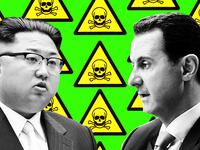
Photo Illustration by Lyne Lucien/The Daily Beast
North Korea is reportedly helping Syria to rebuild its chemical-weapons stockpile, four years after Damascus claimed it had handed over all such munitions to a U.S.-led mission. A panel of U.N. experts has accused North Korea of selling components to Syria that the Syrian regime could use to manufacture chemical weapons, several news outlets reported Tuesday.
The experts’ report, which has not been made public, says that North Korea shipped to Syria industrial equipment including valves, thermometers, and acid-resistant tiles. The components were part of at least 40 shipments from North Korea to Syria between 2012 and 2017, according to The New York Times, which said it reviewed the U.N. report.
“I’ve seen reports of that report,” U.S. State Department spokesperson Heather Nauert told reporters. “This is something the U.S. has been concerned about for some time.”
Pyongyang insists it doesn’t possess chemical weapons. But the Nuclear Threat Initiative, a group advocating for disarmament, estimated that North Korea possesses up to 5,000 tons of chemical weapons—the world’s third-largest stockpile after the United States and Russia, both of which are steadily dismantling their own stockpiles.
In 2017, North Korea used the fast-acting VX nerve agent to kill Kim Jong Nam, the elder half-brother of Supreme Leader Kim Jong Un, in an airport terminal in Kuala Lumpur.
Sign Up for Our Beast Digest Newsletter
By clicking “SUBSCRIBE” you agree to our Terms of Use and Privacy Policy.
The equipment North Korea reportedly shipped to Syria is “dual use”—that is, it has peaceful and military applications. And that makes it easier for Pyongyang to avoid international sanctions meant to limit the spread of weapons of mass destruction.
Coast guards and customs agents inspecting cargo bound for Syria might not even realize they’re looking at potential components of a chemical-weapons plant. “It’s not clear to me these items are even controlled,” Jeffrey Lewis, an arms-control expert at the Middlebury Institute of International Studies at Monterey, told The Daily Beast.
Syria frequently uses chemical weapons against civilians in rebel-held areas of the war-torn country. On Monday a child died and others were hurt in an apparent chlorine attack in East Ghouta. Since war broke out in Syria in 2011, hundreds of people have died in apparent chemical attacks.
In 2013 under the threat of U.S. airstrikes, the regime in Damascus agreed to surrender its chemical weapons stockpile, including mustard gas and sarin and VX nerve agents. A year later, a U.S.-led mission announced it had destroyed all the weapons.
North Korea has to go to extreme ends to get money... Our maximum-pressure campaign is working.
— Heather Nauert, U.S. State Department spokesperson
But the regime either withheld some chemical munitions or produced new ones after 2013, possibly using North Korean components. “Chemical weapons are fairly easy to make,” Lewis explained. “Any country with a decent chemical industry during World War I could make them—and that was more than a hundred years ago.”
There were signs as early as 2009 that Pyongyang was helping Damascus maintain its chemical-weapons capability. In September of that year, the South Korean coast guard intercepted a cargo ship carrying North Korean-made chemical protective suits apparently destined for Syria in violation of U.N. sanctions.
Two months later, in November 2009, Greek authorities detained a merchant vessel hauling 13,000 chemical protective suits and 23,600 gas-detectors, all manufactured in North Korea and again bound for Syria.
In April 2013, Turkish officials stopped a merchant vessel sailing for Syria with 1,400 rifles and pistols, 30,000 rounds of ammunition, and a batch of gas masks, all made in North Korea.
Gas masks are subject to sanctions. Thermometers are not. That shipments of dual-use components have continued could underscore the porousness of sanctions meant both to contain and punish North Korea and prevent Syria from re-arming.
Twice in mid-2017, U.N. member states intercepted North Korean shipments destined for the Syrian government agency responsible for the country’s chemical weapons program, according to a confidential U.N. report. North Korea also supplies Syria’s Scud-missile program, according to former and current U.S. intelligence officials.
But the Trump administration insists the U.N. report on North Korean shipments to Syria is proof that the administration’s hard-line “maximum-pressure” strategy toward Pyongyang is actually working. The administration has boosted military deployments on the Korean Peninsula and abandoned diplomatic talks with Pyongyang.
“As North Korea becomes more desperate, it looks for creative and more horrific ways to fund their criminal regime,” Nauert said. “North Korea has to go to extreme ends to get money... Our maximum-pressure campaign is working.”
In April 2017, Trump ordered airstrikes on a Syrian airfield in retaliation for a gas attack that killed more than 80 people. The administration has threatened further military action if Damascus continues to use chemical weapons.
Lewis, for one, said he’s in favor of U.S. airstrikes on Syria’s chemical sites. But he warned that an air campaign targeting chemical-weapons facilities could be risky. “There are all kinds of reasons that one might not hit a particular site, particularly if it is close to a populated area.”
See more of our coverage in your search results.

Got a tip? Send it to The Daily Beast here.
Register below to read this article for free or subscribe
to unlock unlimited access to The Daily Beast.
Monthly
$1
First month then $5.99/month
Annual
$35
First year then $59.99/year
Premium
$79
First year then $119.99/year
*Substack access provided by the next business day, using your subscription email. Choosing the Premium plan constitutes your permission to share your subscription email with Substack and your agreement to Substack’s Privacy Policy.
Already have an account? Sign In
Looks like you already have a subscription!
You're all set!
Thanks for subscribing.