John Roberts Personally Delivers DOGE Win for Trump
The chief justice intervened on the agency’s behalf.

Win McNamee/Getty Images
Chief Justice John Roberts has personally shielded the Department of Government Efficiency from having to hand over reams of internal data.
Acting as an individual, Roberts temporarily blocked two orders from a lower court that instructed DOGE to turn over thousands of pages of documents and have its administrator, Amy Gleason, sit for a deposition.
The emergency stay only required the approval of Roberts, rather than the entire Supreme Court, because he is the justice who handles these requests when they arise out of the Washington, D.C., courts.
The stay is temporary, likely only to last a few days. It gives the court time to decide whether it wants to consider the case on its merits and make a ruling.
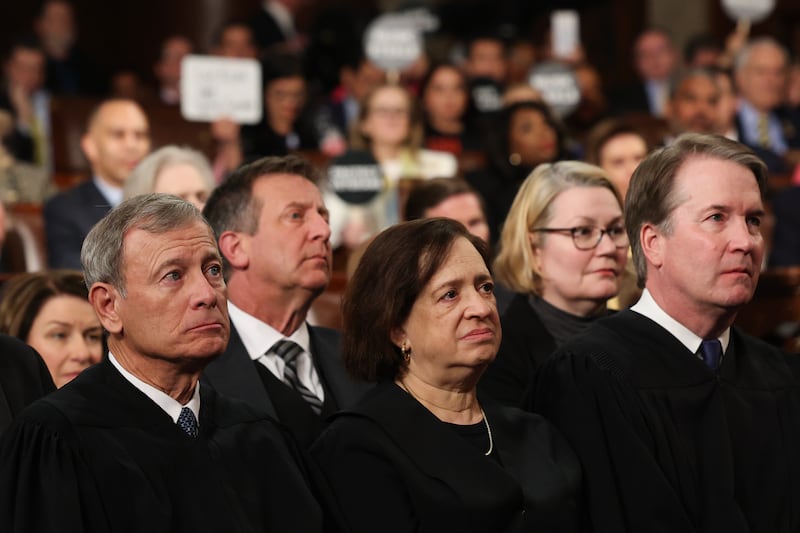
Chief Justice John Roberts (L) has issued a stay of a lower court’s ruling against DOGE.
Win McNamee/Getty Images
The question at stake in the case is whether DOGE is obliged to fulfill public information requests under the Freedom of Information Act. The case hinges on whether the group, which has been led by Elon Musk, is a government agency.
The Trump administration has argued that DOGE is merely an advisory group to President Donald Trump, and is therefore not required to hand over its data.

However, Citizens for Responsibility and Ethics in Washington (CREW), the watchdog group that brought the suit, claims that DOGE has acted as its own agency.
Sign Up for The Swamp Newsletter
By clicking “SUBSCRIBE” you agree to our Terms of Use and Privacy Policy.
Under Musk and Trump’s direction, DOGE led a push to remake the federal government according to the administration’s goals. This entailed firing thousands of federal workers, blowing up entire agencies, seizing control of crucial government systems, and reversing federal spending decisions.
While Musk touted his operation as “maximally transparent,” DOGE has fought hard in court to avoid having to reveal its inner workings to the public.

Musk’s DOGE laid off thousands of government workers and demolished agencies.
Samuel Corum/Getty Images
The lower court’s ruling was intended to allow limited discovery—that is, the documents and the deposition—to help determine whether DOGE is an agency.
Solicitor General D. John Sauer has complained that the ruling is unfair because it gives CREW access to DOGE’s internal data without actually deciding the case in their favor.

“That order turns FOIA on its head, effectively giving respondent a win on the merits of its FOIA suit under the guise of figuring out whether FOIA even applies,” Sauer said.
After Roberts’ decision, CREW told Axios that the outcome was not a surprise and that it still expected to win the case.
“We hope to see the Court decide on the merits of the government’s petition after the holiday weekend,” the organization said in a statement.
See more of our coverage in your search results.

Got a tip? Send it to The Daily Beast here.
Register below to read this article for free or subscribe
to unlock unlimited access to The Daily Beast.
Monthly
$1
First month then $5.99/month
Annual
$35
First year then $59.99/year
Premium
$79
First year then $119.99/year
*Substack access provided by the next business day, using your subscription email. Choosing the Premium plan constitutes your permission to share your subscription email with Substack and your agreement to Substack’s Privacy Policy.
Already have an account? Sign In
Looks like you already have a subscription!
- Account (completed)
- Payment (completed)
- Confirmation (completed)
You're all set!
Thanks for subscribing.
- 1Account
- 2Payment
- 3Confirmation