Edward Snowden Inspires European Youths to Train as Spies
Thousands of European youths are clamoring to spy for their countries as a means of protesting and fighting back against U.S. snooping. By Barbie Latza Nadeau.

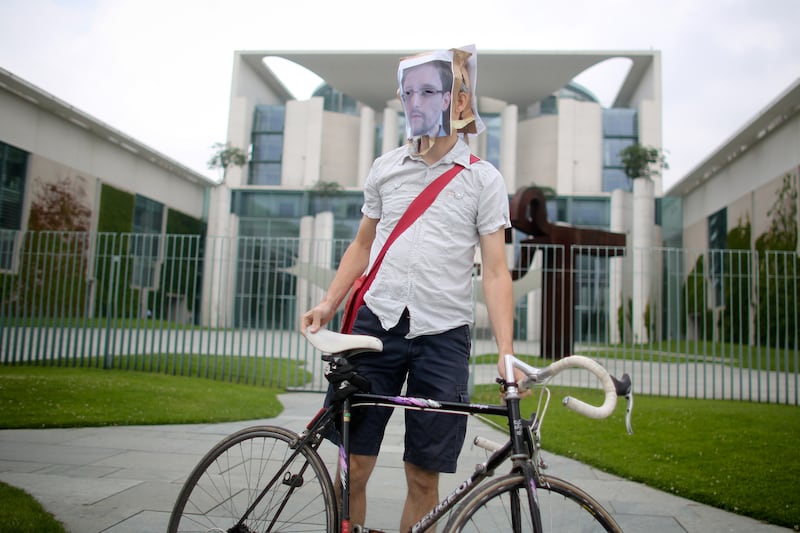
Kay Nietfeld/AFP/Getty
Get the Beast Digest newsletter delivered straight to your inbox
By clicking “SIGN UP” you agree to our Terms of Use and Privacy Policy.
Call it the Snowden effect. A growing number of aspiring secret agents have been clamoring to join European secret service agencies in recent weeks. But it’s not about the promise of a life of international intrigue. The surge in applicants is pegged to fighting back against American snoops.
Giordana, a 25-year-old law student at La Sapienza University in Rome, wants to be a spy. She speaks Italian, English, French, and Mandarin, and she says she would like to put her knowledge to use to help protect her country. She was one of more than 2,000 applicants who filled out an online application to join Italy’s secret service last week. “I want to help protect my country,” she told The Daily Beast. “I was so enraged to learn that the Americans are spying on everything we do, I feel a duty to do something about it.”
Giordana is one of a growing number of young Europeans who want to be part of the intelligence community. The notable surge in applicants in countries like Italy, Germany, and the United Kingdom in the last two weeks has many wondering if Edward Snowden’s saga is proving especially enticing a whole new stable of would-be spooks. It is easy to romanticize the spy’s life, especially the way the Snowden affair is covered by much of the European media, where he has been touted as a hero for exposing America’s rampant breaches of privacy rather than as a traitor who betrayed his nation’s trust. And the presumption that he is living incognito in a Russian airport, hiding from American agents, seems straight out of a James Bond movie, minus the remedial use of a refrigerator as a jamming device for his cellphones and revelations that he had nothing more sophisticated than sunglasses and a baseball cap to hide his identity. “Of course he is a hero,” says Giordana, who says she looks up to the 30-year-old. “His courage is inspirational, but what he exposed is what drives me to want to get involved.”
Giordana is obviously not alone in her desire to get involved. Around 200 applicants a day have been applying to Italy’s secret service agency through the country’s new online recruitment website in recent weeks. The administrator says that the site gets at least 15,000 unique hits a day. Of the last 2,000 applicants, 1,740 were men with advanced degrees. Around 1,000 consider themselves cyber experts. Almost all the applicants were multilingual and searching for their first post-university jobs.
The German Bundesnachrichtendienst federal intelligence agency has also seen an influx of aspiring 007 applicants thanks to a budgetary boost of €100 million earmarked for new staff to work on interception detection. Even the British GCHQ intelligence agency is rumored to be considering reviving its “crack the code” campaign in which an online game was used to lure mastermind hackers to the intelligence agency’s services in 2011.
The surge in applications is driven by increased demand in intelligence and counter-intelligence services, says Giampiero Massolo, Italy’s director of Security Intelligence, who says cyber war is the new battlefield going forward, which is why intelligence agencies are increasingly using online recruitment to attract potential cyber gurus by “speaking their language.” Gone are the days when a “tap on the shoulder” by an unsuspecting undercover agent was the only invitation to apply. Now secret service agencies are in full recruitment mode, and they are looking for a new type of tech-savvy spy that is well versed in the information technology. One recruitment agent who screens Italian applicants told The Daily Beast that they look for people who are proficient in gaming and hacking and even those who played obsessively with Lego blocks as a child which shows a certain penchant for logical construction and deconstruction.
Massolo, (who incidentally does not believe Snowden is a hero) says that the Snowden affair certainly reminds people that espionage is a noble career choice, but the real reason for the surge could come down to economics. Because of increasing security risks, especially in cyber threats, agencies are searching for new agents with specific skill sets right at a time when few others are hiring. Massolo says that rampant unemployment and the economic crisis have turned many people to consider jobs in the intelligence community that would likely never have considered the field before. “People with a CV like Snowden’s easily fit the profile of new recruits,” he told The Daily Beast. ““But the Snowden effect will have the greatest impact on how employees are vetted more than anything else.”
See more of our coverage in your search results.

Got a tip? Send it to The Daily Beast here.
Unlock a year of full access to The Daily Beast for $35.
Monthly
$1
First month then $5.99/month
Annual
$35
First year then $59.99/year
Premium
$79
First year then $119.99/year
*Substack access provided by the next business day, using your subscription email. Choosing the Premium plan constitutes your permission to share your subscription email with Substack and your agreement to Substack’s Privacy Policy.
Looks like you already have a subscription!
- Account (completed)
- Payment (completed)
- Confirmation (completed)
You're all set!
Thanks for subscribing.
- 1Account
- 2Payment
- 3Confirmation
Sign in or create an account
Register below to read this article for free or subscribe
to unlock unlimited access to The Daily Beast.
Monthly
$1
First month then $5.99/month
Annual
$35
First year then $59.99/year
Premium
$79
First year then $119.99/year
*Substack access provided by the next business day, using your subscription email. Choosing the Premium plan constitutes your permission to share your subscription email with Substack and your agreement to Substack’s Privacy Policy.
Already have an account? Sign In
Looks like you already have a subscription!
- Account (completed)
- Payment (completed)
- Confirmation (completed)
You're all set!
Thanks for subscribing.
- 1Account
- 2Payment
- 3Confirmation