Hackers Hijack Websites of CNN, BBC and Major Banks
This week’s cyber chaos has hit some of the world’s biggest companies.

Photo Illustration by Thomas Levinson/The Daily Beast/Getty
Get The Swamp newsletter delivered straight to your inbox
By clicking “SIGN UP” you agree to our Terms of Use and Privacy Policy.
Hackers were able to mine data from 178 sites across several global industries—including media giants CNN and BBC—through a breach of a single platform, cybersecurity experts have revealed.
An unidentified hacker added malicious code to the Optimizely Web Experimentation program, which allows businesses to test and personalize websites, to skim payment cards, swap cryptocurrency wallets, and steal screenshots from an unknown number of consumer devices.
So far, cybersecurity firm Report URI confirmed a little over $7,000 in cryptocurrency exchanges were deposited into the hacker’s account on Tuesday.
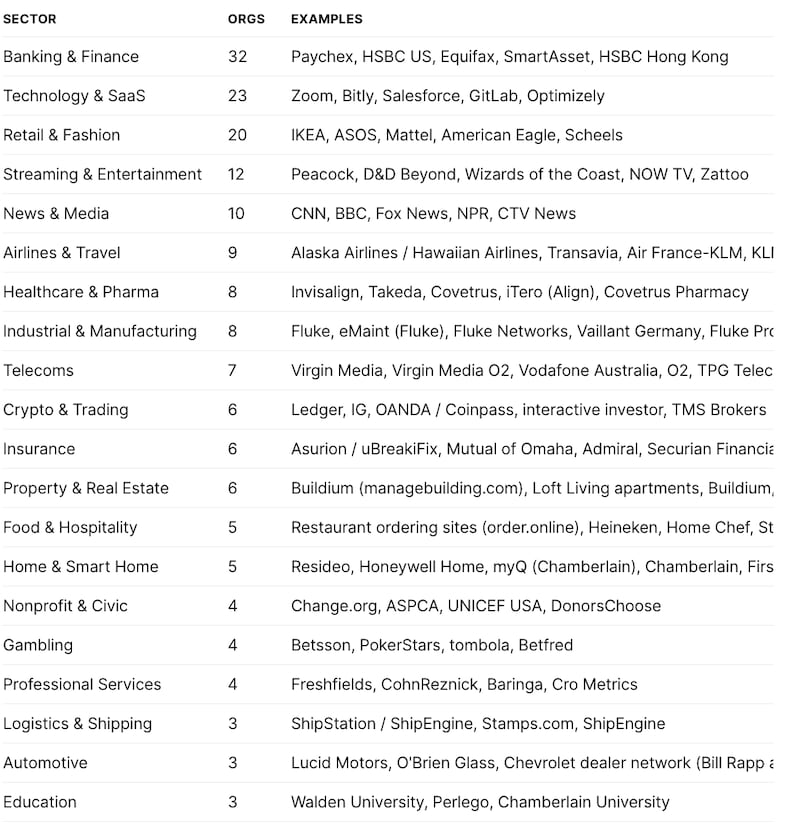
A partial list of the organizations affected by the hacking incident.
Report URI
Optimizely is used by many organizations, including the BBC, CNN, Equifax, Zoom, Alaska Airlines, and IKEA. Report URI researcher Scott Helme wrote that the hackers added a near-match of Optimizely’s code to the affected organizations’ sites, allowing the attack to go unnoticed.
Researchers are unsure how the hackers gained access to each site and have no way of knowing how many credit cards and other payment methods were skimmed in the last two days.
The malicious code was detected on the BBC’s website on Monday. Since then, hackers have continually modified the code in order to gain access to more sites.
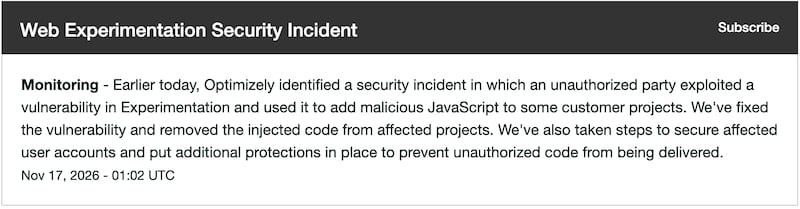
Optimizely claimed that it had fixed the vulnerability that exposed 178 organizations to data mining.
Optimizely
Optimizely did not respond to a request for comment from the Daily Beast, but told ABC that the company “identified a security incident in which an unauthorized party exploited a vulnerability.”
The company added in a status update that it was able to remove the vulnerability and fix the code on its customers’ sites. It is unclear whether every site was fully repaired or whether the hackers still have access.
“We’ve fixed the vulnerability and removed the injected code from affected projects,” the company wrote. “We’ve also taken steps to secure affected user accounts and put additional protections in place to prevent unauthorized code from being delivered.”

Zoom was one of the first companies to publicly respond to the hacking incident.
Dado Ruvic/Dado Ruvic/Illustration/REUTERS
Some of the affected companies issued statements in the wake of the incident.
“Zoom is aware of the Optimizely security incident,” the videoconference company wrote. “As a precautionary measure, Zoom has disabled Optimizely across our production environments. At this time, we have not identified any impact to customer data. We continue to monitor the situation closely.”
“We immediately investigated this issue and ceased our use of Optimizely,” Equifax said in a statement to KPRC 2. “We have not identified evidence of any compromise to our systems or impact to our data.”

After several large-scale tech incidents in the last few days, some have expressed worry that the outages could have come from attacks on U.S. digital infrastructure.
Donald Trump’s national intelligence chief, Jay Clayton, told CNBC on Tuesday that the recent stream of cyberattacks and outages are unrelated and not “a coordinated effort by a nation-state.”
“Many people are patching their systems; they know that their legacy systems have vulnerabilities, they’re outdated, they don’t work well with new systems,” Clayton said. “This is not something that is a coordinated cyber attack or state-sponsored effort against the U.S.”
See more of our coverage in your search results.
Got a tip? Send it to The Daily Beast here.
Register below to read this article for free or subscribe
to unlock unlimited access to The Daily Beast.
Monthly
$1
First month then $5.99/month
Annual
$35
First year then $59.99/year
Premium
$79
First year then $119.99/year
*Substack access provided by the next business day, using your subscription email. Choosing the Premium plan constitutes your permission to share your subscription email with Substack and your agreement to Substack’s Privacy Policy.
Already have an account? Sign In
Looks like you already have a subscription!
- Account (completed)
- Payment (completed)
- Confirmation (completed)
You're all set!
Thanks for subscribing.
- 1Account
- 2Payment
- 3Confirmation
Sign in or create an account
Login dialog
Loading comments…