Judge Deals Major Blow to Trump’s Plot to Mass-Fire Federal Employees
A federal judge paused the president’s plan to fire tens of thousands of government employees while the policy is challenged in court.

Kevin Dietsch/Getty Images
Get The Swamp newsletter delivered straight to your inbox
By clicking “SIGN UP” you agree to our Terms of Use and Privacy Policy.
A federal judge has issued a scathing order requiring President Donald Trump’s administration to put a hold on its plans to fire tens of thousands of federal employees while the mass layoffs are challenged in court.
Judge Susan Illston had previously ordered the administration not to fire employees or close offices at 22 federal agencies for two weeks while she heard preliminary evidence in the case. On Thursday, she granted an injunction extending that pause until she issues a final ruling.

A group of plaintiffs that include labor unions representing the employees argued that Trump and his “Department” of Government Efficiency—which was originally led by Elon Musk—were attempting to reorganize the federal government without congressional approval.
The Trump administration, however, has argued that the government is reducing the federal workforce “consistent with applicable law,” and that the layoffs don’t amount to a reorganizing of the federal government.
In her order, however, Illston wrote that the evidence so far “discredits” the Trump administration’s claims.
“Presidents may set policy priorities for the executive branch, and agency heads may implement them. This much is undisputed,” Illston wrote. “Agencies may not conduct large-scale reorganizations and reductions in force in blatant disregard of Congress’s mandates, and a president may not initiate large-scale executive branch reorganization without partnering with Congress.”

Elon Musk originally oversaw the DOGE initiative that began the mass firings.
Kevin Lamarque/Reuters
In a statement, White House spokesperson Harrison Fields called the decision “an extreme judicial overreach into the executive branch” and said the administration expected to ultimately prevail in the case.
“Congress has expressly granted the President, through the Office of Personnel Management, authority to implement reductions in force across agencies,” Fields said. “The President must retain the ability to manage the Executive Branch, including implementing reductions in force when necessary, as has been the practice for nearly 150 years.”
The government had already asked the Supreme Court to intervene and block the two-week pause, and is expected to ask the justices to overturn Illston’s latest ruling as well, The New York Times reported.
In its request, the administration wrote that Illston’s ruling was “based on the extraordinary view” that the president didn’t have the authority to direct executive agencies on large-scale personnel actions.
The new order slammed the government for refusing to present evidence in the case, and for taking the position that “there are no relevant facts to review,” as Illston put it.
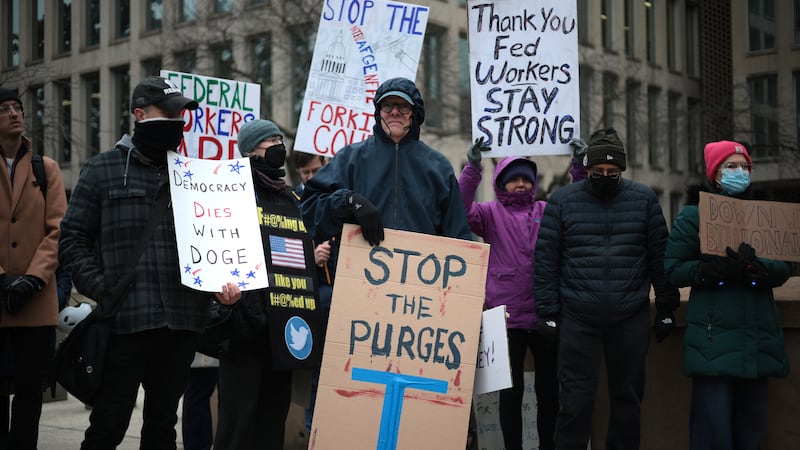
Protesters rallied against the planned federal employee layoffs outside the headquarters of the Office of Personnel Management in February.
Alex Wong/Getty Images
The administration’s lawyers submitted just one sworn declaration from an agency official to support their position, and then fought the court’s order to disclose the agency’s reduction in force and reorganization plans, the judge wrote. In its appeal to the Supreme Court, the government argued that the plans were protected by executive privilege.
“Defendants insist that the new administration does not need Congress’s support to lay off and restructure large swathes of the federal workforce, essentially telling the Court, ‘Nothing to see here,’” Illston wrote in her order. “In their view… The Court and the bystanding public should just move along.”
And yet evidence presented by the plaintiffs showed that the administration wasn’t just reducing the workforce—it was making changes that “intentionally or negligently flout the tasks Congress has assigned” the agencies, the order continued.

Russell Vought, the director of the White House Office of Management and Budget, is taking over DOGE from Elon Musk.
Bill Clark/CQ-Roll Call, Inc via Getty Images
“After dramatic staff reductions, these agencies will not be able to do what Congress has directed them to do,” Illston wrote.
Many of the employees were given termination notices and then put on paid administrative leave until the end of the notice period, which “undercuts [the defendants’] ostensible concern for efficient and effective government,” the order said.
On a practical level, the decision keeps those employees on paid administrative leave throughout the duration of the lawsuit in an attempt to avoid the firing, rehiring and refiring that thousands of probationary employees have been subjected to since February, the Times reported.

The administration has argued in several lawsuits challenging DOGE’s work—including the one before Illston—that federal agencies are downsizing of their own accord and not at the president’s direction. The claim asks the court to use “tunnel vision and ignore whatever may be happening on the ground,” the judge wrote.
“Put simply, in this case, defendants want the Court to either declare that nine Presidents and twenty-one Congresses did not properly understand the separation of powers, or ignore how the executive branch is implementing large-scale reductions in force and reorganizations,” she wrote. “The Court can do neither.”
See more of our coverage in your search results.

Got a tip? Send it to The Daily Beast here.
Register below to read this article for free or subscribe
to unlock unlimited access to The Daily Beast.
Monthly
$1
First month then $5.99/month
Annual
$35
First year then $59.99/year
Premium
$79
First year then $119.99/year
*Substack access provided by the next business day, using your subscription email. Choosing the Premium plan constitutes your permission to share your subscription email with Substack and your agreement to Substack’s Privacy Policy.
Already have an account? Sign In
Looks like you already have a subscription!
- Account (completed)
- Payment (completed)
- Confirmation (completed)
You're all set!
Thanks for subscribing.
- 1Account
- 2Payment
- 3Confirmation