ICE Barbie’s ‘Catastrophic’ Blunder Finally Exposed
DHS won’t say how many investigations were affected after a routine change crippled wiretap surveillance for “months.”

Photo Illustration by Eric Faison/The Daily Beast/Getty/Reuters
A “catastrophic” tech blunder by Kristi Noem’s Department of Homeland Security put the public in danger by preventing ICE from using wiretaps to catch suspected criminals for months.
The extraordinary failure in April last year—which experts say will take “years” to recover from—followed an “inadvertent” change to the internet provider used by Homeland Security Investigations (HSI), ICE’s criminal investigative arm, according to information buried deep in an obscure government document uncovered by PunchUp.

The outage coincided with the number of wiretaps reported by DHS investigators collapsing by more than 80 percent under then-Homeland Security Secretary Noem, 54.

In admitting its mistake, DHS warned that losing wiretap capability for long periods can “severely cripple” ongoing high-stakes criminal investigations and pose a “direct, unquantifiable risk” to undercover agents and the public.
And PunchUp, the Daily Beast’s sister investigations Substack, has also found that the failure could have had even wider ramifications because DHS records show HSI’s electronic-surveillance operation supports investigations involving other federal agencies, including the FBI and DEA.
Get the best of The Beast delivered right to your inbox
By clicking “SUBSCRIBE” you agree to our Terms of Use and Privacy Policy.
Eric Balliet, a former Homeland Security Investigations agent who spent 25 years in federal law enforcement and used between 250 and 300 wiretaps, said he was astonished by the blunder.
“I cannot fathom a federal law enforcement agency not having the capability or capacity to legally intercept communications,” he told PunchUp. “When you lack the ability to intercept communications—phone calls, messaging apps and texts—the criminal networks win. Fentanyl, cocaine and heroin hit the streets. People are smuggled. People die.”
Balliet, who retired in July 2024, added, “I truly cannot comprehend how a law enforcement agency could drop the ball in such a catastrophic manner.”
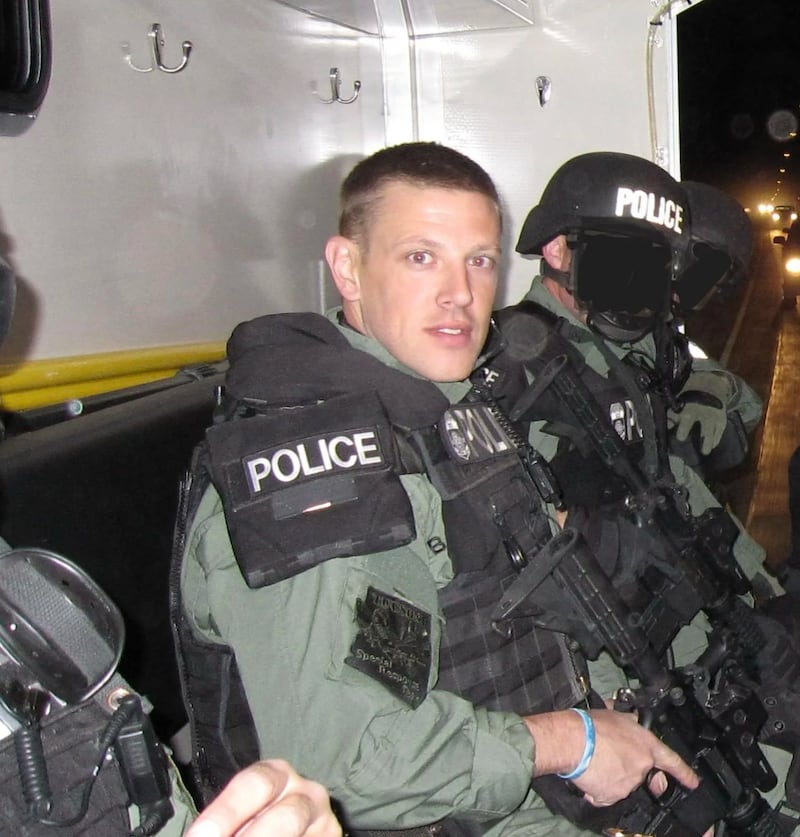
Eric Balliet as a young law enforcement officer. He went on to become a master of wiretaps, which put him in a strong position to comment on the disaster under Noem.
Supplied
Richard Marianos, a former assistant director with the Bureau of Alcohol, Tobacco, Firearms and Explosives (ATF), which used the HSI wiretap system, said the potential ramifications of wiretaps being out of action for such a prolonged period were massive.
“It becomes much more difficult to get intelligence against an organization and take out the high-value targets who are the decision makers on a telephone rather than those out on the streets committing crimes,” said Marianos, who teaches a master’s class on wiretapping at D.C.’s Georgetown University and is a protective intelligence expert at Kronus Intelligence Group.

“The longer those criminal kingpins are able to operate with impunity because wiretap tactics are unavailable, the more dangerous the organization will become because they are still operating on the street.”
Brandi Young, a federal prosecutor for 16 years who handled DHS wiretap cases and is now a partner at Texas law firm Keith & Lorfing, said an inability to use the technology could lead some of the most serious criminal investigations to “stall”—in some cases “forever.”

Former DHS Secretary Noem was forced to explain her chaotic tenure to a House Judiciary Committee hearing a day before Donald Trump fired her on March 5. But the full extent of the chaos is still being uncovered.
Elizabeth Frantz/REUTERS
Balliet agreed, warning that even brief disruptions to surveillance capabilities could devastate complex investigations. “You lose track of who is talking to whom, the devices they are using, their nicknames,” he said, adding, “To not have that function for months is a dereliction of duty, malfeasance of what the American public expects from their law enforcement personnel.”
The potentially costly error only came to light in a procurement document DHS released late last month. The department appears to have disclosed its failure only to justify retaining its existing internet provider under a new sole-source contract.
Federal records show ICE awarded Cox Virginia Telcom a contract without competition on Sept. 25, potentially worth $702,884.56, to provide dedicated network circuits for HSI’s Title III and Linguistics Unit, the federal legal framework governing court-authorized interception of communications.

Kristi Noem was dubbed “ICE Barbie” for her love of getting dressed up as a federal immigration agent.
U.S. Immigration and Customs Enforcement via Getty Images
The episode also offers a rare glimpse inside the infrastructure used for wiretaps. The document says HSI uses static internet addresses to maintain connections with roughly 50 telecommunications providers. Those connections let intercepted content transfer into HSI’s own network.
But DHS admits a simple change caused that system to break down.
When HSI’s internet provider was inadvertently switched in April 2025, three months after Noem took charge at DHS, the agency was assigned a new internet address. Connections with providers then had to be rebuilt. DHS admitted the result was “months of downtime for wiretaps.”
The records do not say exactly how long the wiretap capability was out for, how many of HSI’s seven sites were affected, or how many investigations were disrupted. DHS declined to say.
But the Administrative Office of the U.S. Courts reported that DHS’s Investigations Office had just 23 wiretaps in 2025, compared with 133 in 2024—a fall of almost 83 percent.

HSI agents at the entrance of Rep. Ilhan Omar’s home after U.S. authorities conducted a raid as part of an ongoing Justice Department investigation, in Washington, D.C. this month.
Annabelle Gordon/REUTERS
DHS has given several other explanations for that slump, citing operational delays from government shutdowns, shifting enforcement and prosecutorial priorities, and staffing attrition and reorganization.
It has refused to say whether its months-long wiretap failure contributed to the extraordinary decline, how many court-authorized interceptions or criminal investigations were affected, whether evidence was lost as a result, who was responsible, or whether it undertook any review to prevent it happening again.
A DHS spokesperson told PunchUp, “We will not comment on law enforcement sensitive methods.”
Balliet illustrated the importance of maintaining wiretap capabilities with his experience investigating notorious Mexican drug lord Joaquín “El Chapo” Guzmán while working as an assistant special agent in charge in Nogales, Arizona.
“We had a team of 15 people doing nothing but working out who was going to change their device, their phone number, or their BlackBerry Messenger PIN,” he said. “That was their sole job because the criminal network was constantly changing its communications strategy to avoid detection.”

Mexico’s top drug lord Joaquin “El Chapo” Guzman is escorted by HSI agents as he arrives in New York in January 2017, after his extradition from Mexico. His arrest, Balliet says, would not have been possible without wiretaps.
U.S. officials/Handout via Reuters
Balliet—who has published a book, Kingpins and Coyotes, about his career—added, “If we did not have that, he would not have been captured and would still be running the scene,” he said. “It really is that big a deal.”
Daniel Brunner, a retired FBI supervisory special agent who now runs a Spanish-language media platform on the bureau, says such a long delay would have been completely avoidable.

He told PunchUp: “DHS should have come to the FBI and said its system is down, and they needed help. Perhaps Kristi Noem didn’t want to show weakness or her systems were failing. There’s no reason why it was out for so long.”
For Balliet, the consequences could extend far beyond the outage itself. “It will take years to recover from something like this,” he said. “It’s laughable, but in an almost unbelievable way.”
Tom Latchem exposes the secrets, scandals, and stories that powerful people and institutions want to keep under wraps. Follow all of his reporting at PunchUp on Substack.
See more of our coverage in your search results.

Got a tip? Send it to The Daily Beast here.
Register below to read this article for free or subscribe
to unlock unlimited access to The Daily Beast.
Monthly
$1
First month then $5.99/month
Annual
$35
First year then $59.99/year
Premium
$79
First year then $119.99/year
*Substack access provided by the next business day, using your subscription email. Choosing the Premium plan constitutes your permission to share your subscription email with Substack and your agreement to Substack’s Privacy Policy.
Already have an account? Sign In
Looks like you already have a subscription!
You're all set!
Thanks for subscribing.
Sign in or create an account
Login dialog
Loading comments…