Obama Libya Speech: How the President's War Has Won Him Arab Respect
In the president's speech on Libya, he laid out his moral argument for saving lives in defense of democracy, without boots on the ground—an American role that has won him support in the Arab world.
Dennis Brack-Pool / Getty Images
Get the Beast Digest newsletter delivered straight to your inbox
By clicking “SIGN UP” you agree to our Terms of Use and Privacy Policy.
In the president’s speech on Libya, he laid out his moral argument for saving lives in defense of democracy, without boots on the ground—an American role that has won him support in the Arab world. Plus, more Obama speech reaction.
It’s one of those twists of irony that the U.S.-backed no-fly zone over Libya has more support in the Arab world than in the U.S. Congress. I’m not sure if Obama’s eloquent defense of the American military mission in Libya during his address to the nation Monday night convinced a skeptical Congress of its value, but his speech certainly articulated an American role that many Arabs embrace.
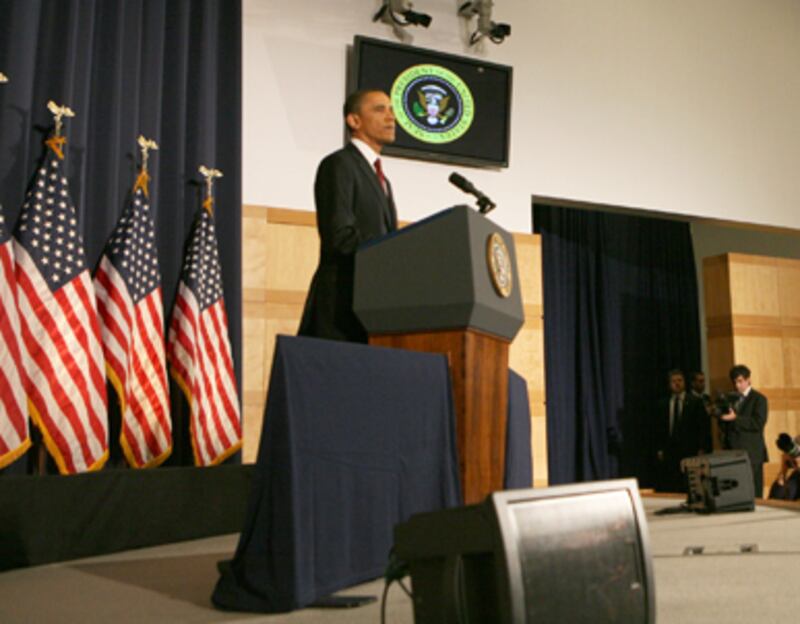
Obama made a strong moral argument on behalf of saving Libyan lives in defense of democracy, and committed to doing so without putting boots on the ground. That’s proving to be a popular position in the Arab world.
Five weeks ago as pro-Gaddafi forces were stepping up their attacks on civilians and rebels, I met a visiting delegation of young Tunisian professionals. The group of 40-something men and women were still giddy from their own country’s pro-democracy revolution and horrified by the prospect of the bloodshed their neighbors in Libya would face. Over dinner in Washington, D.C., they beseeched the Obama administration to exercise its influence and stand up for Libyan human rights by setting up a no-fly zone.
“The U.S. is the only country that can stop Gaddafi,” a well-coiffed businesswoman told me. “It must help, but it mustn’t send in troops.”
As Muammar Gaddafi’s forces retreated recently under allied bombings, I’m sure my Tunisian acquaintances were enormously relieved. And they weren’t the only ones. While some Arabs griped about the motives behind the U.S. intervention, far more applauded our support. A Syrian dissident told me the no-fly zone had inspired Syrians to shed their fear and rise up against their own oppressive regime. A Saudi friend told me it was one of the rare occasions he’d seen a U.S. foreign policy in the Middle East align with America’s backing for human rights and democracy.
Perhaps it’s worth the cost of a limited war over Libya to win a little love in an increasingly surprising Arab world.
Today, as critics ask valid questions about the cost and length and rationale of the U.S. military role in Libya, they should ponder what it’s worth to earn Arab respect and appreciation. At a time when America’s alliances and interests in the region have been upended by multiple pro-democracy revolutions, perhaps it’s worth the cost of a limited war over Libya to win a little love in an increasingly surprising Arab world.
Kate Seelye is vice president of the Middle East Institute. She was a journalist for NPR and PBS based in Beirut from 2000 to 2009.
See more of our coverage in your search results.

Got a tip? Send it to The Daily Beast here.
Unlock a year of full access to The Daily Beast for $35.
Monthly
$1
First month then $5.99/month
Annual
$35
First year then $59.99/year
Premium
$79
First year then $119.99/year
*Substack access provided by the next business day, using your subscription email. Choosing the Premium plan constitutes your permission to share your subscription email with Substack and your agreement to Substack’s Privacy Policy.
Looks like you already have a subscription!
- Account (completed)
- Payment (completed)
- Confirmation (completed)
You're all set!
Thanks for subscribing.
- 1Account
- 2Payment
- 3Confirmation
Sign in or create an account
Register below to read this article for free or subscribe
to unlock unlimited access to The Daily Beast.
Monthly
$1
First month then $5.99/month
Annual
$35
First year then $59.99/year
Premium
$79
First year then $119.99/year
*Substack access provided by the next business day, using your subscription email. Choosing the Premium plan constitutes your permission to share your subscription email with Substack and your agreement to Substack’s Privacy Policy.
Already have an account? Sign In
Looks like you already have a subscription!
- Account (completed)
- Payment (completed)
- Confirmation (completed)
You're all set!
Thanks for subscribing.
- 1Account
- 2Payment
- 3Confirmation