‘Euphoria’ Star Is Transcendent in Chillingly Prescient Show
Starring Michelle Yeoh and Hunter Schafer, “Blade Runner 2099” is a moody, mesmerizing epic.

Get the Obsessed newsletter delivered straight to your inbox
By clicking “SIGN UP” you agree to our Terms of Use and Privacy Policy.
Blade Runner is, at its core, a cautionary tale about the dangers of creating AI-powered robots. Yet Ridley Scott’s original 1982 classic isn’t so much a warning as a lament, exuding a doomed noir romanticism rooted in issues of autonomy and identity.
Blade Runner 2099, the third entry in the franchise—following Denis Villenueve’s 2017 sequel Blade Runner 2049—is similarly infused with melancholic ideas about sovereignty and the self, channeling its predecessors’ look and atmosphere to craft a kindred forlorn vision of a future in which the biological and mechanical vie for supremacy and independence. A worthy eight-part TV follow-up that simultaneously upends and hews to convention, it’s a gripping new story saturated with its predecessors’ soul.
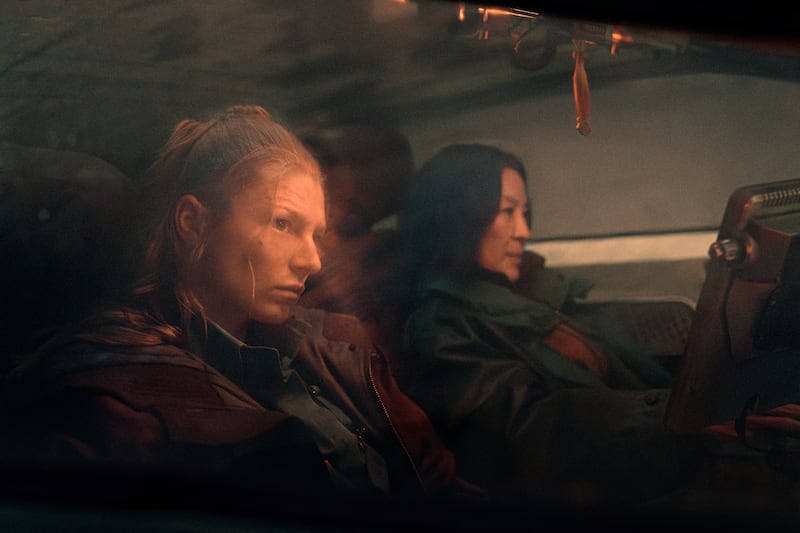
Cora (Hunter Schafer), Olwen (Michelle Yeoh) in Blade Runner 2099
Clay Enos/Prime Video
A continuation that benefits from—but doesn’t require—having knowledge of the prior films, Silka Luisa’s Blade Runner 2099 (Nov. 25, Prime Video) picks up 50 years after Villeneuve’s entry. In Los Angeles, in the aftermath of a civil war, humans are now subjugated, and replicants (sentient artificial beings designed to be workers and companions) are the subjugators.
In another paradigm-altering shift, Blade Runners are the agents previously assigned to find rogue replicants. Now tasked with hunting down insurgents, they’re the new LAPD, and though they’re stronger, faster, and smarter than their organic counterparts, they have two glaring weaknesses: they don’t feel empathy (monitored via the replicant-detecting Voight-Kampff test), and they have limited lifespans.
Olwen (Oscar winner Michelle Yeoh) is one such Blade Runner—a cutting-edge Nexus 9 model whose demise is eight days away—and her search for a rebel goes awry when the individual in question, Cora (Euphoria’s Hunter Shafer), evades capture. Cora is wanted for her involvement in a revolutionary act, and she now operates under false identities provided to her by Bebeto (Dimitri Abold) while caring for her crippled brother Elias (Lewis Gribben).

Hunter Schafer as Cora in BLADE RUNNER 2099
Clay Enos/Prime Video
Following her narrow escape, Cora covets a way to flee L.A. for good, and Bebeto gives her one: pose as a replicant Blade Runner (a process that requires drastic modifications) and retrieve an item for a buyer who, in exchange, will supply her and Elias with visas to Mexico City, the last stronghold of humanity.
Olwen has a jerky, perpetually suspicious partner in Yahya (House of the Dragon’s Matthew Needham), but when Cora arrives at the precinct, she’s paired with the newbie. “You’re so alone, you’re not a person anymore,” Bebeto says about Cora to explain why she’ll be successful at passing as an android. He’s correct: her loneliness makes her a match for the lonesome Olwen, whose impending expiration hangs over her head like a storm cloud, even though she behaves as if it’s merely an unavoidable part of her programming.
Olwen’s primary focus is finding her former partner Marek (Johnny Harris), who’s now on the run and whom (in a Blade Runner first) she’s been ordered to kill. As luck would have it, Cora also seeks Marek, since he might have the valuable commodity she’s been hired to recover.
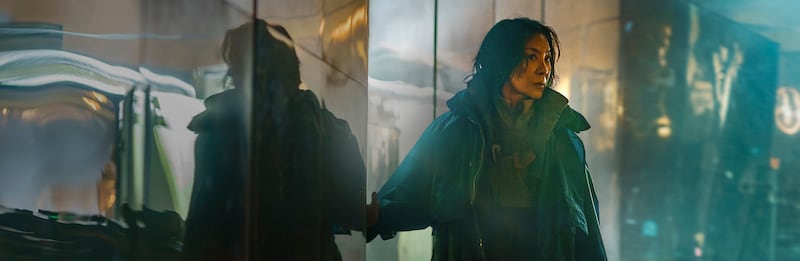
Michelle Yeoh
Clay Enos/Prime Video
Especially in its opening episodes, Blade Runner 2099’s plotting is a tad oblique, and while that can be disorienting, it inspires a necessary measure of concentration and adds to the hazy, hallucinatory mood. Per franchise tradition, the series is drenched in mist, rain, shadows, grime, and stark neon lights, and if directors Jonathan van Tulleken, Marcela Said, Karena Evans, and Ariel Kleiman don’t quite equal the artistry of Scott and Villeneuve, they successfully evoke the material’s trademark mix of despair, dread, longing, and fatalism.
Moreover, they approximate their ancestors’ majesty via a procession of stunning, large-scale tableaus of techno-LA (whose streets are damp and gritty, and whose glittering skyscrapers look perpetually under construction) and oceanic and desert wastelands (full of enormous, dilapidated structures and litter-strewn plains)—panoramas that enhance the proceedings’ monolithic majesty.
Further contributing to Blade Runner 2099’s splendor is a Leopold Ross score that layers opulent, ominous synth waves with wailing saxophone. Aesthetically, the series is nearly on par with its illustrious cinematic forebears. Its story is no slouch either.

Michelle Yeoh as Olwen in BLADE RUNNER 2099
Clay Enos/Prime Video
Both Cara and Olwyn are well-defined protagonists whose missions (and fates) intertwine in a compellingly knotty fashion, and their saga strikes just the right blend of mystery, action, and philosophical inquiry, all of which soon revolves around a clandestine figure played by Tom Burke who appears to be interested in procuring what Marek and Cora want. Even at its fuzziest, the plot is convoluted in a manner that reflects the in-flux nature of this sci-fi reality, and its momentum swells once the specifics of its heroes’ quest become clearer.
Yeoh’s formidable sternness belies Olwyn’s subtly conflicted heart, and Shafer is similarly captivating as a fugitive working undercover in the belly of the beast whose feelings about replicants are slowly muddied by the bombshells she unearths regarding their—and her own—past. At once stout, vulnerable, frazzled, and resolute, it’s Shafer’s finest performance to date, and she and Yeoh share a taut chemistry that’s energized by faint, persistent hints that perhaps things between Olwyn and Cora aren’t as straightforward as they seem.
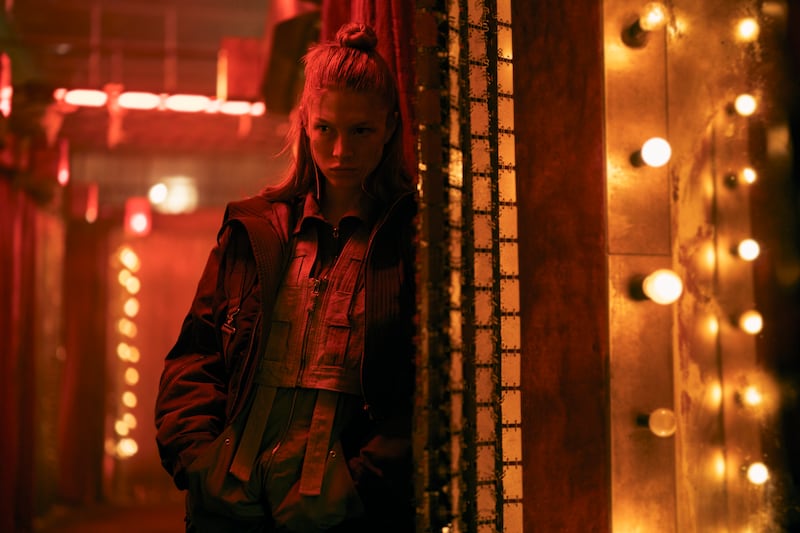
Hunter Schafer as Cora in BLADE RUNNER 2099
Clay Enos/Prime Video
Aside from Gribben, whose Elias proves unintentionally grating, Blade Runner 2099’s cast is assured, and Burke in particular stands out in later installments, courtesy of a narrative that intriguingly refuses to posit any of its players as outright villains. Instead, rational and understandable motivations propel the series’ main characters forward, allowing Luisa to keep the spotlight on the larger questions—about death, self-definition, evolution, and freedom—lurking beneath her wet, rusty surfaces.
Set in a magnificently haunting sci-fi city marked by gargantuan pyramid-style structures that loom over a world gone to seed, Blade Runner 2099 boasts awe-inspiring scale.
It’s a show that echoes what came before while gazing into tomorrow, and perhaps its finest accomplishment is that what it sees there is the same stew of existential fears that have forever plagued self-conscious creatures. In this universe, transcending mortality may be what’s on the horizon, but as Luisa’s faithful series suggests, there’s nothing more desirable than being human.
Obsessed with pop culture and entertainment? Follow us on Substack and YouTube for even more coverage.

Got a tip? Send it to The Daily Beast here.
Unlock a year of full access to The Daily Beast for $35.
Monthly
$1
First month then $5.99/month
Annual
$35
First year then $59.99/year
Premium
$79
First year then $119.99/year
*Substack access provided by the next business day, using your subscription email. Choosing the Premium plan constitutes your permission to share your subscription email with Substack and your agreement to Substack’s Privacy Policy.
Looks like you already have a subscription!
- Account (completed)
- Payment (completed)
- Confirmation (completed)
You're all set!
Thanks for subscribing.
- 1Account
- 2Payment
- 3Confirmation
Sign in or create an account
Register below to read this article for free or subscribe
to unlock unlimited access to The Daily Beast.
Monthly
$1
First month then $5.99/month
Annual
$35
First year then $59.99/year
Premium
$79
First year then $119.99/year
*Substack access provided by the next business day, using your subscription email. Choosing the Premium plan constitutes your permission to share your subscription email with Substack and your agreement to Substack’s Privacy Policy.
Already have an account? Sign In
Looks like you already have a subscription!
- Account (completed)
- Payment (completed)
- Confirmation (completed)
You're all set!
Thanks for subscribing.
- 1Account
- 2Payment
- 3Confirmation
Sign in or create an account
Login dialog
Loading comments…