Oscar Winner’s Latest Feel-Good Fable is Very, Very Bad
‘Klara and the Sun’ is a great big ball of flaming sentimentality.

Sony Pictures
Taika Waititi has made a handful of amusing movies and TV series, but his schmaltzier instincts are catastrophic, as he demonstrated in 2019 with the execrable Jojo Rabbit—a leading contender for worst film of the 21st century, regardless of its Oscar win—and which he now reconfirms with the insufferably cloying Klara and the Sun.

An adaptation of Kazuo Ishiguro’s novel that yanks at the heartstrings like participants at a World’s Strongest Man tug-of-war competition, Waititi’s latest directorial effort (October 23) is the story of a quirky robot who leaves behind her eccentric robot pals to learn about love—which is “happiness and pain”—with a friendly girl and her imperious mom in their enormous country home. With Jenna Ortega spearheading a cast of fine actors doing some of the worst work of their careers, and Waititi ladling on the syrupiness until the proceedings practically choke on it, it’s a wannabe-inspiring fable that proves its maker’s preternatural gift for noxious sentimentality.
In a crowded city in a make-believe future, Klara (Ortega)—a discontinued model of companion robot—yearns to be purchased from the two-bit retailer that she calls home and which is run by Store Manager (Natasha Lyonne). Klara is a “blank slate” who’s meant to be imprinted upon by her owner, thereby rendering her the equivalent of an empty-headed childlike innocent. Consequently, she greets each day bright-eyed and bushy-tailed, not only because she’s sure she’s destined to fulfill her purpose of making a human child happy, but because she starts her mornings speaking directly to the sun that gives her power and which she’s convinced is a deity that answers prayers.
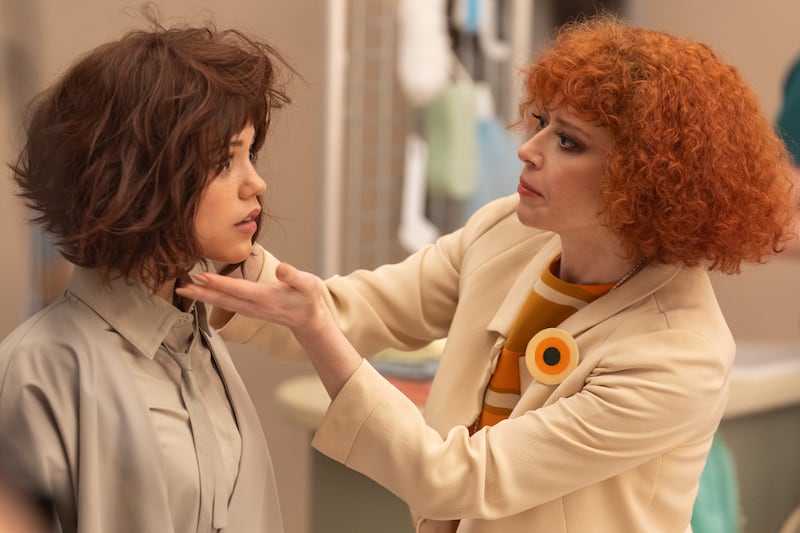
Jenna Ortega and Natasha Lyonne in Klara and the Sun.
Sony Pictures
Klara has faith, although Klara and the Sun wields its quasi-religious concerns for nothing but mawkishness. One day, Josie (Mia Tharia) emerges from a cloud of street-sweeper smog and chooses Josie as her “AF” (artificial friend), and amazingly, Waititi (who co-wrote the script with Dahvi Waller) doesn’t employ that abbreviation for a joke about its modern definition. He does, however, immediately indulge in sappy affectations, such as pixelated shots from Klara’s point of view and the sight of a couple on the street becoming engulfed in sparkling light when they embrace—a moment which teaches Klara that this is the sign that two people are in love.
There’s more hostility than warmth in the home of Josie and her mom Chrissie (Amy Adams), the latter of whom is stern and snooty, and not merely because she’s still grieving the loss of her husband and elder daughter. Josie makes snide remarks about Chrissie’s interior-decorator profession and shows off to Klara her numerous intellectual and artistic gifts—the byproduct of a genetic process known as “lifting” that’s made her borderline-superhuman. Josie is proud of her condition, and yet she’s not arrogant, as evidenced by her quasi-romantic relationship with Rick (Aran Murphy), the boy-next-door tech genius who constructs artificial birds simply because he thinks they’re beautiful.
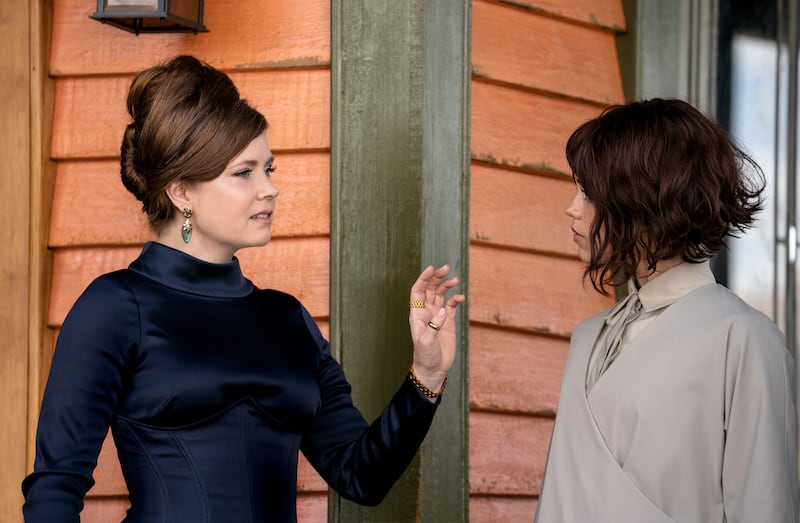
Amy Adams and Jenna Ortega in Klara and the Sun.
Sony Pictures
Klara does impressions of her new friends, dotes on Josie, and suffers the skeptical looks of housekeeper Melania (Rachel House), along with walking awkwardly on stairs (she just can’t figure them out!) and routinely standing on one leg like a flamingo. This mannerism is indicative of Klara and the Sun’s tweeness, and that mounts once Josie begins displaying grave medical symptoms. The nature of that malady is revealed by Chrissie, as is the grieving mother’s ulterior motives, which Klara and the Sun so badly fails to conceal that viewers wind up an hour ahead of the unsubtle and obvious story, waiting for it to catch up.
Get the best of Obsessed delivered right to your inbox
By clicking “SUBSCRIBE” you agree to our Terms of Use and Privacy Policy.
Ortega plays Klara as a chipper automaton who pleads with the sun to provide “super-duper nourishing nourishment” and reacts to most everything with wide-eyed excitement. It’s a performance that’s at once unoriginal and excruciating, and thus it pairs perfectly with Adams’ monotonous turn as the prickly and aloof Chrissie. Neither strikes a single moving note. Moreover, it’s difficult to see why either was attracted to the sloppy material in the first place, except that the Wednesday star seems to have a thing for idiosyncratic and mannered outsiders and Adams, on the heels of Hillbilly Elegy, The Woman in the Window, Dear Evan Hansen, and Cape Fear, has become irresistibly attracted to the dreariest of projects.
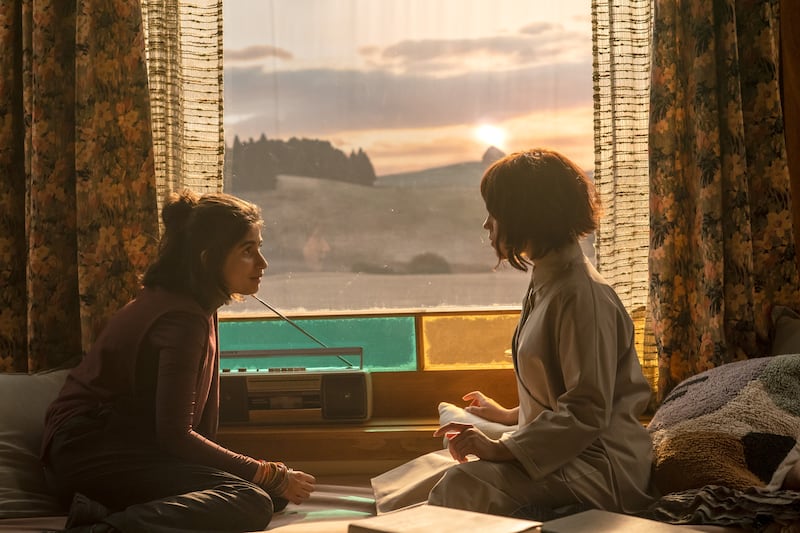
Mia Tharia and Jenna Ortega in Klara and the Sun.
Sony Pictures
Klara and the Sun is assembled from the spare parts of Bicentennial Man, After Yang, and countless similar robo-buddy predecessors, and once Chrissie starts taking Josie to the city for mysterious pictures, it also trades in elements explored more interestingly by Obsession, Get Out, and even You Can See Everything. These comparisons aren’t meant to be flattering; rather, they’re just intended to italicize that the film is a superficial hodgepodge of familiar bric-a-brac. Waititi doesn’t have any interest in issues of identity, loss, belief, or amour—his sole goal is eliciting feel-good waterworks, and to that end, he employs Michael Giacchino’s manipulative score without restraint.
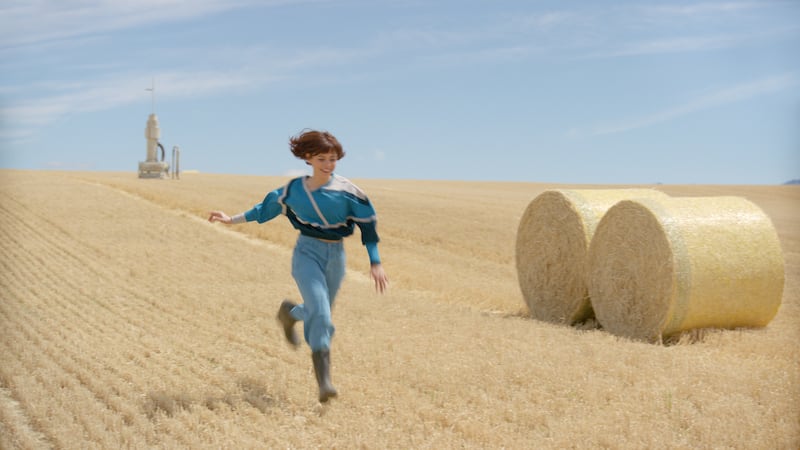
Jenna Ortega in Klara and the Sun.
Sony Pictures
In Klara’s confrontations with pollution-spewing industrial machines that she considers “monsters,” Klara and the Sun faintly recalls P. D. Eastman’s classic Are You My Mother? That children’s-fable vibe is enhanced by Klara’s cutesy relationship with a scarecrow robot (Jesse Griffin), though it’s offset by the tale’s more adult atmosphere, creating a disharmony it never successfully resolves. Waititi’s numerous scenes of Klara tilting her head upwards to the heavens to speak to the sun, meanwhile, have the adverse effect of dragging the film down into a morass of maudlin mush. The same is true of Klara’s handwringing over being returned (she fears getting packaged in her “evil” cardboard shipping box) and Josie’s party with other “lifted” kids who turn out to be snobby and cruel weirdos in some of the silliest future-fashion outfits ever committed to film.
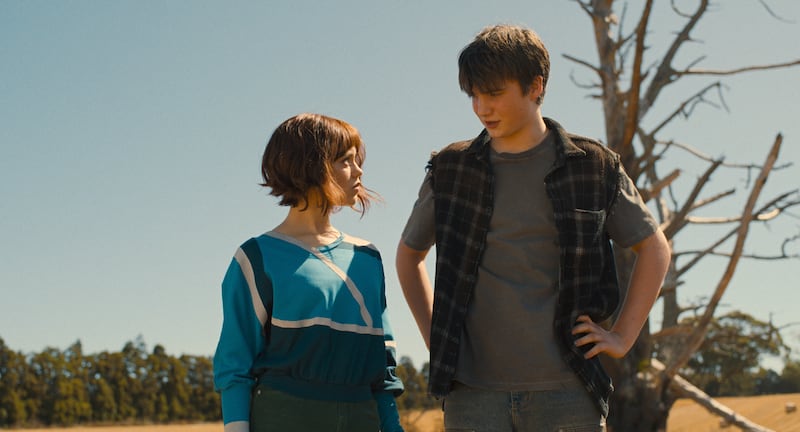
Jenna Ortega and Aran Murphy in Klara and the Sun.
Sony Pictures
When Klara’s not going on the fritz or visiting a hillside barn where she believes the sun lives (because it sets behind it every night and the robot is a naive dimbulb), she learns from Josie that dreams (which she has) are things for which one passionately pines. Watching Klara and the Sun, I had one too—and after 116 minutes of this torturously treacly fiasco, mine came true when the credits rolled.
Obsessed with pop culture and entertainment? Follow us on Substack and YouTube for even more coverage.

Got a tip? Send it to The Daily Beast here.
Register below to read this article for free or subscribe
to unlock unlimited access to The Daily Beast.
Monthly
$1
First month then $5.99/month
Annual
$35
First year then $59.99/year
Premium
$79
First year then $119.99/year
*Substack access provided by the next business day, using your subscription email. Choosing the Premium plan constitutes your permission to share your subscription email with Substack and your agreement to Substack’s Privacy Policy.
Already have an account? Sign In
Looks like you already have a subscription!
You're all set!
Thanks for subscribing.
Sign in or create an account
Login dialog
Loading comments…