Netflix’s Epic Answer to ‘The Odyssey’ Has Arrived
Thanks to the streamer’s big push, “La Bola Negra” will be one of the year’s most talked-about award contenders.

Netflix has pinned many of its Oscar hopes on La Bola Negra—and for good reason.
A gay historical epic that, with its lush melodrama and tragic romanticism spread across multiple time frames, resembles Anthony Minghella’s 1996 Academy Award-winning The English Patient crossed with Claire Denis’ 1999 critical darling Beau Travail, Javier Calvo and Javier Ambrossi’s film feels both old and new. Sweeping and poignant even when its schematic seams show, it’s a moving saga about the knotty ties that bind us to our pasts—and, with any luck, are slowly unknotted—which suffuses its conventions with heft and heart.
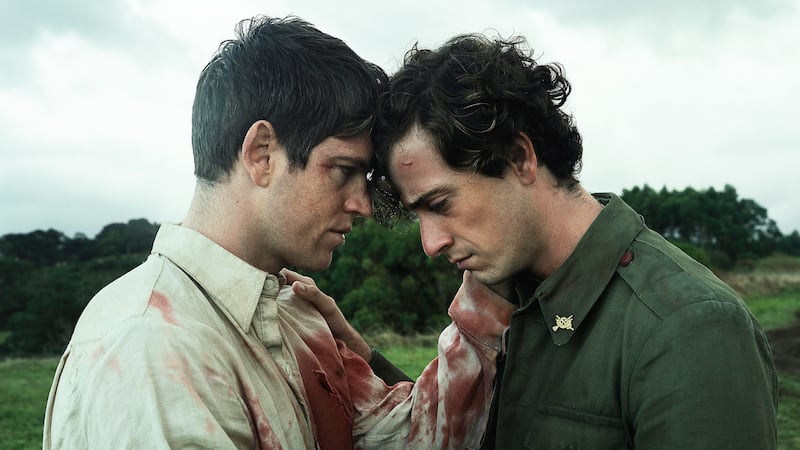
Guitarricadelafuente and Miguel Bernardeau in La Bola Negra.
Carla Oset/Netflix
Premiering in theaters on Oct. 16 after celebrated showings at the Cannes, Toronto, and San Sebastián film festivals—and streaming on Netflix starting Dec. 2—La Bola Negra draws on Federico García Lorca’s unfinished play of the same name. Lorca wrote just four pages of that incomplete work before being killed in 1936, and the first of Calvo and Ambrossi’s three narratives dramatizes it, with Carlos (Milo Quifes) visiting a casino in 1932 Granada to learn whether he’ll be granted membership.

Penélope Cruz.
Carla Oset/Netflix
The answer, it turns out, is no, as the older, dark-suited gentlemen who run the place largely vote in the negative with black balls because, as subsequently becomes clear, they oppose the white-suited Carlos’ homosexuality.
As Carlos endures this unpleasant decision and, shortly thereafter, is ordered by his father to return to the casino to demand another vote, La Bola Negra simultaneously concentrates on Sebastián (Guitarricadelafuente). A trumpeter living in a small rural town with his mother in 1937, the musician narrowly survives an attack during the Spanish Civil War by Italian bombers and, to stay alive, joins the country’s Nationalist army.

Carlos González and Julio Torres.
Carla Oset/Netflix
Sebastián is a sensitive would-be artist who’s not cut out for his new vocation, and this becomes more pronounced when he’s tasked with guarding prisoner Rafael (Miguel Bernardeau), a “red” who’s badly injured and for whom he slowly develops feelings, further attracting his comrades’ suspicions.
Get the best of Obsessed delivered right to your inbox
By clicking “SUBSCRIBE” you agree to our Terms of Use and Privacy Policy.
La Bola Negra doesn’t initially denote Carlos’ story as Lorca’s final (partial) play, nor does it immediately elucidate the connection between these plot strands and its 2017-set action involving Alberto (Carlos González), a failed playwright who lives in Madrid with his boyfriend Juan Pablo (SNL alum Julio Torres) and who’s researching 1920s-era queer music recordings.
He puts this pursuit on the back burner when he’s informed by a lawyer that his maternal grandfather has died and left him an inheritance. Because his mother, Teresa (Lola Dueñas), is intensely hostile to any discussion of this matter, getting answers about his ancestor requires a trip to Cantabria. What he discovers there turns out to be more than he bargained for—and, in the process, helps bind the film’s disparate threads.

Guitarricadelafuente and Miguel Bernardeau.
Carla Oset/Netflix
In their sophomore directorial outing (after 2017’s La llamada), Calvo and Ambrossi demonstrate impressive formal grace with La Bola Negra, transitioning agilely between their decades (and protagonists) so that parallels and echoes emerge naturally from their shrewd editorial juxtapositions.
Intuitively constructed, the film is something like a memory piece, less with regard to one character than to the Spanish nation as a whole—and, in particular, its gay community, whose subjugation is an extension of the fascist tyranny engulfing the country during the ‘30s.
While that impression is subtle in earlier passages, it becomes powerful in later stanzas, as the mysterious bonds shared by Carlos, Sebastián, Rafael, Alberto and Teresa come into sharper focus and, consequently, foreground remembrance as a key piece of its puzzle.

Milo Quifes.
Carla Oset/Netflix
A swirl of art, amour, repression, and conflict set in the midst (and aftermath) of authoritarianism and war, La Bola Negra is both a universal tale of loss and endurance and an explicitly queer fable about identity, agency, survival and progress. Calvo and Ambrossi’s trio of gay protagonists are all in the process of figuring out, and embracing, their true selves, and the directors evoke their confusion, yearning, fear, and excitement with palpable intimacy, be it in vistas of nude soldiers frolicking along a rocky shore or a close-up of Sebastián’s hand hovering over Rafael’s wounded body.
In the case of Sebastián, his awakening is additionally aided by a trip to the theater, where he’s wowed by the brashly sexual performance of Nené Romero, a firebrand who’s vividly embodied by Penélope Cruz even though the script saddles her with the thankless role of being Sebastián’s LGBTQ+ tutor, complete with the entertainer announcing that “transvestitism” holds “the fantasy of possibility.”

Guitarricadelafuente in La bola negra.
Carla Oset/Netflix
Aside from Nené’s (and a few other) on-the-nose remarks, La Bola Negra refrains from indulging in more exposition than is necessary, and Calvo and Ambrossi deepen their multipronged portrait by populating their frame with a cornucopia of striking faces. Whether it’s the aged visages staring down at Carlos as he awaits his casino-membership fate or the server and customers at the restaurant where Teresa reacts poorly to Alberto’s queries about his heritage, the frame’s background is rife with personality, contributing to the film’s richness. Their visuals strive for the mythic without losing sight of their main characters’ reality, and that balance between the lofty and the grounded remains consistent throughout.

Guitarricadelafuente as Sebastián.
Carla Oset/Netflix
Like Cruz, Glenn Close’s participation as a Lorca expert whom Alberto eventually seeks out is more distracting than beneficial; despite the star’s capable Spanish, she sticks out in a cast of authentic and stirring (and, here in the States, largely unknown) Spanish actors. It’s difficult not to feel as if both Hollywood veterans were recruited more because they’ll help sell the film than because they totally fit the material. Still, they’re too peripheral to significantly interfere with the generally evocative proceedings, which sway and swoon toward an affecting all-roads-meet finale.

Glenn Close and Carlos González.
Carla Oset/Netflix
If La Bola Negra’s temporal flip-flopping can occasionally be a tad conservative, its foregrounding of gay desire, suffering, and quiet triumph is less so, and its poise is epitomized by a conclusion that delivers the touching payoffs the directors have been building toward.
Whether or not it gets Calvo and Ambrossi (and Netflix) to the Academy Awards stage in a year where Christopher Nolan’s own war epic, The Odyssey, is set to dominate the awards field, it’s a feature that announces the duo as artists of considerable promise.
Obsessed with pop culture and entertainment? Follow us on Substack and YouTube for even more coverage.

Got a tip? Send it to The Daily Beast here.
Register below to read this article for free or subscribe
to unlock unlimited access to The Daily Beast.
Monthly
$1
First month then $5.99/month
Annual
$35
First year then $59.99/year
Premium
$79
First year then $119.99/year
*Substack access provided by the next business day, using your subscription email. Choosing the Premium plan constitutes your permission to share your subscription email with Substack and your agreement to Substack’s Privacy Policy.
Already have an account? Sign In
Looks like you already have a subscription!
You're all set!
Thanks for subscribing.
Sign in or create an account
Login dialog
Loading comments…