This Classic Tale’s Reimagining Makes One Fatal Mistake
The latest take on Jane Austen’s “Sense and Sensibility” has a major problem at its center.

Once upon a time, the movies had color. Fiery yellows. Ruby reds. Sunburnt oranges. Bruised purples. And lush greens and radiant blues that made the grass and sky look even more wondrous than they do in reality. Those hues—and their myriad variations—imbued projected images with a vitality that enhanced the emotions writ large across the screen. They were part and parcel of the cinema’s transportive power.
Those days, alas, are apparently gone—or at least far rarer than they should be, thanks to color grading (also perpetrated by Netflix) that often renders films dreary and monotonous. Such is the unfortunate case with Sense and Sensibility.

Esmé Creed-Miles and Daisy Edgar-Jones.
Focus Features
A new adaptation of Jane Austin’s 1811 debut novel has handsome staging and production design, a stately score, and fine performances—all of which are offset by a muddy visual palette that turns even the ostensibly brightest day drab. Dampening the endeavor’s spirit and, with it, the roiling emotions that are its lifeblood, this version’s downcast approach drains it of the spark it demands.
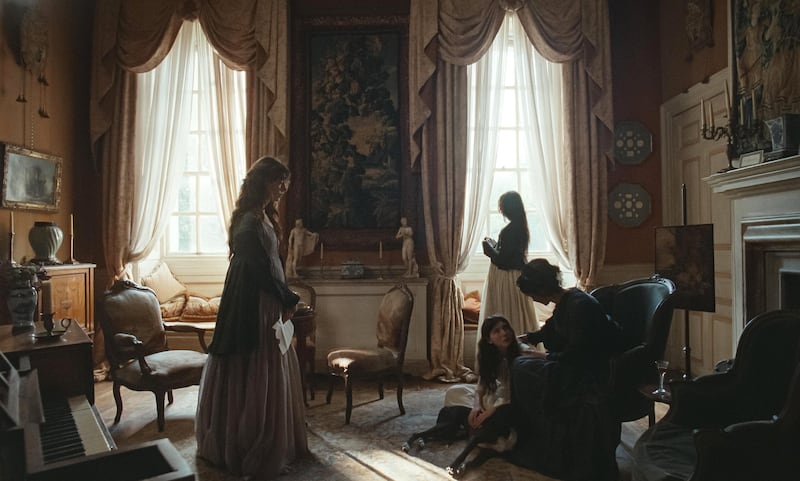
Bodhi Rae Breathnach, Caitríona Balfe, Esmé Creed-Miles, and Daisy Edgar-Jones.
Focus Features
Because Ang Lee and Emma Thompson’s Oscar-winning 1995 Sense and Sensibility remains an excellent take on Austen’s classic, Georgia Oakley’s rendition (Oct. 16 in theaters) can’t help but feel like a relatively unnecessary do-over. Nonetheless, bemoaning the needlessness of remakes is often akin to screaming at the wind, and moreover, this update—in most respects—acquits itself admirably.
Hewing close to its source material, it won’t roil the Austen faithful. It will, however, likely grate the nerves of those who appreciate vibrancy in their period pieces, especially when the story in question is rooted in passionate amour, agonized outrage, and barely suppressed longing for the joyful connections that appear just out of reach.

George MacKay and Daisy Edgar-Jones.
Focus Features
Written eloquently by Diana Reid, Sense and Sensibility, per tradition, is the story of Elinor (Daisy Edgar-Jones) and Marianne Dashwood (Esmé Creed-Miles), who, along with their younger sibling Margaret (Bodhi Rae Breathnach) and mother Mrs. Dashwood (Caitriona Balfe), are left in dire straits by the death of their patriarch. They believe their fortunes are changed for the better by the arrival of Mrs. Dashwood’s half-brother John (Tom Brooke), who feels obligated to lend a helping hand.
Get the best of Obsessed delivered right to your inbox
By clicking “SUBSCRIBE” you agree to our Terms of Use and Privacy Policy.
That doesn’t last, courtesy of John’s wife Fanny (Stacy Martin), who has no interest in serving as a benevolent benefactor and who especially balks at her visiting brother Edward Ferrars’ (George MacKay) brewing closeness with penniless Elinor, whom she views as an unacceptable match.

Bodhi Rae Breathnach and Caitríona Balfe.
Focus Features
Temporary salvation (of the pecuniary kind) comes via Mrs. Jennings (Fiona Shaw), a boisterous relative whose generosity is as grand as her filter is faulty. Shaw generates the lion’s share of Sense and Sensibility’s humor as the doting, loud-mouthed Mrs. Jennings, who offers the Dashwood women residence at the cottage owned by her son-in-law Sir John Middleton (Turlough Convery). There, Elinor waits with bated breath for word of Edward’s promised arrival.
Meanwhile, Marianne sprains her ankle and is swept off her feet by John Willoughby (Frank Dillane), an attractive suitor for whom she quickly falls—thus putting the kibosh on any potential pairing with the older, more reserved Colonel Brandon (Herbert Nordrum).

George MacKay, Bodhi Rae Breathnach, and Daisy Edgar-Jones.
Focus Features
Oakley doesn’t appreciably deviate from Austen’s template, with the composed and rational Elinor (introduced handling books in a study) juxtaposed with the effusive and uninhibited Marianne (first spied lounging in, and running through, the untamed countryside). As Marianne says, she reveals while Elinor conceals. Yet despite that bedrock dynamic, the film ably recognizes that their differences are not enough to overshadow their similarities, and the two boast trace elements of the other’s personality and are bonded by their desire for love.

Esmé Creed-Miles and Daisy Edgar-Jones.
Focus Features
Edgar-Jones is a rather bland screen presence and therefore a suitable fit for Elinor (the title’s “sense”), who suppresses her yearning and anguish behind a brave face. Creed-Miles is equally comfortable as Marianne (the personification of “sensibility”), exuding the character’s unruliness and the tender (adolescent) heart that lurks beneath it.
Sense and Sensibility rests, to a significant degree, on its leads, and while they don’t surpass Thompson and Kate Winslet’s 1995 performances, they proficiently capture their protagonists’ hopes, dreams, and all too frequent disappointments at the hands of an unjust world that restricts their autonomy.
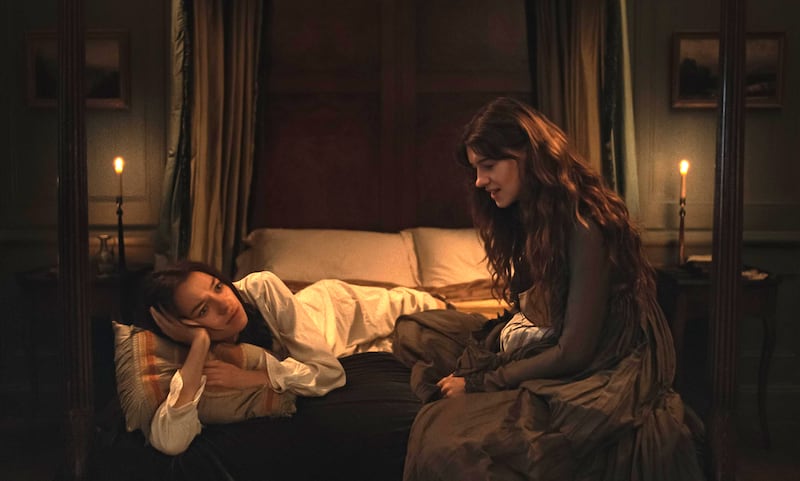
Esmé Creed-Miles and Daisy Edgar-Jones.
Focus Features
Social mores and monetary concerns conspire to reduce Elinor and Marianne (and their female compatriots) to pawns in a game in which they can make few independent moves. Sense and Sensibility mercifully refrains from trying to be timely.
Instead, it focuses on the many ways Elinor and Marianne are thwarted by financial considerations born of their poverty and dependency; the complications of English law circa the late eighteenth century; and the obligations and limitations placed on their male compatriots, particularly Edward, whose decisions are shaped by his inheritance. Oakley and Reid are true to Austen’s portrait of the era as one of vexing constraints, which gives poignant weight to the inevitable happily ever after.

Esmé Creed-Miles.
Focus Features
Despite its inferiority to Lee’s predecessor (if not some of its other adaptation ancestors), Sense and Sensibility is largely commendable. Consequently, its aesthetic dinginess is all the more frustrating. Michael Coulter’s low-lit imagery creates the unwanted impression that everything is taking place under perpetual storm clouds, such that Sir John’s dull wife (Chloe Pirrie) incessantly commenting on the weather comes across as an unintentionally apt running joke. Worse, the film’s gloominess stifles the drama.
Whether Elinor and Marianne are excited or despondent, the action operates on a wavelength that’s more even-keeled than rambunctious, and though that’s intermittently apt—say, whenever things go south for the Dashwood siblings—the proceedings’ visual cheerlessness is enervating.
Sense and Sensibility’s pictorial shortcomings don’t extend to Oakley’s elegant compositions or Izabella Curry’s fluid editing, and once one becomes accustomed to the film’s brown-and-gray dowdiness, it’s easier to concentrate on the various elements that do warrant appreciation, be it Nordrum’s charismatically stoic Colonel Brandon or MacKay’s empathetic and endearing Edward.
Still, there’s no ignoring the fact that the director, with so many correct pieces in place, opts for an ill-fitting cinematographic approach to her hallowed tale, resulting in a new interpretation that’s surprisingly mustier than those which preceded it.
Obsessed with pop culture and entertainment? Follow us on Substack and YouTube for even more coverage.

Got a tip? Send it to The Daily Beast here.
Register below to read this article for free or subscribe
to unlock unlimited access to The Daily Beast.
Monthly
$1
First month then $5.99/month
Annual
$35
First year then $59.99/year
Premium
$79
First year then $119.99/year
*Substack access provided by the next business day, using your subscription email. Choosing the Premium plan constitutes your permission to share your subscription email with Substack and your agreement to Substack’s Privacy Policy.
Already have an account? Sign In
Looks like you already have a subscription!
You're all set!
Thanks for subscribing.
Sign in or create an account
Login dialog
Loading comments…