‘Stranger Things’ Star Takes on TV’s Biggest Fantasy Series
“The Lord of the Rings—The Rings of Power” embraces the darkness in its epic third season.

The Dark Lord takes center stage in the third season of The Lord of the Rings—The Rings of Power, and Prime Video’s prequel to J. R. R. Tolkien’s famed fantasy saga imagines his final push to forge the “one ring to rule them all” with a malevolent grandeur that comes close to equaling that of Peter Jackson’s Oscar-winning film adaptations—and is now bolstered by the participation of Stranger Things’ Big Bad.
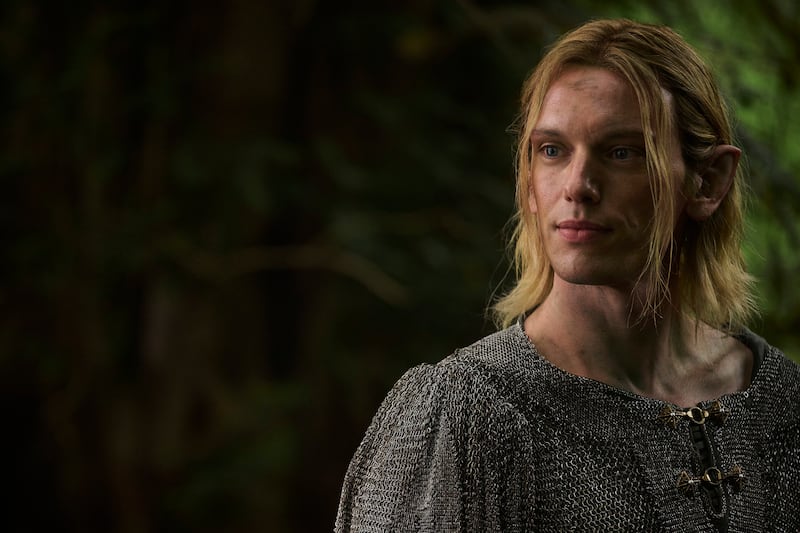
Jamie Campbell Bower as Celeborn
Ben Rothstein/Prime
J. D. Payne and Patrick McKay’s series has always sought a scale to match its big-screen predecessors, and in its latest go-round (Nov. 11), it achieves a mythic majesty, peaking with a penultimate episode that does fitting justice to the creation of the omnipotent piece of jewelry at the core of its sprawling tale.
Narratively, visually, and emotionally, it’s a work of terrific size and scope. Yet what most distinguishes this TV opus is its marriage of the enormous and the intimate, all while staying true to the spirit—and iconography—of its source material.
Having tricked Celebrimbor (Charles Edwards) into fashioning tainted rings of power for the realms of Dwarves and Men, Sauron (Charlie Vickers) now covets a single all-powerful ring. The problem is that, with Celebrimbor dead, he doesn’t know how. So he decides the surest way to solve this puzzle is to obtain one of the three original rings the Elves made, since they weren’t influenced by his dark magic and might hold the key to completing his project.
To track those down while growing his army for his ongoing war against the Elves, he gifts the rings in his possession to others who, once wearing the jewelry, become his ring-servants—and, as their scary masks, crowns, and black outfits indicate, are on the path to becoming his undead Nazgûl.
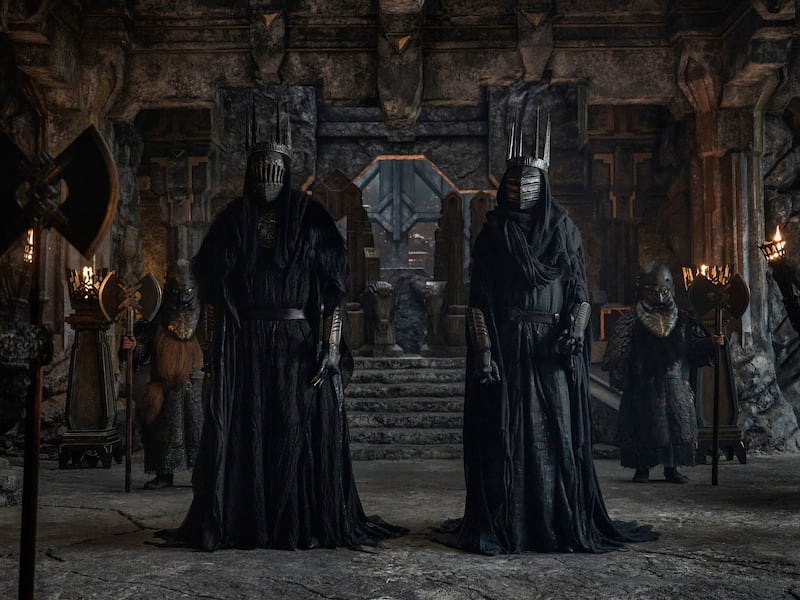
The Nazgûl
Ben Rothstein/Prime
Vickers fully grows into the role of Sauron in Season 3 of The Rings of Power, oozing unholy menace through cold, comforting smiles, deliberate gestures, and a calm disposition. His villain is a titan who fears nothing and is completely confident in his destiny, and Payne and McKay shrewdly reveal his evil without trying to humanize him. He’s the embodiment of all that is corrupt and wicked, and that makes him at once terrifying and seductive, as Elven warrior Galadriel (Morfydd Clark) knows too well.
Sign Up for Our Obsessed Newsletter
By clicking “SUBSCRIBE” you agree to our Terms of Use and Privacy Policy.
Her dreams are haunted by romantic visions of Sauron, whom she’s drawn to despite her burning desire to kill him; Galadriel is tormented by her twisted feelings, complicated by the series’ revelation that, an age earlier, she was smitten with another.
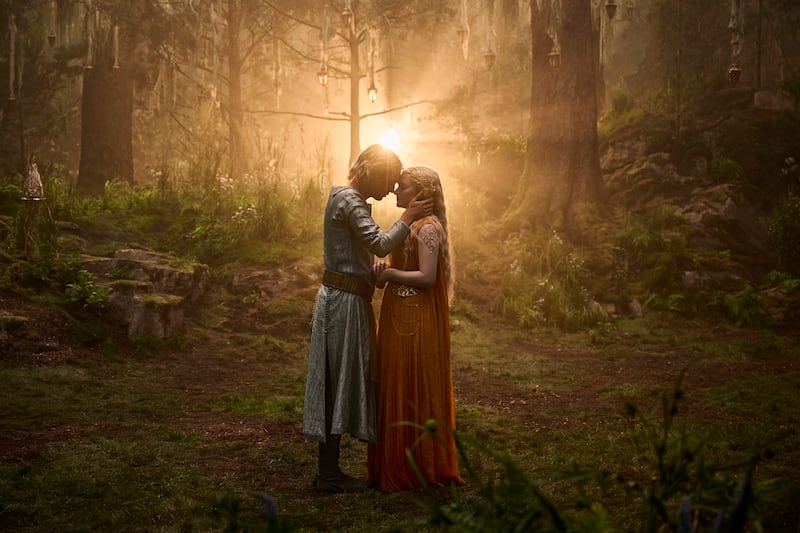
Jamie Campbell Bower as Celeborn, Morfydd Clark as Galadriel
Ben Rothstein/Prime
That would be Celeborn, played by Jamie Campbell Bower (Stranger Things villain Vecna), with whom Galadriel once planned to spend the rest of her days. Celeborn isn’t relegated to mere flashbacks in The Rings of Power, but he doesn’t arrive in the primary timeline until midway through the season because the show juggles so many concerns.
Payne and McKay handle their various threads with aplomb, including an appearance from a dragon (thereby directly challenging House of the Dragon). And fortunately, at least for now, they’ve set aside concentrating on the Harfoots, the Hobbit ancestors who were the first to discover Gandalf (Daniel Weyman) and whose cutesy antics aren’t missed in this outing.
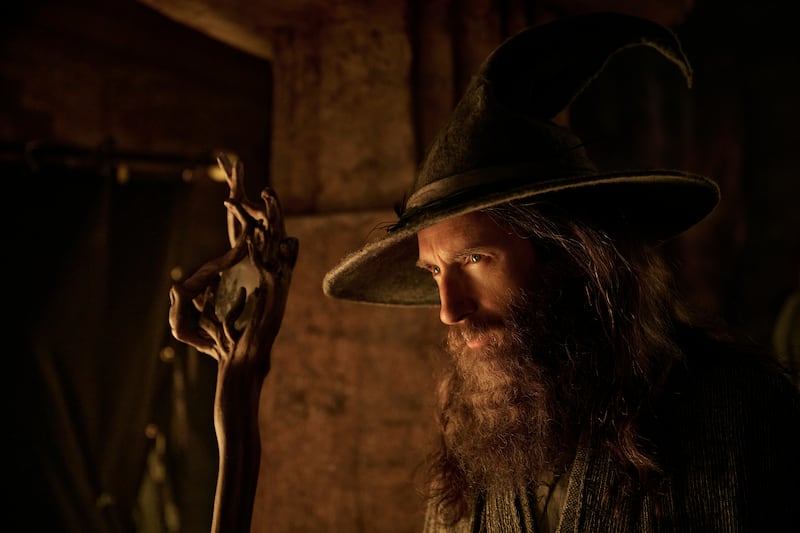
Daniel Weyman as Gandalf
Ben Rothstein/Prime
Gandalf’s entrance isn’t immediate in The Rings of Power, but he eventually squares off against the Dark Wizard (Ciarán Hinds), the ruler of Rhûn, a desert kingdom which Sauron covets. At this point, however, their plot is somewhat secondary, as the series focuses on Sauron, Galadriel, and the goings-on in the dwarf mountain kingdom of Khazad-dûm and the human island kingdom of Númenor.
In the former, King Durin IV (Owain Arthur) tries to keep his collection of untrustworthy rings out of his compatriots’ hands, only to have that effort undermined by a visit from his treacherous brother Thrain (Eddie Marsan). In the latter, maleficent king Pharazôn (Trystan Gravelle) attempts to crush the rebellion of the faithful led by deposed Queen Miriel (Cynthia Addai-Robinson) and carried out by Elendil (Lloyd Owen), his son Isildur (Maxim Baldry), and an undercover agent.
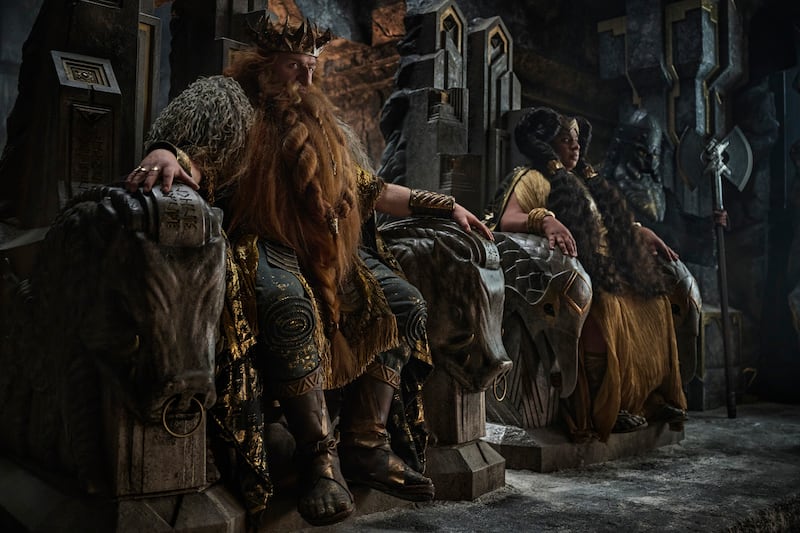
Owain Arthur as Prince Durin IV, Sophia Nomvete as Princess Disa
Ben Rothstein/Prime
A turncoat Orc with knowledge about a sole surviving ring-smith kicks The Rings of Power into gear, and directors Charlotte Brandstrom, Sanaa Hamri, and Stefan Schwartz dramatize their action with a bevy of establishing shots that soar and swoop over and into Middle Earth’s fantastical milieus. From its stately cinematography and Bear McCreary’s rousing score (and Howard Shore’s stellar theme music) to its excellent CGI and varied and distinctive production, costume, and make-up design, the series has a prestige splendor.
It also boasts a fantastic cast that breathes idiosyncratic personality into its main players, be it Arthur as the feisty Durin, Ismael Cruz Córdova as tormented Elven soldier Arondir, or Robert Aramayo as half-Elven politician Elrond, whose brother was the founder of Númenor, thereby making him the ideal person to try to broker peace between Pharazôn and Miriel.
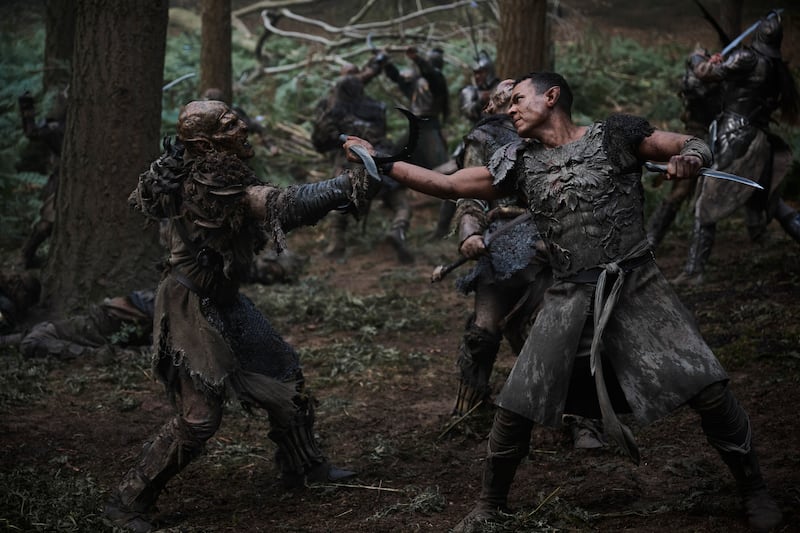
Ismael Cruz Córdova as Arondir
Ben Rothstein/Prime
No matter where you turn in The Rings of Power, the allure of might, wealth, and domination proves a threat to the stability of society, if not the entire natural order, and Payne and McKay address that temptation in multifaceted and compelling ways.
This is still a story about good and evil, yet as with Frodo and Bilbo’s quests, Galadriel and company’s opposition to Sauron is fundamentally a battle against their less noble instincts, and that struggle enhances a third season that strikes a surefooted balance between character drama, political scheming, and extravagant combat set pieces embellished with imposing slow-motion vistas of heroes in action.
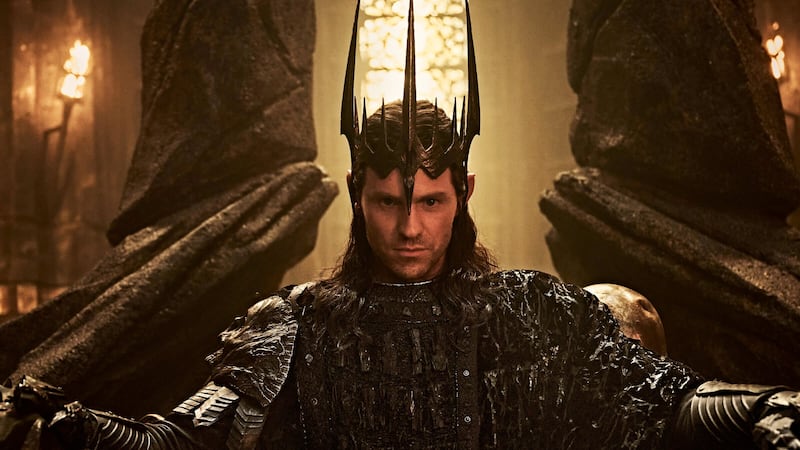
Charlie Vickers as Sauron
Ben Rothstein/Prime
Prime Video didn’t provide press with the season finale of The Rings of Power, but the conclusion to its seventh installment is a series high point, depicting Sauron’s (preordained) triumph with sinister symphonic opulence. Living up to the legendary moment, it’s an outstanding showstopper that suggests the forthcoming battles for Middle Earth will be unmissable television events.
There’s no reason to look too far into the future, however, when the current proceedings are so thrilling, moving, and—courtesy of Vickers’ standout performance as the Lord of the Rings—marvelously malicious.
Obsessed with pop culture and entertainment? Follow us on Substack and YouTube for even more coverage.

Got a tip? Send it to The Daily Beast here.
Register below to read this article for free or subscribe
to unlock unlimited access to The Daily Beast.
Monthly
$1
First month then $5.99/month
Annual
$35
First year then $59.99/year
Premium
$79
First year then $119.99/year
*Substack access provided by the next business day, using your subscription email. Choosing the Premium plan constitutes your permission to share your subscription email with Substack and your agreement to Substack’s Privacy Policy.
Already have an account? Sign In
Looks like you already have a subscription!
- Account (completed)
- Payment (completed)
- Confirmation (completed)
You're all set!
Thanks for subscribing.
- 1Account
- 2Payment
- 3Confirmation
Sign in or create an account
Login dialog
Loading comments…