This Is the Greatest Beatles Song Never Released
60 years ago, The Beatles recorded a perfect track that didn’t see the light of day for decades.
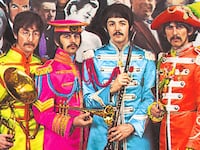
EMI
Get the Obsessed newsletter delivered straight to your inbox
By clicking “SIGN UP” you agree to our Terms of Use and Privacy Policy.
Time has moved in strange ways when it comes to the Beatles, both accelerating and slowing down depending on the situation.
Consider November 24, 1966. John Lennon, Paul McCartney, George Harrison, and Ringo Starr have reconvened in Studio 2 at London’s EMI Studios to commence work on new material. The producer is George Martin. The band’s latest album, Revolver, unlike anything before it, came out just a few months earlier on August 5. They’d played their final concert in San Francisco at the end of that same month, which included scrappy rhythm and blues numbers like “I Wanna Be Your Man” from the relative dark ages of 1963.
But even his fast-evolving bandmates couldn’t have been prepared for the fruits John Lennon brought on that late November Thursday. He’d spent his brief Beatle downtime in Spain acting in How I Won the War, directed by Richard Lester, the man who’d overseen the Beatles’ A Hard Day’s Night (1964) and Help! (1965) films.
It was in Almería that Lennon wrote his greatest song, whose best recording didn’t get officially released until long after the band broke up. This would be “Strawberry Fields Forever.” The song was inspired by the Salvation Army home where Lennon played in his boyhood, becoming a symbol and a vessel for the untrammeled nature of imagination itself, and particularly his own, which in turn is made universal through art.

At the session, Lennon played the song solo on acoustic guitar for Martin and his mates. These were men used to having their minds blown in these surroundings, but “Strawberry Fields Forever” stood apart. This was a new new. Now it was a matter of realizing Lennon’s vision on tape and bringing it into the world for other minds to be blown.
The “Strawberry Fields Forever” most people know, and commonly cite as an all-time favorite song, is often described as a psychedelic opus. Psychedelic songs often have a distance to them. They’re opaque, open-ended. The listener—who may also be under the influence of something mind-expanding—hears what they wish.
Psychedelic opuses are rarely of a deeply personal nature. They aren’t cries, declarations, all-but-official statements of the human soul. They’re “far out, man,” if you will, rather than what lodges deep inside us.
The official version of “Strawberry Fields Forever” had a difficult gestation. The band tried to do it slowly. Then they did it fast. They traded in beauty, and then a psychedelic, pre-metal thunder, with Lennon ultimately commanding producer Martin to somehow jam these strains together into a finished offering.

A lot had changed since 1963.
Michael Ochs Archives/Getty Images
Martin’s solution became part of the finest single ever released, a double A-side, with McCartney’s “Penny Lane.” But the “Strawberry Fields Forever” one most needs—and needs as much as anything the Beatles ever cut—is the first take from that November session.
When people talk about the quality of a Beatles song, they’re often really talking about the quality of a Beatles recording, without realizing it. For example, a universally acclaimed album like Abbey Road is weak—Beatles-wise—in terms of its actual songs. Fragments and half-baked ideas were stitched together.
The album sounds incredible. It is incredible. But not consistently because of its songs.
The released “Strawberry Fields Forever” leans hard into that idea of being a sonic construction, whereas the first take is as pure as a song can get. It defies categorization. No psychedelic opus here. It wasn’t only that nothing had ever sounded like this first take, but also that nothing had ever been written like it.
Increasingly, songwriting is seen as lyric-writing. For example, one will encounter the Beatles’ own “I Want to Hold Your Hand” disparaged as simple because of its lyrics, as if the insane chords and changes the band deployed don’t factor into what constitutes a great song.
The first take of “Strawberry Fields Forever” suggests an English pastoral, as well as the post-folk introspection still to come from the likes of Nick Drake. Lennon’s voice is naked. This was someone who did naked well when they sang, despite his paradoxical insistence on having Martin smother that voice in effects, as with the official “Strawberry Fields Forever.”
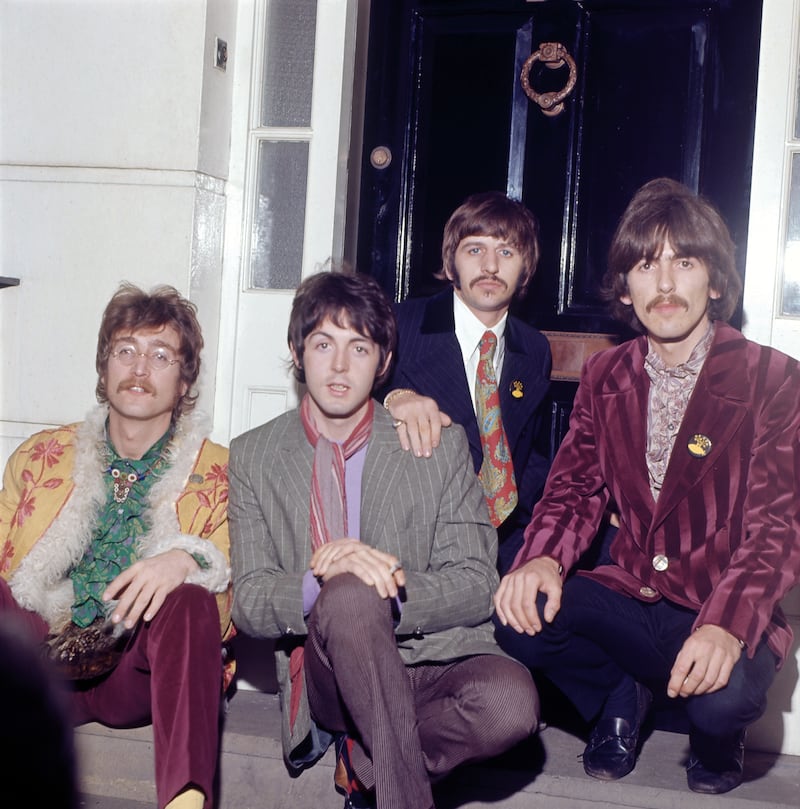
“Sgt. Pepper's Lonely Hearts Club Band” was released in May, 1967.
Jeff Hochberg/Getty Images
Listen to the first bridge of 1964’s “I Should Have Known Better,” when Lennon’s vocal is single-tracked. It’s the quintessential rock-and-roll voice. “Strawberry Fields Forever” isn’t rock and roll, but it’s quintessential singing of a unique stripe.
Unlike the officially released track, Lennon begins with a verse rather than the chorus, and a line that deepens in resonance as we sputter along in our faltering human experiment: “Living is easy with eyes closed,” he sings in a manner that could send an angel off to dreamland, and the sage listener thinks, “Yes, it is at that,” and makes a mental note to address the matter in their own life.
Official “Strawberry Fields Forever” got loud. Was that Ringo Starr or Keith Moon of the Who having a go at it on the drums?
Take 1 has a gossamer timbre. McCartney works the Mellotron, which would play a different role—more to the evocative fore—on the single. You want a McCartney working with you on your singular song, because he’ll help you be as true to yourself as possible. A genius facilitator.
Starr plays with impeccable touch, as Starr always did. Whatever suited a song, he gave it. Harrison crafts some of his most indelible guitar fills while staying mindful of the spaces better left alone.
Lennon later wrote that life is what happens while you’re busy making other plans. Take 1 of “Strawberry Fields Forever” is the sound of that life happening, but with the singer acutely aware of it, as though he has stepped clear of time as we generally treat it and moved into a state of complete presence that the listener is welcome to join.
Slide guitar was overdubbed onto the take. McCartney and Harrison sing impossibly seraphic background vocals. The song’s speech patterns spit in the eye of artifice, which can feel radical to us in our personal performative spheres with their thick coatings of gloss.
The song progresses through downturns. Rather than race ahead in its emotionalism—and clearly this is an emotional song—it calls for an exactitude in one’s thinking. The singer’s thoughts are qualified, vetted, and edited as they occur. That’s how in tune the singer is with himself.
“Always, no, sometimes think it’s me / But you know I know when it’s a dream.”
Note the natural ritardando effect of this free verse, how it precludes careening, keeps singer and listener on point. It’s like the mental version of a deep breath. Who had ever spoken/sung like this in a song? Lennon’s unique recitative is thought made audible.
The singer is unbothered by what he now refuses to pretend to be; that is, anything save himself. That can strike us as a rebellious conceit in a social media world, and “Strawberry Fields Forever” is the ultimate anti-social media—and AI, come to think of it—song.
Lennon jokingly said that the real message of rock is be here now. We listen to this first take of “Strawberry Fields Forever,” and think, wait, maybe he wasn’t joking.
This is popular music’s Hamlet moment, only we aren’t talking a debate as to be or not, but rather opening one’s self up to fully being instead. The singer wants to take us down. He’s polite about it, with that “Let me…” lead-in.
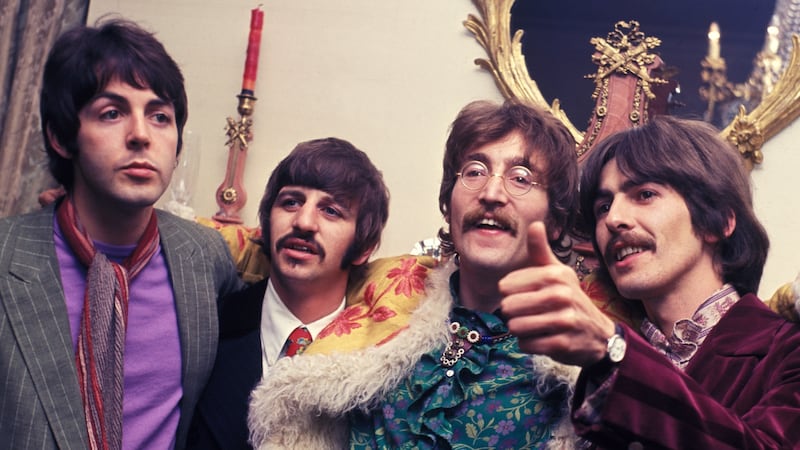
“Strawberry Fields Forever” was one of the Beatles’ first psychedelic tracks.
Courtesy of The Beatles
The Beatles themselves didn’t know that this day marked the start of what would become Sgt. Pepper’s Lonely Hearts Club Band. Releasing the first take of “Strawberry Fields Forever” was never an option. It wouldn’t have been seen as worked over enough. It could have been a guy on a stool playing a song in real time with his buddies helping him out, which it essentially was. Call it the timeless version of real time.
But like the 1963 BBC sessions, the first take of “Strawberry Fields Forever” is imperative if one is to understand this band and their art. As the former was as Beatles-esque as anything they produced, so too is this the most Lennon-esque of Lennon recordings.
If there was only one performance by him to hear, venture no further, for you’ve come down to the place where it’s always fruitful to spend every form of time.
Obsessed with pop culture and entertainment? Follow us on Substack and YouTube for even more coverage.

Got a tip? Send it to The Daily Beast here.
Unlock a year of full access to The Daily Beast for $35.
Monthly
$1
First month then $5.99/month
Annual
$35
First year then $59.99/year
Premium
$79
First year then $119.99/year
*Substack access provided by the next business day, using your subscription email. Choosing the Premium plan constitutes your permission to share your subscription email with Substack and your agreement to Substack’s Privacy Policy.
Looks like you already have a subscription!
- Account (completed)
- Payment (completed)
- Confirmation (completed)
You're all set!
Thanks for subscribing.
- 1Account
- 2Payment
- 3Confirmation
Sign in or create an account
Register below to read this article for free or subscribe
to unlock unlimited access to The Daily Beast.
Monthly
$1
First month then $5.99/month
Annual
$35
First year then $59.99/year
Premium
$79
First year then $119.99/year
*Substack access provided by the next business day, using your subscription email. Choosing the Premium plan constitutes your permission to share your subscription email with Substack and your agreement to Substack’s Privacy Policy.
Already have an account? Sign In
Looks like you already have a subscription!
- Account (completed)
- Payment (completed)
- Confirmation (completed)
You're all set!
Thanks for subscribing.
- 1Account
- 2Payment
- 3Confirmation
Sign in or create an account
Login dialog
Loading comments…