‘Victorian Psycho’ Crowns a New Queen of Horror
The 33-year-old star breaks through in this truly terrifying period piece.

If American Psycho’s Patrick Bateman had a kindred-spirit ancestor, she’d look a whole lot like Winifred Notty (Maika Monroe), the murderous 19th-century protagonist of Victorian Psycho.
Director Zachary Wigon’s follow-up to his sterling debut Sanctuary (starring Margaret Qualley and Christopher Abbot) is a gothic nightmare indebted not only to Bret Easton Ellis’ 1991 novel but also to the works of Mario Bava and Hammer Horror films, even as it signs its own distinctively deranged signature in blood. A superb period-piece horror show, it delivers precisely what its title promises, except with an unexpected dose of delirious wit.
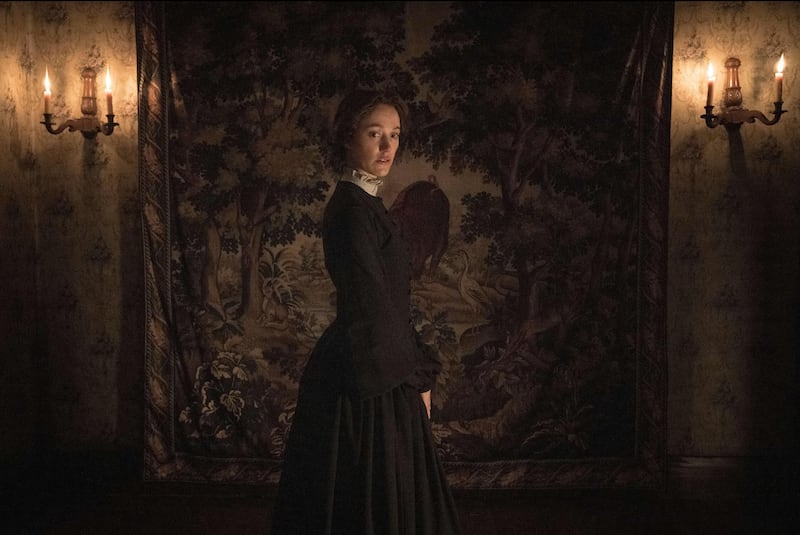
Maika Monroe in Victorian Psycho
Bleeker Street
Written by Virginia Feito (adapting her novel of the same name), Victorian Psycho (Nov. 13 in theaters) opens with wavelengths of blurry, indecipherable fire—manifestations, it’s implied, of the mind of Winifred, who arrives at a remote English estate known as Enson House to commence employment as a governess. A rude welcome awaits her, although the unnerving look on her face as she glances over her shoulder while entering the mansion suggests that she’s the place’s truly nasty (new) resident.
Victorian Psycho is narrated by Winifred, whose placid inner monologue makes clear that she’s not altogether there. Additionally contributing to that impression is the fact that, upon unpacking her belongings in her quarters, a severed ear falls from her clothes onto the floor and her response is to pick it up, tilt her head toward the ceiling, and drop it into her open mouth.
This is the first of numerous instances in which Wigon’s camera assumes the perspective of grotesque and/or deadly objects, and those dexterous POV shots, along with scary in-your-face close-ups of his oft-smiling main character, create hilarious intimacy with the lunatic.
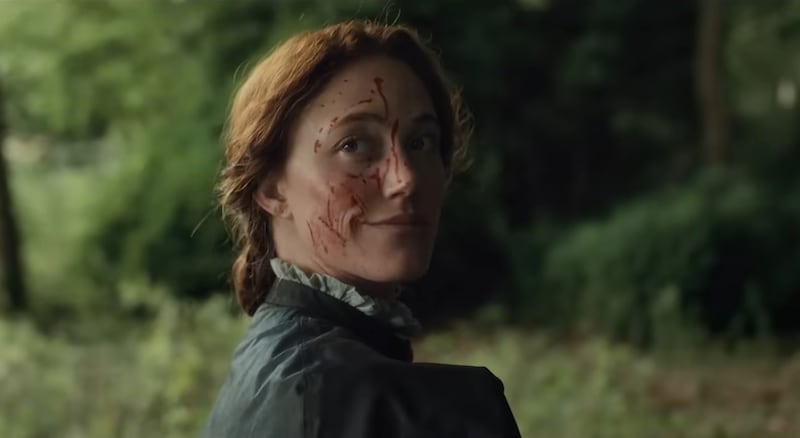
Maika Monroe in Victorian Psycho
Bleeker Street
Winifred is stark raving mad, as she demonstrates in all sorts of (first small, then big) ways. With inapt intensity, she announces at the dining room table to Enson House’s owners, Mr. (Jason Isaacs) and Mrs. Pounds (Ruth Wilson), “I shall strive to be worthy of this family!” That includes the two children whom she’s tasked with molding: young Andrew (Hamnet’s Jacobi Jupe) and his older sister Drusilla (Evie Templeton).
Sign Up for Our Obsessed Newsletter
By clicking “SUBSCRIBE” you agree to our Terms of Use and Privacy Policy.
Because Andrew is the heir to their fortune, Mr. and Mrs. Pounds care only about his education; they tell Winifred that Drusilla needs only be adequately smart. Nonetheless, both kids get the full breadth of Winifred’s teachings, beginning with a lesson on the “most important thing in life”: knowing right from wrong and, with it, one’s place in society, whose rules must be upheld.
Winifred, of course, is an agent of chaos who aims to destroy, rather than maintain, the status quo. Still, like Patrick Bateman in 1980s New York City, she’s not an outsider in her social system; on the contrary, she’s an expression of its cruelty, rage, and insanity, all of which she turns against it. Composer Ariel Marx’s score, full of atonal strings, gurgling-water droning, and soaring orchestral compositions, is in harmony with Winifred’s headspace. So too is Nico Aguilar’s topsy-turvy cinematography, which rocks, sways, and rotates in tune with each scene’s back-and-forth dynamics, and giddily follows keys into keyholes, bullets through books, and axes into flesh.
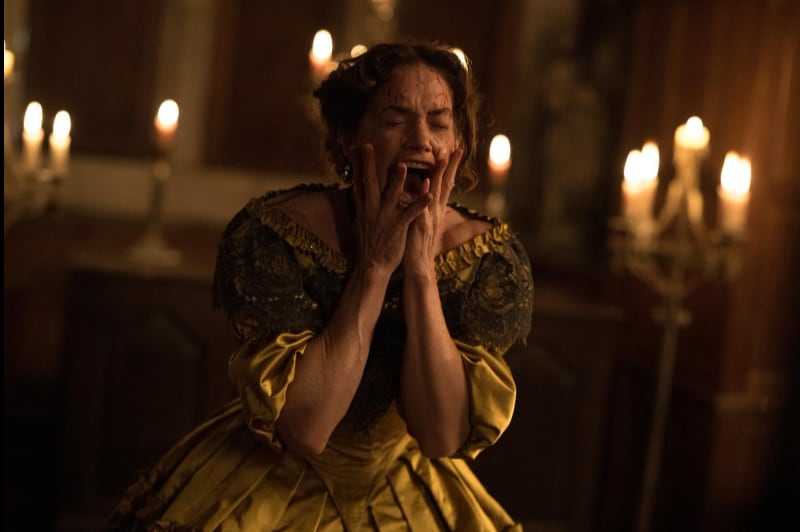
Ruth Wilson in Victorian Psycho
Bleeker Street
As Winifred acclimates herself to her surroundings, Victorian Psycho drops hints about her backstory (such as comments about missing children in her hometown) with a playfulness that’s anything but coy. Wigon casts Winifred as a maniac from the get-go, and then patiently reveals the extent of her mania.
That doesn’t take long, since during her maiden class with Andrew and Drusilla, she escorts the duo on a stroll in the woods, which brings them to an injured deer. Winifred’s course of action with regard to this animal proves she has a few screws loose, and that goes double for her response to a gardener’s attempt to blackmail her with the truth about her past—leading to a scene with the misty, shadowy beauty of Bava’s Black Sunday.
With severe cheekbones that contrast perfectly with her haunted, bonkers eyes (one of the film’s recurring visual motifs), Monroe is magnificent as Winifred, lacing every word with off-kilter psychosis and not-so-subtle menace that renders her both humorous and horrifying. No stranger to such grisly material following It Follows, Watcher, and Longlegs, the actress does unhinged expertly. The further her performance treads into demonic territory—complete with deranged internal mutterings and chats with figures who don’t appear to be real—the funnier and more engrossing it becomes.
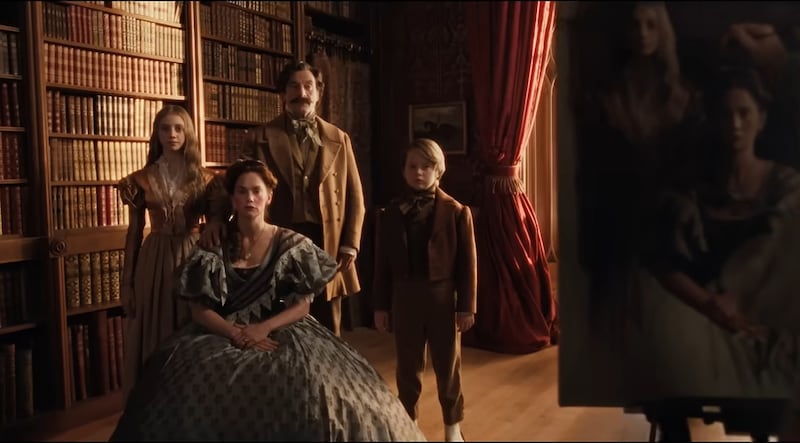
Evie Templeton , Jason Isaacs, Jacobi Jupe and Ruth Wilson in Victorian Psycho
Bleeker Street
Sporting a ridiculously large mustache and oozing inappropriate sexual longing, Isaacs embodies Mr. Pounds as a typically repulsive chauvinist (complete with a staunch belief in the pseudo-science of Phrenology). Wilson matches him in the repugnance department as Mrs. Pounds, an imperious lady of the house who seems to have her nose perpetually up in the air. In comparison, Jupe and Templeton never quite come into total focus as the couple’s spoiled brood. Even so, the latter gets a couple of standout late moments that speak to the misogynistic rot at the core of the Victorian age.
Victorian Psycho is rooted in the prejudice and classicism of its milieu, yet it gracefully avoids didacticism. From loopy start to gruesome finish, the filmmaker and his accomplished cast and crew are on the same demented page, taking great pleasure in artfully reimagining the era as a hotbed of abandonment, malice, selfishness, and the ugliness that arises in response.
Wigon’s direction is central to this, creating unease via protracted shots that glide between figures’ points of view, and comedy through unexpected bursts of violence, some of which eventually involve Ms. Lamb (Thomasin McKenzie), the naïve nursemaid who, after hearing Winifred’s tall tales about ghouls in the surrounding area, warms to the governess’ wacko-feminist attitude.
Victorian Psycho makes no bones about where it’s headed, and its relatively transparent trajectory saps it of some surprise. Thanks to Monroe’s excellent turn and Wigon’s stellar stewardship, however, the film is a delight right up to a sharp conclusion which underlines that sexism breeds a malevolent darkness that can’t be contained—and, scarier still, is contagious.
Obsessed with pop culture and entertainment? Follow us on Substack and YouTube for even more coverage.

Got a tip? Send it to The Daily Beast here.
Register below to read this article for free or subscribe
to unlock unlimited access to The Daily Beast.
Monthly
$1
First month then $5.99/month
Annual
$35
First year then $59.99/year
Premium
$79
First year then $119.99/year
*Substack access provided by the next business day, using your subscription email. Choosing the Premium plan constitutes your permission to share your subscription email with Substack and your agreement to Substack’s Privacy Policy.
Already have an account? Sign In
Looks like you already have a subscription!
- Account (completed)
- Payment (completed)
- Confirmation (completed)
You're all set!
Thanks for subscribing.
- 1Account
- 2Payment
- 3Confirmation
Sign in or create an account
Login dialog
Loading comments…