Our Heroes Suffer Hell From Above in Trump’s War of Choice
Drone blasts risk leaving hundreds of troops with life-altering brain injuries—just as the White House guts funding for treatment.
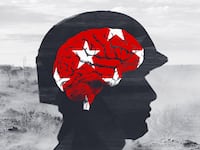
Photo Illustration by Victoria Sunday/The Daily Beast/Getty Images
Get The Swamp newsletter delivered straight to your inbox
By clicking “SIGN UP” you agree to our Terms of Use and Privacy Policy.
What is proving to be the signature wound of the Iran conflict appears 171 times in the official listing of 427 U.S. service members injured between Feb. 26 and May 19.
“Head Trauma.”
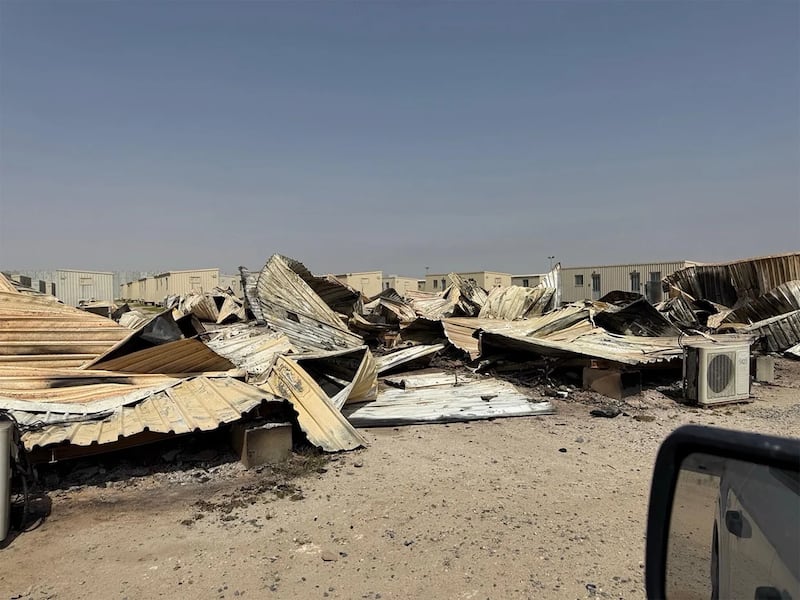
Trailers destroyed by Iranian strike, Camp Buehring, Kuwait.
U.S. military service members
That translates to nearly half the casualties on the list, which the news site War Horse obtained in July through a Freedom of Information Request. It reveals that 40 soldiers suffered head trauma, along with the six who were killed by a one-way Iranian attack drone on March 1 in Port Shuaiba, Kuwait.
A full, detailed accounting of particular injuries suffered in the conflict is not publicly available. But the Pentagon officially put the total number of wounded at 865 as of October. Military officials have told the Associated Press that a majority of them suffered head trauma. If a National Institutes of Health (NIH) study of post 9/11 veterans is any indication, a significant number will have suffered a brain injury.

The aftermath of an Iranian strike on Camp Buehring, Kuwait, in an undated photo.
Leaked
The Invisible Wounds Foundation notes that there is currently no medical device that can accurately diagnose Traumatic Brain Injury (TBI). Wounded warriors with significant TBI can be told their imaging tests - including CT scans and MRIs - came back normal.
The foundation commissioned a 2025 RAND Corporation survey of military TBI studies and reported that “while many TBIs go undiagnosed or are mild, they often co-occur with such conditions as post-traumatic stress disorder and depression and lead to significant long-term health impacts.”
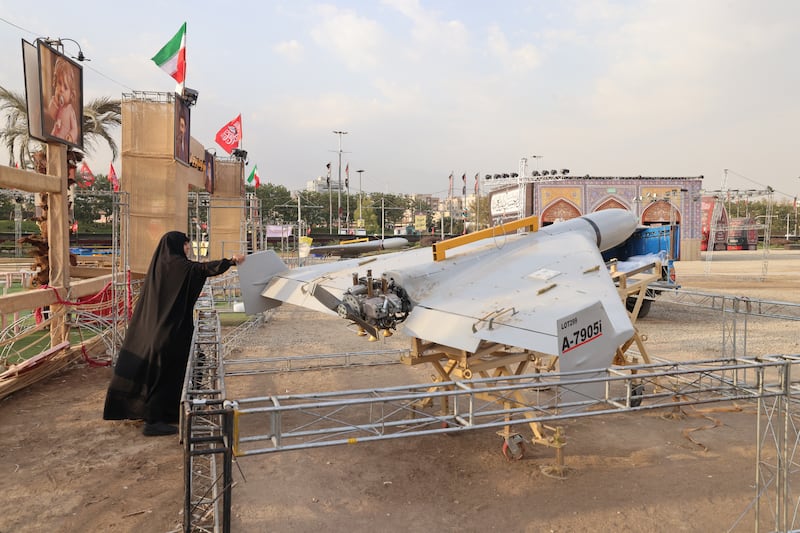
An Iranian-made drone is displayed at Azadi Square in Tehran.
ATTA KENARE/AFP via Getty Images
A National Suicide Prevention Report found that, in 2023, the rate among veterans with TBIs was 94.3 percent higher than among those without.
Despite all that is all known about the insidious effects of TBIs, the supposed patriots of the Trump administration and Congress have perpetrated drastic cuts to research and treatment.

Smoke rises from a reported Iranian strike in the area where the U.S. Embassy is located in Kuwait City on March 2, 2026, a day after another Iranian strike killed six U.S. service members in Kuwait.
AFP via Getty Images
In 2025, there was a 77 percent cut to the TBI and Psych health program under the Department of Defense’s Congressionally Directed Medical Research Programs (CDMRP). The funding has not been restored in this year’s House of Representatives appropriations bill, even though Trump’s war is resulting in hundreds of U.S. service members suffering head trauma. The word for that is betrayal.
Secretary of War Pete Hegseth spoke to news cameras on the fourth day of the war, acting as if the Iranians were no greater threat than mosquitoes at a picnic and boasting that the U.S. had “uncontested airspace.”
“This was never meant to be a fair fight. And it is not a fair fight. We are punching them while they’re down, which is exactly how it should be,” he told the press in March.

Dr. James Kelly, chief medical scientist of the Invisible Wounds Foundation, is reluctant to speculate what proportion of those suffering head wounds during the continuing conflict have a traumatic brain injury (TBI). But he studied and treated TBIs among the wounded from Afghanistan and Iraq as the founding director of the National Intrepid Center of Excellence at the Walter Reed National Military Medical Center. And he can describe in vivid detail what happens when people are hit by a blast wave, which often makes them feel squeezed.
“The wave itself actually crushes, squeezes everything about us that’s soft,” Kelly told the Daily Beast on Thursday. “And so, as a result, they feel like their breath is knocked out, and, like, a punch in the gut kind of thing. But also, when that happens to us, there’s a pulse of blood that goes up into the head. This pulse of blood has been shown for years now, decades ago, in animal studies, to also injure the brain.”
“So, not only is the waveform hitting the skull, coming through the ears, and probably through the eye sockets, and directly reverberating through skull into the brain, but also there’s a pulse that comes up from below, from the neck,” he continued.
He concluded: “It’s a very complicated kind of injury.”

Dr. James Kelly is a leading expert in traumatic brain injuries.
Devin Sena/Courtey of Dr. James Kelly
The TBI center at Walter Reed, where Kelly was founding director, is still operating, and he understands it has begun to handle service members from the list of 427 suffering head injuries from above in Trump’s war of choice.
Such wounds were all too common from the IEDs of the forever wars, where 500,000 U.S. service members were diagnosed with TBI. President Trump promised to be the peace president, but went ahead and started the current conflict in Iran, figuring it would be an easy win. Kelly figures that the individual injuries in this one may be even worse because the enemy’s weapons are airborne.
“Logically, as you can figure out anatomically, the head is more exposed,” he said. “It’s more vulnerable under those circumstances. And so, instead of somebody stepping on a landmine, or some trip wire…and things like their legs are damaged or lost, that is less so the case, because things are coming through the roof…And not uncommonly there’s not much protection there.”

Protection for another era, L-shaped concrete barriers and a tin roof before the Iranian drone strike at the Shuaiba port base in July 2021.
Staff Sgt. David Simon/U.S. Army
He suggested that protective L-shaped concrete barriers, such as those set outside buildings to guard against car bombs, may well magnify the effect of explosives delivered from on high.
“That’s inside walls, containment walls, echo and reverberate…in various kinds of complex waveforms,” He said. “If it’s outside, it just goes in all directions away from the center of the blast. If it’s inside, it keeps bouncing around and doesn’t just dissipate as easily. We know that.”

Trump and Hegseth's handling of their war of choice in Iran has come under incessant criticism.
Andrew Harnik/Pool via Reuters
As a result of the work by Kelly and other physicians and scientists, we have made considerable progress in understanding and treating TBIs. The effects can resolve spontaneously, but they can also persist for months or even years.
“Those are the people we’re taking care of: that have lingering symptoms. Then you have to figure out some way of not only treating the symptoms and helping them feel better and function better, if not [at] the same level of demand and time constraints.”

The TBI wound may be invisible even to the one who is wounded.
“That’s where the wheels come off,” Kelly said. “It’s maddening and scary. A lot of times, people are saying, ‘I think, I’m losing my mind.’ And they think it’s a psychiatric problem of some kind, and it’s not. It’s neurological.”
“The brain is the organ of the mind,” he noted. “And so it’s all mixed together. It often looks very much like a stress reaction that sometimes is mixed with a stress reaction.”

The National Intrepid Center of Excellence in Bethesda, Maryland, was opened in 2010.
The Washington Post/The Washington Post via Getty Im
Trump and Hegseth seek to minimize the 32 dead by comparing the toll to other wars and do not mention the wounded at all. They are unlikely to pay much attention to a warning from Shannon Connell, CEO of the Invisible Wound Foundation.
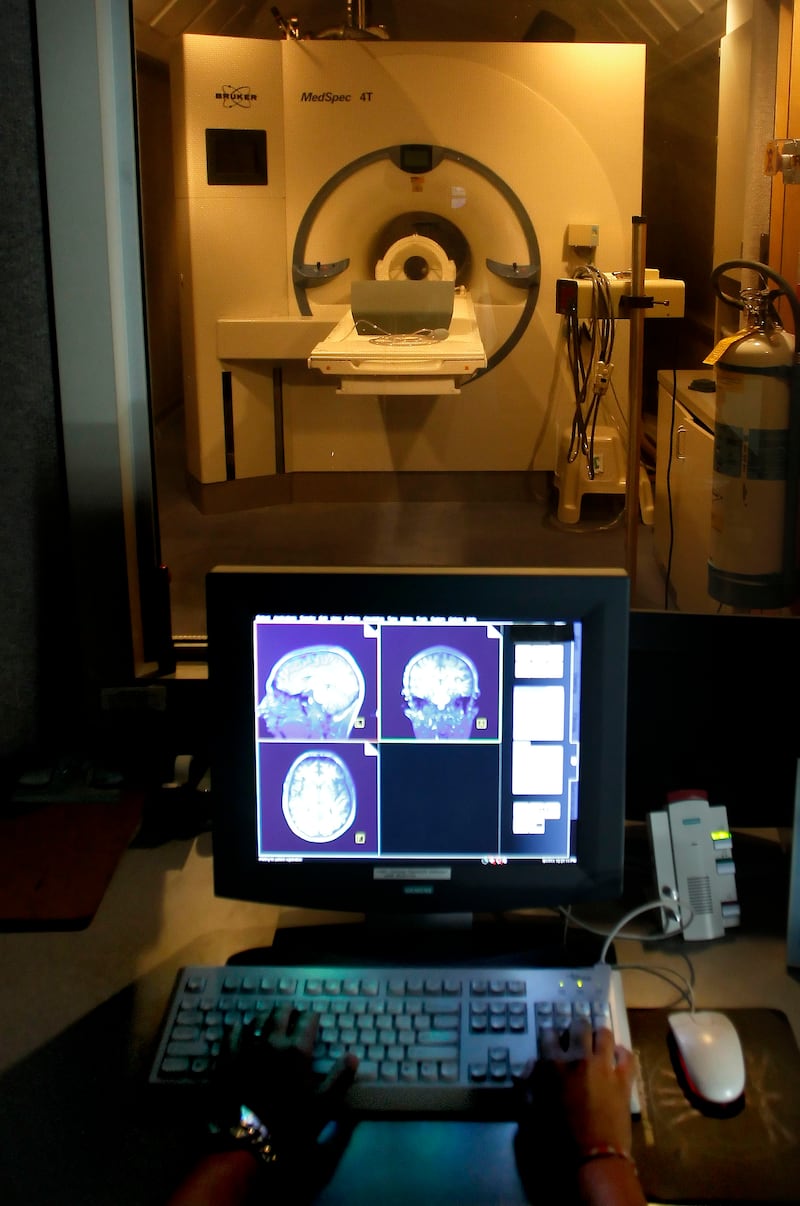
Research Associate Joseph Brewer displays brain scans from one of the most advanced MRI machines in the Veterans Administration system.
San Francisco Chronicle/Hearst N/San Francisco Chronicle via Gett
“The seriousness and urgency of military TBI cannot be understated,” Connell said. “The cuts in program funding for traumatic brain injuries essentially shuts down the pipeline of research needed to understand the underlying cause of these injuries.”
She added, “Until effective diagnostics and treatments can be developed, our warfighters, veterans, and their families will continue to struggle and suffer.”
See more of our coverage in your search results.

Got a tip? Send it to The Daily Beast here.
Unlock a year of full access to The Daily Beast for $35.
Monthly
$1
First month then $5.99/month
Annual
$35
First year then $59.99/year
Premium
$79
First year then $119.99/year
*Substack access provided by the next business day, using your subscription email. Choosing the Premium plan constitutes your permission to share your subscription email with Substack and your agreement to Substack’s Privacy Policy.
Looks like you already have a subscription!
- Account (completed)
- Payment (completed)
- Confirmation (completed)
You're all set!
Thanks for subscribing.
- 1Account
- 2Payment
- 3Confirmation
Sign in or create an account
Register below to read this article for free or subscribe
to unlock unlimited access to The Daily Beast.
Monthly
$1
First month then $5.99/month
Annual
$35
First year then $59.99/year
Premium
$79
First year then $119.99/year
*Substack access provided by the next business day, using your subscription email. Choosing the Premium plan constitutes your permission to share your subscription email with Substack and your agreement to Substack’s Privacy Policy.
Already have an account? Sign In
Looks like you already have a subscription!
- Account (completed)
- Payment (completed)
- Confirmation (completed)
You're all set!
Thanks for subscribing.
- 1Account
- 2Payment
- 3Confirmation
Sign in or create an account
Login dialog
Loading comments…