Pluto’s Ancient Ice Volcanoes Might Tease the Possibility of Alien Life
New findings show Pluto could be hotter than we once thought.
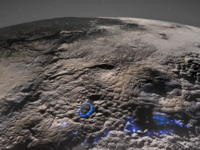
NASA/Johns Hopkins University Applied Physics Laboratory/Southwest Research Institute/Isaac Herrera/Kelsi Singer
We best know volcanoes to be volatile mountains that spew hot lava and gas, but this isn’t entirely the case elsewhere in the universe. Sometimes they are icy, prone to ejecting into the air a mixture of water, ammonia, methane, and chlorinated chemical compounds out into their below-freezing surroundings, topped off with icy versions of these compounds. In a new study published on Tuesday in the journal Nature Communications, an international group of astronomers discovered the beloved (former) ninth planet from the sun has ice volcanoes that may have been more recently active than initially believed. It’s not just a fun geological discovery that sheds more light on the faraway dwarf planet’s internal temperatures. The new findings may even open the door to us finding evidence of distant alien life.
Scientists have known about Pluto’s ice volcanoes, or cryovolcanoes, since 2015. And Pluto is far from the only body in our solar system to boast such phenomena: They’ve also been found on Saturn’s moon Titan, Jupiter’s moon Europa, and fellow dwarf planet Ceres (the largest rock in the asteroid belt).
Since ice volcanoes need a sustainable internal heat source to keep things flowing, it was never entirely clear how much heat the deathly cold Pluto was once packing and whether this activity was still occuring. In the new study, astronomers analyzed images from NASA’s probe New Horizons, which launched in 2006 and arrived at Pluto in 2015. They noticed an ice-covered basin called Sputnik Planitia, where there appeared to be relatively recent ice volcano activity with volcanic domes jutting out as far as four miles high and anywhere from six to nearly 100 miles in diameter.
“The existence of these massive structures suggests Pluto’s interior structure and evolution allows for either enhanced retention of heat or more heat overall than was anticipated before,” the researchers wrote in their paper, adding this finding might help astronomers better understand how the faraway dwarf planet has stored and generated heat throughout its lifetime.
Studies on Pluto’s ice volcanoes are still ongoing, but they may lead us down some interesting paths, like whether the dwarf planet’s frozen water and ammonia may contain or encourage alien life. If so, it could be a remarkable discovery for us and a tantalizing possibility for galactic neighbors, whether big or small, on distant, icy planets.
See more of our coverage in your search results.

Got a tip? Send it to The Daily Beast here.
Register below to read this article for free or subscribe
to unlock unlimited access to The Daily Beast.
Monthly
$1
First month then $5.99/month
Annual
$35
First year then $59.99/year
Premium
$79
First year then $119.99/year
*Substack access provided by the next business day, using your subscription email. Choosing the Premium plan constitutes your permission to share your subscription email with Substack and your agreement to Substack’s Privacy Policy.
Already have an account? Sign In
Looks like you already have a subscription!
You're all set!
Thanks for subscribing.