Strong and Stronger
Get the Beast Digest newsletter delivered straight to your inbox
By clicking “SIGN UP” you agree to our Terms of Use and Privacy Policy.
At a recent informal meeting with Jewish Americans at the White House, President Barack Obama apparently expressed concerns about “domestic political constraints” holding back Palestinian President Mahmoud Abbas on the peace process with Israel. This has led a number of observers, including Peter Beinart, to conclude that Abbas is politically "weak," or at least that Obama thinks so.
But this misreads the political realities in the West Bank. In fact, Abbas is in a very strong political situation domestically. Indeed, Abbas’s strength, like that of his Israeli counterpart, Prime Minister Benjamin Netanyahu, is just the problem: without outside prodding, neither has a real political imperative to deal with the other.
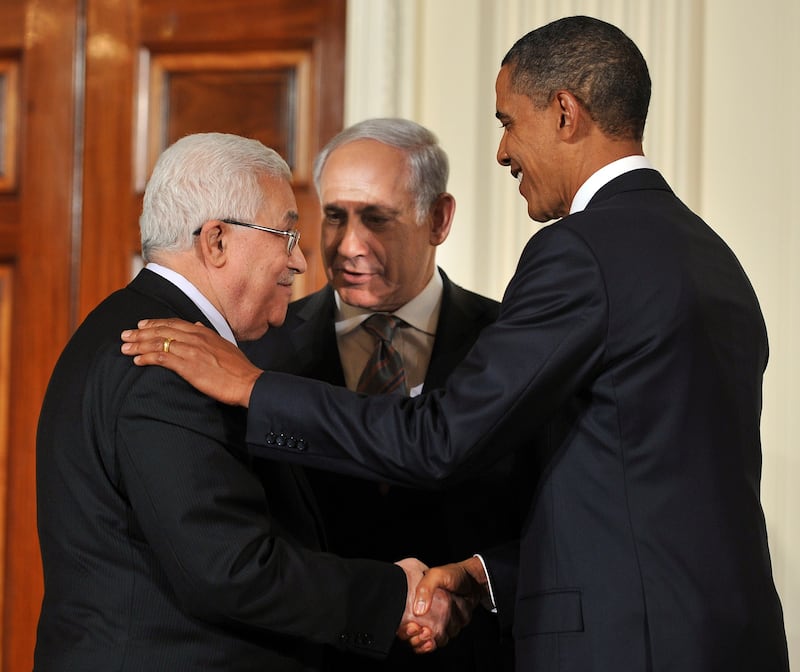
To be sure, Abbas’s power is not totally unfettered. His office recently overreached by shutting down several websites, some of them owned by a discredited rival. The uproar within Palestinian society, and indeed within the Palestinian Authority and Palestine Liberation Organization, forced a reversal of the censorship. But Abbas has been systematically removing, discrediting or fending off all potential rivals, and he has no clear successor.
True, Palestinians are increasingly fed up with their situation, most significantly with the occupation. And they're clearly dissatisfied with both Fatah and Hamas. But a recent poll showed that if an election were held today, Fatah would most likely crush Hamas. This is less a matter of Fatah's popularity than an index of Hamas's profound unpopularity outside of its base. So in spite of general dissatisfaction, popular challenges to Abbas are also well under control. The alternatives are either obviously less palatable or hard to identify.
Like Netanyahu, Abbas finds faces no strong political challengers. But the political strengths of both are a product of, and dependent on, the status quo. The national interests of Israelis and Palestinians clearly demand bold moves on peace, but there isn't much political incentive for either leader to take such measures.
Palestinian options are significantly limited: Israel, as the occupying power, holds almost all the cards. But it would be unrealistic not to acknowledge that Abbas's policies have contributed to the present impasse. All three major players—Israel, the United States and the Palestinians— have either made mistakes in recent years. Abbas has not managed his relationship with the United States well. And he repeatedly miscalculated the balance between domestic political considerations and Palestinian diplomatic imperatives, at times with avoidable negative consequences on both.
Netanyahu's allies frequently cited the “domestic political constraints” of his previous coalition as a major reason why he could not take major diplomatic initiatives. Plainly that no longer applies, at least in the way it used to, to his new gigantic coalition. Unfortunately, there is no evidence so far that Netanyahu's thinking has changed meaningfully regarding peace. He insists he wants an agreement, and indeed he might, but anyone who doesn't harbor doubts about his sincerity on this issue is profoundly naïve. The explosion of settlement activity, initiated by his former coalition in its final months, is continuing at full speed.
For at least the next fifteen months, Netanyahu can no longer cite a fragile coalition as an excuse for inaction. Of course he still faces considerable “domestic political constraints” for any serious move towards peace. But there is no question Netanyahu has much greater wiggle-room now than he had with his previous coalition. We will know much more about his broader intentions in a year or so.
The Israelis and the Palestinians are at such an impasse and degree of polarization that, left on their own, it will be extremely difficult for them to break out of the status quo. They would greatly benefit from outside help to find a diplomatic initiative that is also politically tolerable.
The United States is the only candidate to play that role, but at the moment our national leadership is otherwise occupied. Interestingly, of the three key leaders, it might be Obama who is facing the greatest “domestic political constraints” on bold action. Running for reelection, he faces a lousy economy and a Republican challenger who will probably outspend him by at least 30 percent. So the administration is understandably risk averse on foreign policy.
Neither the Israeli nor the Palestinian leadership can convincingly cite profound domestic political weakness or vulnerability to explain policies that are counterproductive, ineffective, or downright dangerous (such as Israel's settlement expansions). They can wait for the United States to finish its election, and hope for the best after that, or they can use their real domestic political power to adopt their own more constructive policies.
See more of our coverage in your search results.

Got a tip? Send it to The Daily Beast here.
Unlock a year of full access to The Daily Beast for $35.
Monthly
$1
First month then $5.99/month
Annual
$35
First year then $59.99/year
Premium
$79
First year then $119.99/year
*Substack access provided by the next business day, using your subscription email. Choosing the Premium plan constitutes your permission to share your subscription email with Substack and your agreement to Substack’s Privacy Policy.
Looks like you already have a subscription!
- Account (completed)
- Payment (completed)
- Confirmation (completed)
You're all set!
Thanks for subscribing.
- 1Account
- 2Payment
- 3Confirmation
Sign in or create an account
Register below to read this article for free or subscribe
to unlock unlimited access to The Daily Beast.
Monthly
$1
First month then $5.99/month
Annual
$35
First year then $59.99/year
Premium
$79
First year then $119.99/year
*Substack access provided by the next business day, using your subscription email. Choosing the Premium plan constitutes your permission to share your subscription email with Substack and your agreement to Substack’s Privacy Policy.
Already have an account? Sign In
Looks like you already have a subscription!
- Account (completed)
- Payment (completed)
- Confirmation (completed)
You're all set!
Thanks for subscribing.
- 1Account
- 2Payment
- 3Confirmation