The Rise of China’s First Families
China’s princelings are likely to emerge as the winners of the country’s political transition.

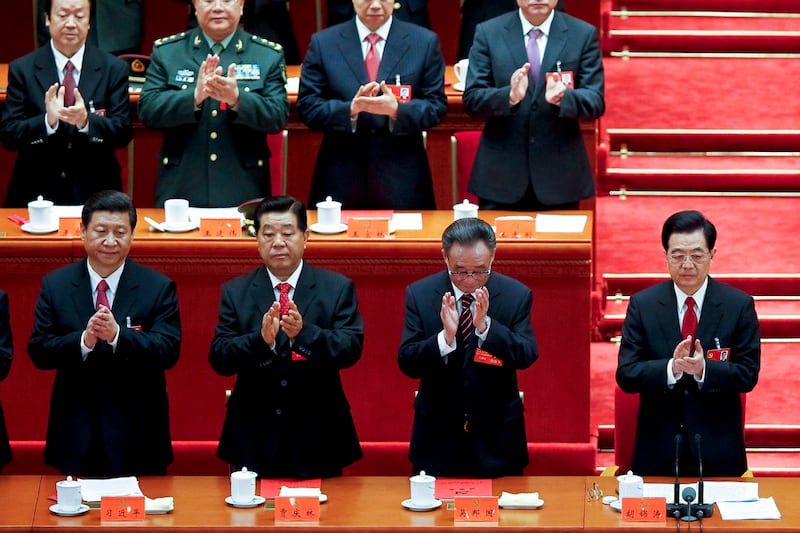
Diego Azubel, EPA / Landov
Though China’s 18th Party Congress, which launched the country’s once-in-a-decade political transition, ended on Wednesday, party leaders have still offered few details about who will become part of the nation’s new top leadership team. Yet one trend that appears to have emerged in the succession process, which began last week, is the growing influence of China’s so-called princelings—the relatives of party veterans who participated in the country’s communist takeover and early rule.
Zhang Lifan, an analyst formerly with the Chinese Academy of Social Sciences in Beijing, said this will likely mark the first time the top leadership will be dominated by what’s known as China’s red second generation: “[Princelings] will have both economic and political power in their hands,” he said.
What the new leadership will do with this power—and how it will impact the country’s political and economic landscape—remains a major question mark. But the princelings’ expected rise will likely highlight how many of China’s first families have powerful vested interests, having used their status to develop elaborate personal networks, which play a major role in government and business.
“The princelings have won,” said David Zweig, a Sinologist at the Hong Kong University of Science and Technology. “Now the question is whether the families of senior leaders, and their business interests, are going to be a block to reform.”
At least rhetorically, China’s leaders have agreed that both economic and political change will be crucial to keeping the world’s second-largest economy on track. But what those reforms will consist of remains unclear. The biggest concern appears to be the gap between rich and poor, which over the past decade has grown to alarming proportions.
Princeling status isn’t always synonymous with politics that favor China’s wealthy elite. Nor does it predict whether an official is conservative or liberal. Still, individual princelings tend to be well educated and well-to-do. Their experiences tend to be a far cry from those of rural-born, blue-collar Chinese whose families often can’t afford quality education or health care.
Get the best of The Beast delivered right to your inbox
By clicking “SUBSCRIBE” you agree to our Terms of Use and Privacy Policy.
The exact composition of China’s new leadership team, known as the Politburo Standing Committee, won’t be announced until Thursday. But the number of seats on the committee is widely expected to shrink from nine to seven, and Vice President Xi Jinping—a prominent princeling and the son of a former Politburo member—will almost certainly take over as party chief, succeeding President Hu Jintao. Another likely development is that Li Keqiang, a Hu protégé who is not a princeling, appears set to become China’s new premier next March when government jobs, as opposed to party posts, are reshuffled.
The shortlist to fill the other slots on the standing committee contains several notable princelings. One is Wang Qishan, son-in-law of a former vice premier, who has earned plaudits for his economic expertise, and who is known by many as the “chief of the fire brigade” for his ability to keep cool during times of crisis. Then there’s Zhang Dejiang, the son of an Army general, who replaced the disgraced Bo Xilai as party boss of Chongqing. Another princeling who could get the nod is Yu Zhengsheng, whose father, a former Tianjin party boss, was the ex-husband of Jiang Qing, who later married Chairman Mao Zedong.
Even if only half of these princelings make it to the Politburo Standing Committee, their presence in this all-powerful decision-making group will increase considerably. The coming transition also appears to be a sign of the waning power of President Hu. Earlier this year, Li Yuanchao, an ally of Hu, was thought to be a shoo-in for the standing committee, before reportedly losing out to last-minute horse-trading, which took place behind closed doors. Another Hu protégé, Ling Jihua, saw his career put on hold after he allegedly tried to cover up the fact that his son and two partially naked young women were involved in a fiery Ferrari crash in Beijing.
In the wake of such setbacks, it’s still not clear whether Hu will attempt to prolong his remaining political influence by retaining the chairmanship of the party’s powerful Central Military Commission as his predecessor did before him. But many Chinese believe Hu can no longer stomach all the political infighting. “On television, Hu seems annoyed with his job now. You can see it in his face,” said Li Datong, former editor of the Chinese political magazine, Freezing Point. “The only thing Hu wants to do now is to step down peacefully.”
Once Hu does step down, the triumph of the princelings will be nearly complete. Then comes the hard part: governing China.
See more of our coverage in your search results.

Got a tip? Send it to The Daily Beast here.
Register below to read this article for free or subscribe
to unlock unlimited access to The Daily Beast.
Monthly
$1
First month then $5.99/month
Annual
$35
First year then $59.99/year
Premium
$79
First year then $119.99/year
*Substack access provided by the next business day, using your subscription email. Choosing the Premium plan constitutes your permission to share your subscription email with Substack and your agreement to Substack’s Privacy Policy.
Already have an account? Sign In
Looks like you already have a subscription!
You're all set!
Thanks for subscribing.