The Sun Is Pummeling Earth. Now What? Solar Storms for Dummies
Good news: Maybe some amazing Northern Lights. Bad news: Don’t depend on GPS. Or electricity. Why explosions on the sun might mess up your weekend.
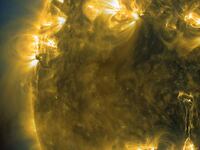
NASA
Get the Beast Digest newsletter delivered straight to your inbox
By clicking “SIGN UP” you agree to our Terms of Use and Privacy Policy.
Two powerful solar storms pummeling Earth have ignited a social-media frenzy over coronal mass ejections, light sabers in the sky, and Armageddon. What’s happening in outer space and how will it affect us Earthlings? Here’s a quick explainer.
What exactly is hitting Earth right now?
A coronal mass ejection, or a CME in astronomy parlance. It’s a gigantic eruption from the sun and at the moment it’s hurtling toward Earth at up to 621 miles per second. This fiery plasma eruption sends a cloud of energized electrons, protons, and other particles into space, and occasionally toward Earth. When that energy gets trapped in Earth’s magnetic field, it causes magnetic storms, which look ethereal but can have a disastrous effect on our planet, frying power grids and disrupting radio and GPS transmissions.
What’s the difference between a CME and a solar flare?
Both are the result of magnetic activity on the sun, but a solar flare has more energy than a CME. The CMEs now roiling the Earth’s magnetic field were unleashed by two solar flares that exploded from the sun’s surface on Monday and Wednesday.
Isn’t there supposed to be some sort of light show?
When CMEs reach Earth, their attendant charged particles excite gases in the upper atmosphere, amplifying the aurora borealis, aka the Northern Lights. The result looks like curtains of red and green beams in the night sky. While they’re usually only visible in far Northern Hemisphere, they may be seen as far south as Pennsylvania on Friday and Saturday nights.
What kind of damage should we expect? Can we still count on Google Maps?
In the wake of the first CME, which hit Earth on Thursday night, space weather forecasters at the National Oceanic and Atmospheric Administration predicted a G2, or moderate, storm on Friday afternoon. But now a G3, or strong, storm watch is in effect for Saturday, a result of the combined energy from the first and second CMEs. The second is scheduled to pummel Earth this afternoon.
While it’s rare for two CMEs to hit Earth around the same time, these ones won’t wreak much havoc on Earth, scientists say.
“G2-G3 geomagnetic storms can cause some problems for the [power] grid but are typically very manageable,” said Bill Murtagh, space weather forecaster for the NOAA. “We may also see some anomalies with satellites, so satellite operators around the world have been notified. And problems with the accuracy of GPS have been observed with this level of storming.”
So there’s no reason to worry about future solar storms?
A gigantic solar storm could fry power grids, knocking out electricity for months. The largest one on record occurred in 1859, amplifying the Northern Lights as far south as Cuba and sizzling telegraph lines around the world. In July 2012, NASA reported that a solar storm of similar magnitude (two large CMEs) had missed the Earth by a week, blasting one of their observational spacecrafts instead.
See more of our coverage in your search results.

Got a tip? Send it to The Daily Beast here.
Unlock a year of full access to The Daily Beast for $35.
Monthly
$1
First month then $5.99/month
Annual
$35
First year then $59.99/year
Premium
$79
First year then $119.99/year
*Substack access provided by the next business day, using your subscription email. Choosing the Premium plan constitutes your permission to share your subscription email with Substack and your agreement to Substack’s Privacy Policy.
Looks like you already have a subscription!
- Account (completed)
- Payment (completed)
- Confirmation (completed)
You're all set!
Thanks for subscribing.
- 1Account
- 2Payment
- 3Confirmation
Sign in or create an account
Register below to read this article for free or subscribe
to unlock unlimited access to The Daily Beast.
Monthly
$1
First month then $5.99/month
Annual
$35
First year then $59.99/year
Premium
$79
First year then $119.99/year
*Substack access provided by the next business day, using your subscription email. Choosing the Premium plan constitutes your permission to share your subscription email with Substack and your agreement to Substack’s Privacy Policy.
Already have an account? Sign In
Looks like you already have a subscription!
- Account (completed)
- Payment (completed)
- Confirmation (completed)
You're all set!
Thanks for subscribing.
- 1Account
- 2Payment
- 3Confirmation