Time to Sell the Family Jewels, Detroit
Saddled with billions in debt, there's no good reason the city shouldn't sell its art collection worth as much as $866 million.

Joshua Lott/Reuters
Get the Cheat Sheet newsletter delivered straight to your inbox
By clicking “SIGN UP” you agree to our Terms of Use and Privacy Policy.
If you really want to make jaws drop in polite conversation, don’t waste your time suggesting that bankrupt Detroit merely stiff its pensioners and creditors harder than John Holmes did his costars in 1976’s Tell Them Johnny Wadd Is Here. Instead, suggest that the city unload its little-seen yet high-valued art collection hiding in plain sight at The Detroit Institute of Arts (DIA).
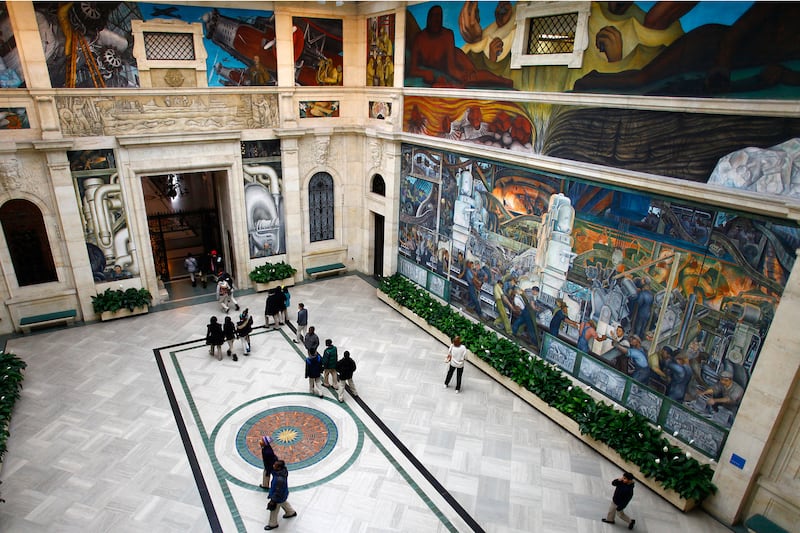
Don’t get me wrong: In its attempts to deal with an estimated $18 billion in debt, Motown will absolutely be giving out buzzcuts worthy of an Army barber to everyone who has ever drawn a paycheck from City Hall or was stupid enough to lend it money. But with a collection valued at somewhere between $452 million and $866 million, the DIA’s collection—featuring pieces by Picasso, van Gogh, Matisse, and other masters—should absolutely be on the market.
Critics of the idea consider such an option not only “delusional” but reminiscent of Stalinist art sell-offs during the 1930s. “Michiganders might remember that in the 1920s and ’30s, the cash-hungry Soviet government sold off Russia’s art treasures, dispersing them to other countries,” sniffs Judith H. Dobrzynski in The Wall Street Journal. “Today, that episode is viewed as a national tragedy.” That may well be true, but if so, it’s among the least objectionable crimes against humanity perpetrated by the USSR. After all, they didn’t destroy the art—they merely sent it to places where it could be appreciated without fear of execution.
Let’s get real: What sort of message would it send to current and future residents—not to mention current and future bondholders—if Detroit refuses to put everything on the table? You can’t eat the DIA’s “Still Life With Fruit, Vegatables, and Dead Game,” no matter how well-rendered, and for most of the past 80 years, the city has been subsidizing not just the day-to-day running of the museum but also its acquisitions. Such spendthrift priorities are one small reason why the burg is in such bad shape to begin with (and also why the city has relatively clear title to the artworks under consideration).
Building a future around a slogan like Detroit: Come for the Bankruptcy but Stay for the Bruegel is no way to resurrect a city whose population peaked back in 1950. As urban theorist Joel Kotkin has put it, “We get it wrong. We think the cultural amenities drives the prosperity [in cities], when it’s really the prosperity that drives the cultural amenities.” Artifacts from past periods of wealth—especially publicly funded museums, sports stadiums, orchestras, and the like—are luxury goods that never pay for themselves, either directly or indirectly. Detroit can rebuild its municipally owned art collection if and when it can afford to cover expenses related to activities beyond the core functions of government. Until then, let the bidding begin!
Indeed, the case for selling off the collection is arguably even stronger from an art lover’s perspective. If art exists to be seen, Detroit is a terrible location for any piece worth a damn. As Virginia Postrel has written, in fiscal 2012, the DIA drew just 498,000 visits, or “barely 1,000 more than it drew in 1928.” The numbers were up in fiscal 2013, which ended in June, partly because the DIA no longer charges an admission fee to residents of the surrounding area. (That’s because they are paying higher property taxes to fund the museum.)
Postrel notes that various galleries and museums in cities such as Dallas, Fort Worth, Houston, Los Angeles, Seattle, and elsewhere have seen huge booms in population and have recently ponied up millions of dollars to buy coveted works. Last year, she writes, the Getty Center in Los Angeles, which has shown interest in buying major pieces, pulled 1.2 million patrons “to a collection whose most impressive asset is the building in which it is housed.”
Selling off Detroit’s enviable art collection thus represents a truly rare win-win on public policy: The city will get much-needed cash that might help it reboot itself, and museums in places that are thriving will be able to add to their offerings. Nobody in their right mind would think of denying Motown residents the right to flee the city in search of a brighter future. It shouldn’t really be any different for works by Rodin, Bernini, or Whistler.
See more of our coverage in your search results.

Got a tip? Send it to The Daily Beast here.
Unlock a year of full access to The Daily Beast for $35.
Monthly
$1
First month then $5.99/month
Annual
$35
First year then $59.99/year
Premium
$79
First year then $119.99/year
*Substack access provided by the next business day, using your subscription email. Choosing the Premium plan constitutes your permission to share your subscription email with Substack and your agreement to Substack’s Privacy Policy.
Looks like you already have a subscription!
- Account (completed)
- Payment (completed)
- Confirmation (completed)
You're all set!
Thanks for subscribing.
- 1Account
- 2Payment
- 3Confirmation
Sign in or create an account
Register below to read this article for free or subscribe
to unlock unlimited access to The Daily Beast.
Monthly
$1
First month then $5.99/month
Annual
$35
First year then $59.99/year
Premium
$79
First year then $119.99/year
*Substack access provided by the next business day, using your subscription email. Choosing the Premium plan constitutes your permission to share your subscription email with Substack and your agreement to Substack’s Privacy Policy.
Already have an account? Sign In
Looks like you already have a subscription!
- Account (completed)
- Payment (completed)
- Confirmation (completed)
You're all set!
Thanks for subscribing.
- 1Account
- 2Payment
- 3Confirmation