Trump’s Own Lawyers Contradict His Kennedy Center Threat
The Board of Trustees voted to immediately close the main complex on Tuesday, September 15.

Carlos Barria/REUTERS
President Donald Trump’s own lawyers have undercut his threats over the Kennedy Center’s future.
The president, 80, is hell-bent on getting his name put back onto the building’s facade, after a judge ordered that it should be removed in June. Trump, however, didn’t give up after the embarrassing legal loss and has instead threatened the performing arts institution’s future, saying that it could be “ripped down” if his name isn’t restored.

“For the Trump administration, for me, to get involved, and to take on long-term, and to carry it, or to raise money to carry it, I think that the Trump administration should certainly have recognition,” the president said last week, days after his hand-picked board voted to close the venue during $250 million renovations.
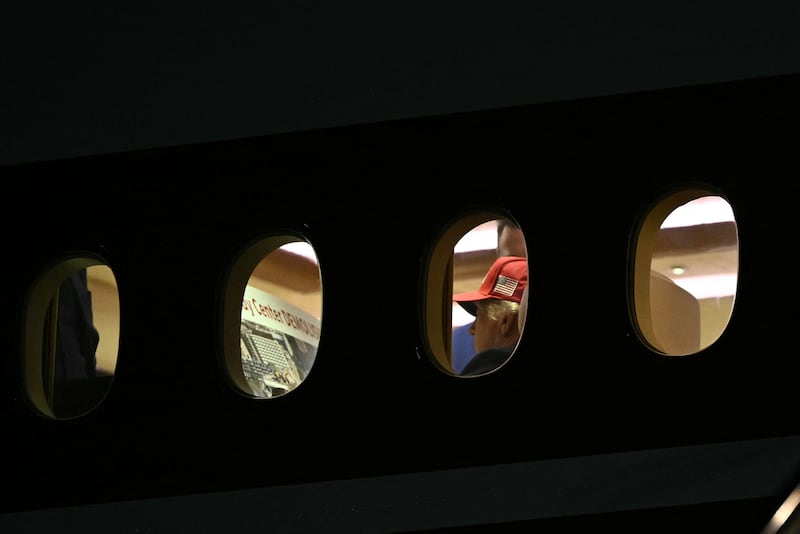
Donald Trump appears to be examining plans to “demolish” the Kennedy Center in this photo taken through the windows of Air Force One last week.
BRENDAN SMIALOWSKI/AFP via Getty Images
The closed-door virtual vote occurred just hours after U.S. District Judge Christopher Cooper blocked the board from adding President Trump’s name back onto the building’s facade.
“Because frankly, if we don’t do that, it’s going to close; it will end up being ripped down,” he threatened.
Sign Up for The Swamp Newsletter
By clicking “SUBSCRIBE” you agree to our Terms of Use and Privacy Policy.
But a new status report filed by the Justice Department in federal court offers a different explanation for the center’s immediate closure, pointing to a string of safety concerns rather than the demolition threat Trump has publicly floated, according to the Washington Sun.
In the report, Kennedy Center Executive Director Matt Floca said the building has several serious safety problems, including ceiling panels that could fall, water getting into electrical equipment, and potentially unsafe theater machinery. Tellingly, his declaration did not say the center needs to be demolished.

Floca added that the temporary closure of the center has been extended for another week because of the safety concerns.
This, according to the report, is “to protect employees, patrons, artists, contractors, and other members of the public while the Center evaluated documented falling-object hazards and other infrastructure conditions and determined what measures would be required for safe occupancy and emergency egress.”
The filing detailed damage and hazards following severe storms that battered D.C. earlier this month, including a large section of ceiling plaster that fell onto the Grand Foyer floor.

Workers prepare scaffolding ahead of removing Trump’s name from the facade of the center.
Jonathan Ernst/REUTERS
The report said the plaster weighed approximately 150 pounds and fell from approximately 60 feet to the floor “in a public thoroughfare.”
Former project managers previously complained that a rush to spruce up the Kennedy Center ahead of President Donald Trump’s FIFA Peace Prize ceremony led to shortcuts that ultimately backfired, leaving behind costly problems.
A September 22 inspection by WB Engineers+Consultants found water apparently getting into the Kennedy Center’s electrical transformer vault and coming into contact with the transformers, along with concrete fragments and other debris on top of the equipment.

The engineers warned that prolonged moisture exposure could cause corrosion, damage electrical insulation, and eventually lead to equipment failure. Staff also raised concerns about lighting supports and the counterweight systems used to operate equipment on the Opera House stage.
Floca, who served as the Kennedy Center’s facilities director before Trump named him executive director in March, stressed that the emergency shutdown was separate from the board’s broader plan to keep the center closed.
The White House has been approached for comment.
See more of our coverage in your search results.

Got a tip? Send it to The Daily Beast here.
Register below to read this article for free or subscribe
to unlock unlimited access to The Daily Beast.
Monthly
$1
First month then $5.99/month
Annual
$35
First year then $59.99/year
Premium
$79
First year then $119.99/year
*Substack access provided by the next business day, using your subscription email. Choosing the Premium plan constitutes your permission to share your subscription email with Substack and your agreement to Substack’s Privacy Policy.
Already have an account? Sign In
Looks like you already have a subscription!
- Account (completed)
- Payment (completed)
- Confirmation (completed)
You're all set!
Thanks for subscribing.
- 1Account
- 2Payment
- 3Confirmation
Sign in or create an account
Login dialog
Loading comments…