Astronomers Find First Ever Green Star
New research suggests that, if we looked at them up close, some stars would appear in shades of green, pink, cyan, yellow, and purple.
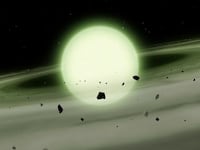
Mark A Garlick/University of Warwick
Astronomers found the universe’s first star that glows “ghostly green,” according to a new study. Most stars come in shades determined by their temperature—usually blue, white, and orange. White dwarves—the dense cores left behind when larger, Sun-like stars die—were widely assumed to follow the same rule. But new research from the University of Warwick suggests some may actually shine in hues of green, pink, cyan, yellow, and purple. “It turns out these incredibly dense stars can produce colors nobody expected, and some of them genuinely surprised me,” study co-author Mark Hollands said in a statement. The stars’ ultra-dense atmospheres and trace elements can interact to create a wider range of colors visible to humans. Because white dwarfs are too far from Earth to see with the naked eye, scientists calculated their color from their spectra, or “fingerprints” of light split by wavelength. Researchers ran the spectra through a human-vision model to predict how they would look up close.
Register below to read this article for free or subscribe
to unlock unlimited access to The Daily Beast.
Monthly
$1
First month then $5.99/month
Annual
$35
First year then $59.99/year
Premium
$79
First year then $119.99/year
*Substack access provided by the next business day, using your subscription email. Choosing the Premium plan constitutes your permission to share your subscription email with Substack and your agreement to Substack’s Privacy Policy.
Already have an account? Sign In
Looks like you already have a subscription!
You're all set!
Thanks for subscribing.