Former Shin Bet Chief Slams Benjamin Netanyahu, Ehud Barak Over Iran
Just ahead of the national election, a potentially game-changing revelation: security chiefs apparently didn’t trust the motives of the Israeli leaders.

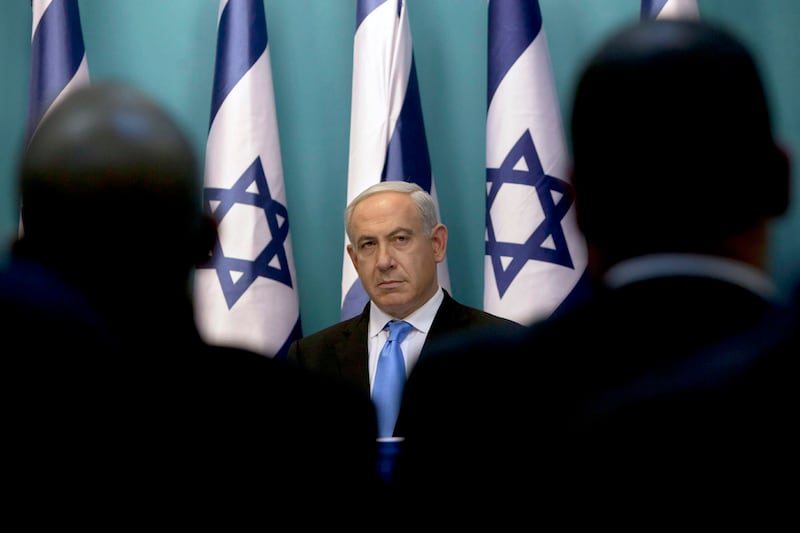
Sebastian Scheiner/AP
Get the Beast Digest newsletter delivered straight to your inbox
By clicking “SIGN UP” you agree to our Terms of Use and Privacy Policy.
A former Israeli security chief has revealed that he and his colleagues worried constantly over the past four years that Israeli Prime Minister Benjamin Netanyahu might try to launch a large-scale assault against Iran’s nuclear installations without seeking prior approval from his cabinet—a move that would run counter to longstanding Israeli policy.
Yuval Diskin, who served as head of the internal Shin Bet security agency for six years and retired in 2011, told the Israeli newspaper Yedioth Ahronoth that on one occasion, the chiefs refused an order from Netanyahu and Defense Minister Ehud Barak to prepare the military for such an assault, telling them it amounted to an end run around the cabinet.
Diskin, who spent 38 years in the Shin Bet, also leveled harsh criticism at Netanyahu and Barak for squandering opportunities to advance peacemaking with Palestinian President Mahmoud Abbas and instead boosting the status of the Islamic Hamas group.
“My colleagues and I were very unsure of whether Netanyahu and Barak could lead an Iranian campaign. We didn’t trust their motives,” Diskin told the newspaper, in his first interview since leaving Shin Bet 19 months ago.
“We were worried that they might pursue various moves that would compromise Israel based on irrelevant considerations or via underhanded ways. We had a feeling that they were trying to sneak something under the radar,” he said.
His remarks echoed those of another retired security chief, Meir Dagan, who said last year that Netanyahu’s threat to attack Iran was the “stupidest idea” he’d ever heard. He repeated the criticism in several appearances and interviews at the time, causing Netanyahu much embarrassment. Security chiefs are widely respected in Israel and don’t usually speak out after their retirement.
But Diskin’s interview, coming less than three weeks ahead of Israel’s national election and splashed over several pages of the mass-circulation newspaper, was in some ways even more challenging for Netanyahu. Polls suggest he will win another term as prime minister, but his Likud Beytenu party has lost substantial support over the past month.
In response to the criticism, Netanyahu’s office went on the attack, saying that Diskin felt slighted for not being named Mossad chief after leaving the Shin Bet. “His baseless remarks ... are being recycled now for political reasons and are motivated by his frustration at not being appointed head of the Mossad.”
Shin Bet handles Israel’s domestic security issues, including threats from Palestinians in the West Bank and Gaza. But as part of that top echelon of defense officials, Diskin participated in almost all the meetings where Iran was discussed. He said at many of the discussions, Netanyahu, Barak, and Foreign Minister Avigdor Liberman radiated scorn toward the security chiefs, smoking cigars and occasionally pouring themselves alcoholic drinks.
“I’m telling you, a picture is worth more than a thousand words,” he said. “In the face of this in-depth discussion, [they exhibited] a kind of total derision towards everyone.”

He described Netanyahu as fearful and indecisive. “There’s a leadership crisis here, a crisis of value,” Diskin said. “Maybe people will think that I’m taking an extreme view of things. I’m telling you, from up close it looks even worse.”
Diskin, who described himself in the interview as a “security hawk,” contrasted Netanyahu with other Israeli leaders he worked alongside, including Yitzhak Rabin, Shimon Peres, Ariel Sharon, and Ehud Olmert. “When I consider this spectrum, I can say that Rabin, Peres, Sharon, and Olmert—in the moment of truth—would always prefer state interests over their own.
“They didn’t always make the right decision, but you knew where they were coming from—Israel’s interests trumped anything else,” he said. “Unfortunately, my feeling, and many others in the defense establishment share it, is that in the case of Netanyahu and Barak, the personal, opportunistic interests came first.”
See more of our coverage in your search results.

Got a tip? Send it to The Daily Beast here.
Unlock a year of full access to The Daily Beast for $35.
Monthly
$1
First month then $5.99/month
Annual
$35
First year then $59.99/year
Premium
$79
First year then $119.99/year
*Substack access provided by the next business day, using your subscription email. Choosing the Premium plan constitutes your permission to share your subscription email with Substack and your agreement to Substack’s Privacy Policy.
Looks like you already have a subscription!
- Account (completed)
- Payment (completed)
- Confirmation (completed)
You're all set!
Thanks for subscribing.
- 1Account
- 2Payment
- 3Confirmation
Sign in or create an account
Register below to read this article for free or subscribe
to unlock unlimited access to The Daily Beast.
Monthly
$1
First month then $5.99/month
Annual
$35
First year then $59.99/year
Premium
$79
First year then $119.99/year
*Substack access provided by the next business day, using your subscription email. Choosing the Premium plan constitutes your permission to share your subscription email with Substack and your agreement to Substack’s Privacy Policy.
Already have an account? Sign In
Looks like you already have a subscription!
- Account (completed)
- Payment (completed)
- Confirmation (completed)
You're all set!
Thanks for subscribing.
- 1Account
- 2Payment
- 3Confirmation