Mars Rover Documentary ‘Good Night Oppy’ Desperately Wants to Be a Pixar Film
The remarkable story of the rover that revolutionized what we know about Mars is reduced to a cutesy documentary more interested in anthropomorphizing WALL-E than science.
Amazon Prime Studios
A great non-fiction story requires little cloying embellishment—a fact that’s wholly ignored by Good Night Oppy. Pressing every button, pushing every note, and pulling on every heartstring, director/producer Ryan White’s documentary (Nov. 4 in theaters; Nov. 23 on Prime Video) works overtime to stir the emotions and wrack the nerves. The result is a wholly manipulative—and surprisingly shallow—portrait of human ingenuity and intergalactic exploration, as well as another case study of form getting in the way of content.
Good Night Oppy’s title refers to Opportunity, a Rover that—along with its “twin” Spirit— was launched in 2003 to Mars. Its goal was to investigate soil samples in the hope of discovering evidence of PH groundwater that might have once allowed for primitive life.
Both machines were the brainchild of principal scientist Steve Squyres, a former geologist who was inspired by the prior Viking missions to Mars to turn his attention to the stars, and who had spent the previous decade trying to convince NASA to return to the planet. Opportunity and Spirit were the successful byproducts of that toil, thus making them akin to Squyres’ kids—a mawkish metaphor that White’s film bludgeons audiences with to the point of eliciting near-constant groans and eyerolls.
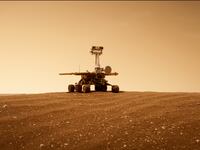
Oppy, as he’s oh-so-affectionately called, is a six-wheeled vehicle with a flat solar-paneled body that faces the sky, an arm that extends outward (with “Swiss army knife” capabilities), and a long vertical neck with a horizontal head boasting camera lenses that look like eyes. It’s an amazing feat of engineering, although Good Night Oppy cares less about its fascinating construction and capabilities than about casting it in anthropomorphic terms as WALL-E by way of R2D2. Oppy has autonomous capabilities that make it clever.

When it gets stuck in the sand, it’s depicted as expressing frustration by beeping, chirping and whirring. Later, after Mars dust creeps into the crevices of its joints, it develops “arthritis,” and its memory failures are described as “amnesia” and compared to Alzheimer’s disease. As if that weren’t enough, Oppy is labeled a “family member” and a “child,” its initial functioning is likened to “first steps,” and its every action and reaction is associated with human life.
Such efforts aren’t cute so much as cutesy, and transparent attempts to engender empathy for this collection of nuts and bolts. Squyres and his interviewed comrades naturally feel a bond with their pioneering achievement, but the strain with which White strives to create an analogous connection between viewers and his subject are too insistent to be successful.
Sign Up for Our Obsessed Newsletter
By clicking “SUBSCRIBE” you agree to our Terms of Use and Privacy Policy.
Much of that has to do with Blake Neely’s egregiously over-the-top score, which swells for uplift, blares for suspense, and tickles the ivories for schmaltzy bathos. There’s rarely a moment left untouched by excessive musical accompaniment, nor by White’s similarly calculating use of split screens, montages, and CGI panoramas of Mars and close-ups of Oppy and Spirit to drum up tears and cheers.
So much of Good Night Oppy’s energy is put into generating a sense of wonder that none materializes; for all its Hollywood blockbuster-style recreations of perilous landings and encounters (courtesy of Industrial Light & Magic), the film is merely a recitation of events whose purpose is left largely unexplained and whose tension is nil. Oppy and Spirit are designed to find signs of water, and, along their journey, they run into a variety of obstacles, be it steep rocky slopes, massive dust storms, or quicksand-ish terrain.
Unfortunately, in each instance, a dilemma arises and is then solved in a hot minute, with the Earthbound team’s problem-solving resourcefulness condensed to a borderline-afterthought degree. Consequently, there’s no genuine drama to the proceedings, only a bunch of temporary roadblocks that are overcome as soon as they arise.
To further humanize Oppy, the film has Angela Bassett read the rover’s “diaries,” and it cursorily focuses on a few team members’ relationships with their fathers and children. Time and again, it prioritizes making Oppy a lovable and adorable figure over actually detailing the specifics of its mission.
Outside a few random discoveries, Oppy’s successes and experiences on the planet are vague, as the material primarily concentrates on its ability to simply survive—something it was only supposed to accomplish for 90 sols (i.e. Mars days, which are approximately an hour longer than ours), but instead did for almost fifteen years. This is, again, a testament to the brilliance of those many NASA men and women who worked on the project. Yet White celebrates that less than Oppy’s just-like-you-and-me qualities, in a vain desire to transform his documentary into a real-life Pixar film—complete with a simultaneously triumphant and melancholy ending.
The personalities of Squyres, mission manager Jennifer Trosper, lead systems engineer Rob Manning, mechanical engineer Kobie Boykins and many other Mars Exploration Rover program leaders are all but absent in Good Night Oppy, since White puts his love and attention into fashioning Oppy as the film’s star.

Meanwhile, the only thrilling moment proves to be a brief scene of NASA personnel anxiously awaiting a signal from Spirit upon its landing. For the most part, endearing corniness is the order of the day, epitomized by staffers’ ritual of choosing “wake up songs” like “Roam,” “Born to Be Wild,” “SOS,” and “Wake Me Up Before You Go-Go” to rouse Oppy from its computerized slumber—an element that, however authentic, resonates as one more of this cinematic endeavor’s mushy gestures.
In the final tally, Good Night Oppy barely relays what Oppy found on Mars, save for a bit of final—and seemingly historic—proof that, millions of years prior, there may have been life-sustaining water on the planet. The ostensibly seismic importance of that revelation, though, is drowned out by sentimental huzzahs to Oppy’s Herculean endurance, as well as mournful tributes to its inevitable demise. In a late soundbite, one engineer states that Oppy’s goal was to “make life better on Earth,” and the ultimate failure of White’s hollow film is that it’s too busy imagining Oppy as a plush toy-ready icon to explain how, or why, that’s true.

Got a tip? Send it to The Daily Beast here.
Register below to read this article for free or subscribe
to unlock unlimited access to The Daily Beast.
Monthly
$1
First month then $5.99/month
Annual
$35
First year then $59.99/year
Premium
$79
First year then $119.99/year
*Substack access provided by the next business day, using your subscription email. Choosing the Premium plan constitutes your permission to share your subscription email with Substack and your agreement to Substack’s Privacy Policy.
Already have an account? Sign In
Looks like you already have a subscription!
You're all set!
Thanks for subscribing.