Obama’s Greatest Failure
Peter Beinart on Obama's failure in Egypt.
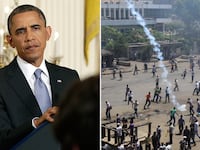
Win McNamee/Getty; Mohammed Abu Zeid/AP
Elliot Abrams was right. Rand Paul was right. I was wrong. More importantly, so was Barack Obama.
After last month’s military coup in Egypt, sober foreign-policy types warned against cutting off U.S. aid. After all, the coup seemed to enjoy substantial public support. President Mohamed Morsi had become increasingly authoritarian. Cutting off aid might destroy what little leverage America had over Egypt’s new military regime.
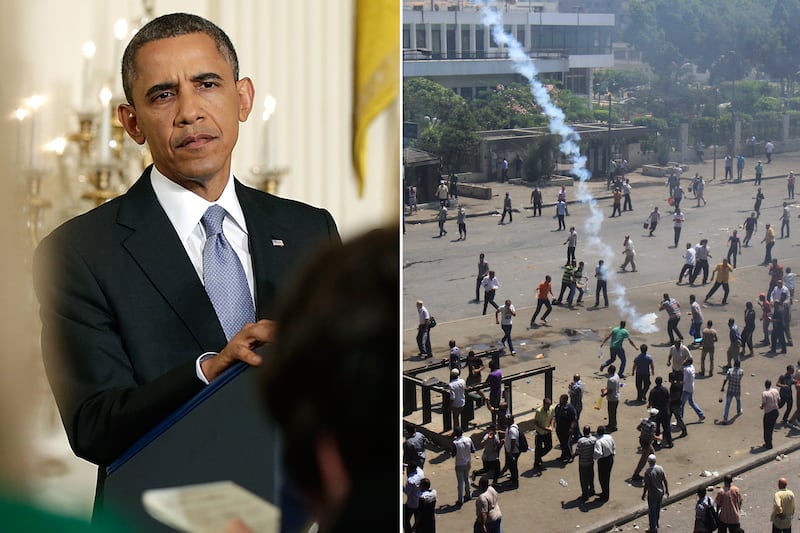
So Obama spoke saccharine words about democracy and inclusion but never called the coup a coup, since under U.S. law that would have required cutting off aid. General Abdel Sisi’s government made it increasingly clear it had no intention of allowing real democratic elections—including Morsi’s Muslim Brotherhood—ever again. Secretary of State John Kerry, in a terrible gaffe, praised the military for “restoring democracy.” And then, today, all hell broke loose as the military slaughtered Brotherhood supporters by the hundreds and instituted military law.
There’s a reasonable argument that nothing Obama did would have mattered. The Persian Gulf states, which adored the coup, quickly offered Egypt far more money than the U.S. could have withheld. And it’s not as if the administration remained passive. Deputy Secretary of State William Burns worked hard to bring the Brotherhood and the military together. The White House even sent two of its domestic tormenters, John McCain and Lindsey Graham, to Cairo to try to hatch a deal.

But in hindsight it’s clear (funny how that works) that the people who wanted blunter action were right: Obama’s only real chance of preventing the military from trying to smash its Islamist foes would have been to cut off military aid.
The irony is that what served the administration so poorly in this case are the very attributes that often serve it well. The hallmarks of Obama’s foreign policy are nuance, humility, caution, which is understandable when you follow George W. Bush. So Obama did the apparently prudent thing. He tried to get both sides to compromise: Asking the military to allow the Brotherhood to participate in politics and the Brotherhood to accept that Morsi wasn’t coming back. He listened to regional allies like Israel and Saudi Arabia, who feared the Brotherhood’s return. He postponed shipments of F-16s without shutting off aid.
In some ways, the approach resembled Obama’s Afghan policy in 2009. Back then, faced with hawks who wanted a full-scale counterinsurgency campaign and doves who said Afghanistan was hopeless, Obama split the baby: both sending more troops and setting a date for withdrawal. And it proved a disaster. A lot of young Americans died in a surge that never had any real chance of success.
Get the best of The Beast delivered right to your inbox
By clicking “SUBSCRIBE” you agree to our Terms of Use and Privacy Policy.
Here, too, Obama’s attempt to find a middle path has produced the worst of all outcomes. As today’s events make gruesomely clear, our supposed leverage with the Egyptian military is a fiction. But we’ve also destroyed whatever limited influence we may have had with the Brotherhood. To anyone in the Muslim world who needed convincing, it now looks unmistakably clear that the United States favors democracy in the Middle East when, and only when, our side wins. If you’re an Islamist who has now watched the United States wink at coups against democratically elected Islamist governments in Algeria and Egypt, and sought to foment one among the Palestinians after Hamas’ democratic election in 2006, the message is clear: Elections are for chumps. Go get your AK-47.
By historical standards, the Obama administration has presided over few genuine foreign-policy disasters. That’s no accident. Its self-consciously Hippocratic approach—modeled on world-weary pragmatists like Dwight Eisenhower and George H.W. Bush—is designed to avoid them. But sometimes the refusal to take a bold, principled stand turns out to be the riskiest course of all.
See more of our coverage in your search results.

Got a tip? Send it to The Daily Beast here.
Register below to read this article for free or subscribe
to unlock unlimited access to The Daily Beast.
Monthly
$1
First month then $5.99/month
Annual
$35
First year then $59.99/year
Premium
$79
First year then $119.99/year
*Substack access provided by the next business day, using your subscription email. Choosing the Premium plan constitutes your permission to share your subscription email with Substack and your agreement to Substack’s Privacy Policy.
Already have an account? Sign In
Looks like you already have a subscription!
You're all set!
Thanks for subscribing.