Stephen Moore Withdraws as Trump’s Federal Reserve Board Pick After Anti-Women Remarks Unearthed
The former Trump campaign advisor’s views on women and other subjects sparked criticism from lawmakers, including Republicans.
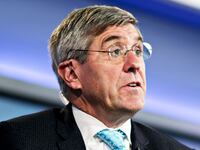
Andrew Harrer/Getty
Stephen Moore withdrew himself from consideration to sit on the Federal Reserve Board on Thursday after drawing substantial criticism for his 25-year history of criticizing gender equality and advancement.
News of his withdrawal came via a Tweet from President Donald Trump.
Steve Moore, a great pro-growth economist and a truly fine person, has decided to withdraw from the Fed process. Steve won the battle of ideas including Tax Cuts....
— Donald J. Trump (@realDonaldTrump) May 2, 2019
Just hours earlier, Moore had told Bloomberg that he was “all in” for the Fed nomination after having talked with the White House the day before. What changed between then and Trump’s tweet is unclear.
But the writing had been on the wall after a number of Republican lawmakers expressed concerns about Moore, a Trump campaign advisor, for his comments about women. CNN kicked off renewed attention to Moore’s anti-women remarks last week when it revealed that he repeatedly suggested women should not be allowed to play or referee sports with men.
Senate Majority Whip John Thune (R-SD) told Politico Tuesday the surfaced comments would “be a good test” for Moore’s support level in the Senate. Sen. Lindsey Graham (R-SC) reportedly called his nomination “very problematic.” Sen. Joni Ernst (R-IA) told reporterst she wasn’t “enthused” about what Moore has written previously. “I think it’s ridiculous,” she stated, adding it was “very unlikely” she would support his nomination to the Fed Board and that she expressed her point of view with the White House.
Get the best of The Beast delivered right to your inbox
By clicking “SUBSCRIBE” you agree to our Terms of Use and Privacy Policy.
Aside from lamenting women’s involvement in men’s sports, The New York Times found a National Review column in which Moore asserted that female breadwinners “could be disruptive to family stability.” CNN additionally reported that he once mocked women as being “sooo malleable,” as an explanation for why they tend to vote Democratic. “No wonder there's a gender gap,” he wrote.

During a 2000 appearance on C-SPAN, he reportedly told a caller that it was “not a good thing that black women are making more than black men.”
“In fact, you know, the male needs to be the breadwinner of the family,” Moore said, according to the Times. “One of the reasons you’ve seen the decline of the family, not just in the black community, but also it’s happening now in the white community as well, is because women are more economically self-sufficient.”
In a 1994 Washington Times editorial, Moore reportedly called the Violence Against Women Act the “most objectionable pork” and took issue with its funding initiative to investigate violent crimes against women. “The act would be more efficient if Congress cut out the federal middleman and simply required every American household to write a $20 check to the radical feminist group of its choice,” he wrote.
.@StephenMoore explains his 2016 joke about Donald Trump moving into the White House and kicking “a black family out of public housing.” Moore says, “That is a joke I always made,” adding he didn’t mean it “like a black person” lived there. “I shouldn’t have said it,” he says. pic.twitter.com/9EO9JzBgtW
— Firing Line with Margaret Hoover (@FiringLineShow) April 30, 2019
On Monday evening, PBS show Firing Line with Margaret Hoover released a clip of Moore explaining away his celebratory 2016 joke about Trump moving into the White House and kicking “a black family out of public housing.” Moore stumbled through the interview, telling Hoover, “That is a joke I always made,” before acknowledging: “I shouldn’t have said it.”
The former Wall Street Journal editorial board member further elaborated on his feelings about women in sports, once declaring that female athletes demanded “equal pay for inferior work” and that there should be “no women anything” in the NCAA’s March Madness tournament.

In a 2016 debate, Moore advocated for children aged 11 and 12 to join the workforce. While he reportedly recognized he was a “radical on this,” he said he would end child-labor laws if he could.
“I'm not even a big believer in democracy,” he said in a 2009 interview, according to CNN. “[T]here are a lot of countries that have the right to vote that are still poor. Democracy doesn't always lead to a good economy or even a good political system."
On top of all of this, Bloomberg reported that Moore owed $75,328.80 to the Internal Revenue Service—which seems to fit his personal view of getting rid of the “damn income tax.”
Moore is now the second of Trump’s picks for the Fed Board to withdraw his own nomination. Herman Cain, a 2016 Republican presidential candidate, pulled out shortly after he insisted that he would stick the confirmation process out. Cain, like Moore, faced scrutiny from lawmakers—mainly due to the sexual-misconduct accusations against him and his potentially bizarre policy recommendations.
For years, Moore has had Trump’s ear on economic issues and policy. In fact, typical, doctrinaire fiscal conservatives (of which Moore used to count himself) would be right to blame him for being one factor as to why President Trump isn’t all that worried about tackling the tens of trillions of dollars in national debt via deep cuts to popular programs.
As Moore recounted to The Daily Beast late last year, he had, as an economic adviser to Trump’s presidential campaign, made several visual presentations to the future president in mid-2016 that showed him the severity of the U.S. debt. However, Moore personally assured candidate Trump that the massive debt could be dealt with by focusing on economic growth—a position that became a pillar of the “Trumponomics” that Moore helped craft.
“That was why, when [the president] was confronted with these nightmare scenarios on the debt, I think he rejected them, because if you grow the economy… you don’t have a debt problem,” Moore said. “I know a few times when people would bring up the enormous debt, he would say, ‘We’re gonna grow our way out of it.’”

By early 2017 meetings in the White House, when senior officials tried to show Trump with colorful charts and graphics the year the debt may reach a critical mass, the president simply responded by pointing out the chart had the debt exploding in a year in which he would no longer be in office: “Yeah, but I won’t be here,” Trump said, according to a source who was in the room.
Moore didn't immediately respond to The Daily Beast's inquiries on Thursday afternoon. Though his gig at the Fed has hit the skids, he is likely to continue to hold some sway in Trumpworld. He remains close to prominent figures in the Trump orbit, including the president’s top economic adviser Larry Kudlow, who previously told The Daily Beast that Moore is “my brother, he’s my dear friend, I was best man at his wedding. He's one of the smartest people I know, [and] I talk to him almost every day.”
Moore will also likely have options for a Plan B in pro-Trump circles, if he desires one that doesn’t require a confirmation vote. Over the past two years, Moore has been invited to private meetings at the White House with President Trump and other senior officials, and just days before his Fed consideration was announced earlier this year, Moore had told The Daily Beast that he had also had conversations with Trump’s 2020 campaign about possibly playing a role for the reelection effort, but that nothing was set in stone. (The Trump campaign did not respond to requests for comment on Thursday.)
The president himself tweeted that he didn’t want Moore going too far. “I’ve asked Steve to work with me toward future economic growth in our Country,” @realDonaldTrump posted on Thursday after Moore was officially out.
See more of our coverage in your search results.


Got a tip? Send it to The Daily Beast here.
Register below to read this article for free or subscribe
to unlock unlimited access to The Daily Beast.
Monthly
$1
First month then $5.99/month
Annual
$35
First year then $59.99/year
Premium
$79
First year then $119.99/year
*Substack access provided by the next business day, using your subscription email. Choosing the Premium plan constitutes your permission to share your subscription email with Substack and your agreement to Substack’s Privacy Policy.
Already have an account? Sign In
Looks like you already have a subscription!
You're all set!
Thanks for subscribing.