Trump Nominee Short Circuits When Asked Simple Constitution Question
A judicial nominee muttered “oh boy, oh boy” to himself as he failed to recall what a Constitutional amendment was.

Get The Swamp newsletter delivered straight to your inbox
By clicking “SIGN UP” you agree to our Terms of Use and Privacy Policy.
A Trump judicial nominee has embarrassed himself by struggling to define the 22nd Amendment at his confirmation hearing—then refused to say whether the president who nominated him could serve a third term.
Texas Supreme Court Justice James Sullivan, who lost his reelection bid this month, appeared before the Senate Judiciary Committee on Wednesday, where Sen. Chris Coons questioned him about the amendment prohibiting individuals from being elected president more than twice.
“Can you just tell me what the 22nd Amendment provides?” Coons asked Sullivan, whom Trump nominated to a lifetime position on the U.S. Court for the Western District of Texas.
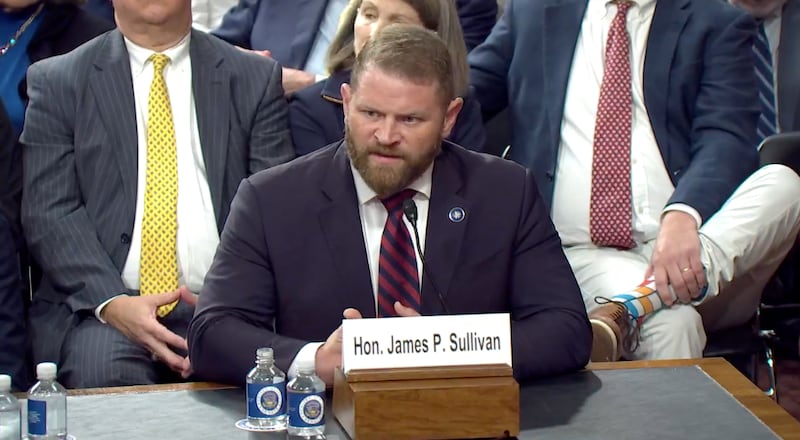
After Sullivan lost his reelection bid earlier this month, Trump nominated him to a lifetime role.
Senate Judiciary Committee
“Senator, uh, if I’m remembering correctly—and I carry it over my heart because sometimes it isn’t in my brain—uh, but if I—if I’m remembering it correctly, it is uh–” Sullivan, 45, said, struggling to remember. He then closed his eyes and whispered to himself, “Oh boy, oh boy.”
Coons, a Yale-educated lawyer, gave him an out: “No person shall be elected…”
“Ah, yes. I’m sorry. Thank you, thank you genuinely, senator,” answered Sullivan, who is a Harvard law graduate. “No person shall be elected, uh, more than twice, I believe, to the office of the president.”

Coons then asked Sullivan about Trump’s electoral history and his future.
“Has President Trump been elected and served now twice as president?”
Sullivan answered, “President Trump has been certified as the winner in the 2016 and the 2024.”
Coons followed up: “Is he eligible to run for president again in 2028?”
Sullivan declined to answer.
“So, senator, as a nominee for a federal district court, it would be a violation, I believe, of Canon 5 for me to opine on something like that,” Sullivan replied, claiming that legal ethics guidelines about judges refraining from “political activity” prevented him from responding. “And so, respectfully, I’m not so sure that I can—I mean, I can certainly tell you how I would think about approaching a problem like that. But this seems like both—it certainly seems like it’s the sort of thing that is a subject of ongoing political debate.”
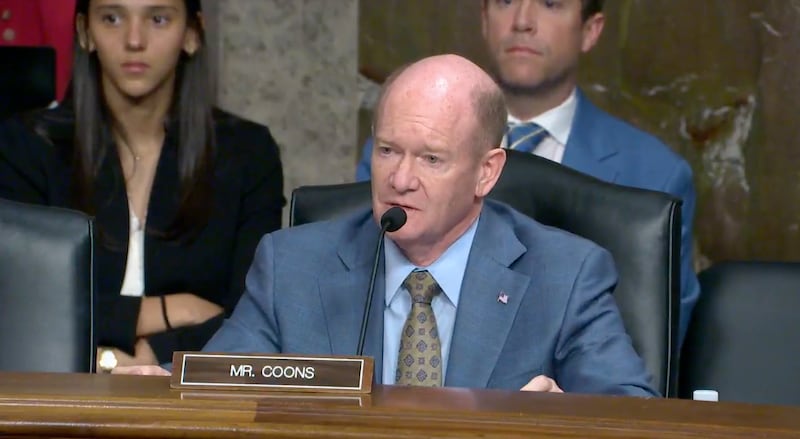
Coons asked multiple Trump nominees about how the 22nd Amendment applies to the president.
Senate Judiciary Committee
Coons said that answer was “very disappointing.”
“It strikes me as just bracingly clear on the face of it: a textualist—anyone who has read the Constitution and is sitting before me for confirmation for a lifetime appointment—I don’t think it is the subject of political debate,” he said.
“I respect your reading of Canon 5, and if I were asking you a question that was the subject of vigorous political debate and unsettled as a matter of constitutional law or interpretation or application, I could respect that answer,” he continued.
“But the question of whether someone can serve a third term as president of the United States, I think, is only unresolved in the mind of President Trump, who has repeatedly said that he’s thinking he might run for a third time,” Coons said. “I don’t understand how there’s any political debate here, sir. Could you help me understand your answer?”

After being reelected, Trump openly mused about serving a third term, but hasn't been making those comments as much lately.
Evan Vucci/REUTERS
“Senator, it strikes me that the reason that we’re talking about this is because you’ve mentioned comments that the president has made about this in the press, and so what I can tell you is about how, whether it’s with the 22nd Amendment or any other—and I do appreciate the refresher on it, that’s why they write these things down and I keep it with me—I would be looking to the text of the provision and the original public meaning of that text, at, you know, what it meant to the people and the states who ratified it at the time that they did it,” he said. “My recollection is that that was in the wake of the Roosevelt, Franklin Delano Roosevelt.”
Coons was perplexed by Sullivan’s response.
“Is there any possible way to interpret that amendment as meaning anything other than no person shall be elected and serve as president for a third term? I almost can’t imagine a provision that is clearer than this. And... I agree with you about the historical context. We had a president who served four terms. There was a broad discussion, debate, and an amendment to the Constitution was adopted that says no one can serve a third term,” he said.
“How is it in any way controversial that any person elected to it—President Trump or anybody else, President Obama—there’s no debate about this, in my view.”

Coons then asked Trump nominee to the U.S. District Court for the District of South Carolina, William Lambert, about how the 22nd Amendment applies to Trump. Lambert had no problem answering.
“Senator, the text of the 22nd Amendment seems clear that no one may serve a third term,” he said.
“And that would include President Trump or anyone else?” Coons asked.
“That would include anyone, Senator,” he said.
“Thank you for your courage,” Coons replied.

The senator later explained his rationale for asking this question of nominees who were “unable or unwilling to deliver an answer.”
“Just because someone raised an outrageous and unfounded challenge or argument about a legal principle, doesn’t mean that it is so subject to political debate that you cannot render an opinion about that when it is this clear,” he said. “I recognize and respect that the Canon prevents you from giving an opinion on something that is genuinely subject to ongoing jurisprudential debate. This is not that.”
See more of our coverage in your search results.

Got a tip? Send it to The Daily Beast here.
Register below to read this article for free or subscribe
to unlock unlimited access to The Daily Beast.
Monthly
$1
First month then $5.99/month
Annual
$35
First year then $59.99/year
Premium
$79
First year then $119.99/year
*Substack access provided by the next business day, using your subscription email. Choosing the Premium plan constitutes your permission to share your subscription email with Substack and your agreement to Substack’s Privacy Policy.
Already have an account? Sign In
Looks like you already have a subscription!
- Account (completed)
- Payment (completed)
- Confirmation (completed)
You're all set!
Thanks for subscribing.
- 1Account
- 2Payment
- 3Confirmation
Sign in or create an account
Login dialog
Loading comments…