Trump Says Leakers Should Be Shot After Secret Plans Exposed
The president has revealed a desire to have some federal employees executed.

President Donald Trump has said leakers of sensitive data “should be shot.”
The 80-year-old has sought to create a watertight administration after his first stab at the presidency was beset by leaks and whistleblowing. However, if Trump’s words are any indication, it hasn’t worked—and he’s frustrated.
“Leakers should be, in my opinion, leakers should be shot,” Trump said at a campaign rally on Wednesday.

The crowd in Bullhead City, Arizona, agreed. Cheers, shouts of “Yeah!” and scattered applause followed the president’s jaw-dropping statement.

Donald Trump told a rally that leakers “should be shot.”
Evan Vucci/REUTERS
He continued, “They should be shot. In the old days, we used to shoot leakers, you know, when they leak what time you’re going to attack a country… leakers should be dealt with very, very strongly. To me, they’re the scum of the earth.”
Trump appeared to be talking about a leak about the start time of Operation Midnight Hammer, the joint effort between the U.S. and Israel to hit Iran with a flurry of airstrikes in June 2025.
Get the best of The Beast delivered right to your inbox
By clicking “SUBSCRIBE” you agree to our Terms of Use and Privacy Policy.
“Somebody leaked, some sleazebag. They ought to go to jail or be shot. For the rest of their life, they should be in jail, but they leaked that we were leaving at 12:07 from Missouri, and it was in The New York Times, CNN.”
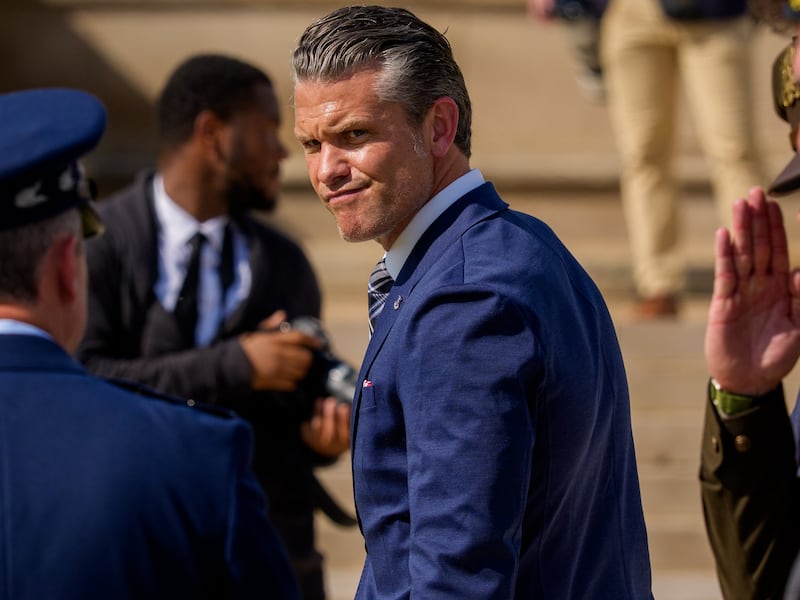
U.S. Secretary of Defense Pete Hegseth was inadvertently behind one of the biggest “leaks” of Trump 2.0.
Andrew Harnik/Getty Images
He then turned his fire on journalists assembled at the rally. “Those same people up there, they’re almost as bad as a leaker, because they leak,” Trump said. “Oh, they leak false information. That makes them a leaker, right?”
Perhaps the biggest leak to rock Trump 2.0, however, was of one of his Cabinet member’s making.
Signalgate, which saw The Atlantic editor-in-chief Jeffrey Goldberg added to a Signal chat comprised of senior Trump administration officials including Pete Hegseth, JD Vance, and Marco Rubio in which sensitive military information was exchanged in March last year, resulted in the departure of National Security Adviser Mike Waltz and his deputy Alex Wong from their roles.

Waltz was the one who inadvertently added Goldberg to the chat, but Hegseth shared sensitive war plans regarding a strike in Yemen, according to an inspector general’s report on the scandal.
Hegseth denied that claim but the full Signal chat later released by The Atlantic showed that the defense secretary shared exact times fighter jets would launch and when they would hit their targets.
One of his messages on Saturday, March 15, included “Just CONFIRMED w/CENTCOM we are a GO for mission launch.” He then went on to include the times of the “F-18s LAUNCH,” “1st Strike Window Starts,” “More F-18s LAUNCH,” “Strike Drones on Target,” and “F-18 2nd Strike Starts.”
One of the lines included “THIS IS WHEN THE FIRST BOMBS WILL DEFINITELY DROP, pending earlier “Trigger Based” targets.”
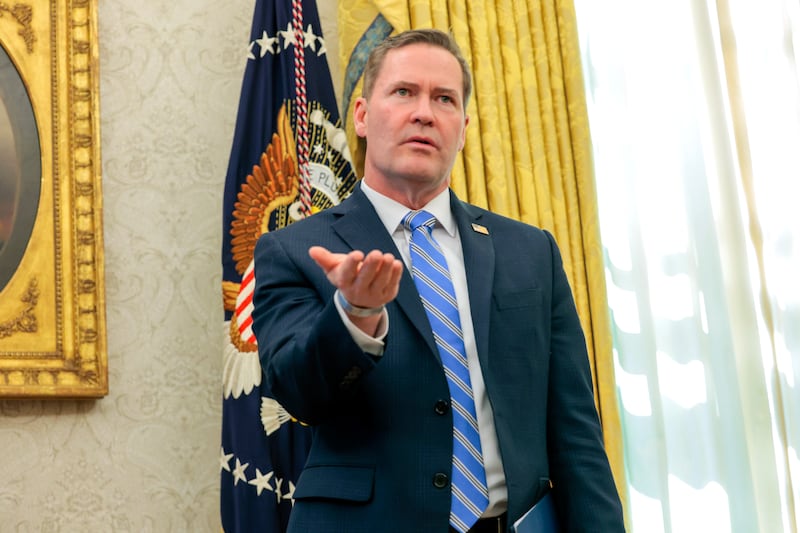
National Security Adviser Mike Waltz admitted he was to blame for the Signalgate debacle.
Anna Moneymaker/Getty Images
The report, published last year, said Hegseth should not have used Signal and violated Pentagon policies about personal phone use for business.
In March this year, the Trump administration proposed that “new and existing federal employees” sign nondisclosure agreements.
“The form is intended to document Federal employees’ acknowledgment of, and agreement to comply with, current legal obligations to safeguard non-public, confidential, or proprietary information, created or obtained through their official duties, while expressly preserving the right to make disclosures authorized by law,” a notice in the Federal Register from the Office of Personnel Management said.
The office noted “several recent instances” in which leakers spoke to the media, including when the New York Times and Washington Post were fed unauthorized information on the U.S. raid on Venezuela.

About 50 members of the U.S. military’s Joint Staff have also been subjected to polygraph tests over whether they have leaked, according to the Times.
The administration has even gone after the journalists. In January, Kash Patel’s FBI searched the home of a Washington Post reporter, Hannah Natanson, who had been digging into the Trump administration.
During the search, the 29-year-old’s devices were checked, and FBI agents seized a phone, a Garmin watch, two laptops, her personal computer, and one belonging to the Jeff Bezos-owned newspaper.

A judge eventually ruled that the administration couldn’t examine the data on her devices. The FBI appealed, but they were knocked back.
That didn’t stop another sortie from the Trump administration in June, when officials reportedly attempted to compel testimony from four journalists from the Post and The Wall Street Journal before a grand jury.
The subpoenas were shelved when the publications pushed back.
The White House has been contacted for comment.
See more of our coverage in your search results.

Got a tip? Send it to The Daily Beast here.
Register below to read this article for free or subscribe
to unlock unlimited access to The Daily Beast.
Monthly
$1
First month then $5.99/month
Annual
$35
First year then $59.99/year
Premium
$79
First year then $119.99/year
*Substack access provided by the next business day, using your subscription email. Choosing the Premium plan constitutes your permission to share your subscription email with Substack and your agreement to Substack’s Privacy Policy.
Already have an account? Sign In
Looks like you already have a subscription!
You're all set!
Thanks for subscribing.
Sign in or create an account
Login dialog
Loading comments…