

Avatar: Fire and Ash contains what is easily the darkest scene in the series so far.
More than halfway through, Jake Sully (Sam Worthington) and Neytiri (Zoe Saldaña) decide they need to do something about their semi-adopted son Spider (Jack Champion).
(Warning: Spoilers ahead.)
Spider has recently gained the ability to breathe Pandora’s air despite his human status. This would be a straightforward miracle if not for how this ability can be exploited by the humans to colonize Pandora. Jake concludes he has no choice: He must murder Spider for the good of the Na’vi.
In other words, the hero of the series spends several minutes here contemplating the murder of a child. The child is someone who just saved his life, who his daughter is clearly in love with, who’s been unflinchingly loyal and kind from the second he was introduced.
It’s a sequence taken straight out of the Bible, a new spin on the story of Abraham feeling pressured to kill his son Isaac. The difference this time is that there is no omnipotent god telling the father figure he needs to do this; Jake comes to this lethal conclusion all on his own.
What makes the sequence messier is that Jake isn’t even treated as a villain here, but as someone who’s been handed an impossible trolley problem.
Spider, through no fault of his own, is an existential threat to the entire planet. There’s a chance that Jake sparing his life will come back to bite him in Avatar 4, that he’ll realize this moment of mercy was a huge mistake.
As much as the Avatar haters have criticized the series for being simplistic and predictable, this is a scene that proves James Cameron’s operating at another level. The fact that a decent segment of the audience fell for Jake’s fake-out stab—that they believed for even a second that this PG-13 movie would really go there—is a sign of how hardcore these movies are. Avatar haters are so quick to dismiss the series as a boring cookie-cutter affair, but this scene at least is anything but.
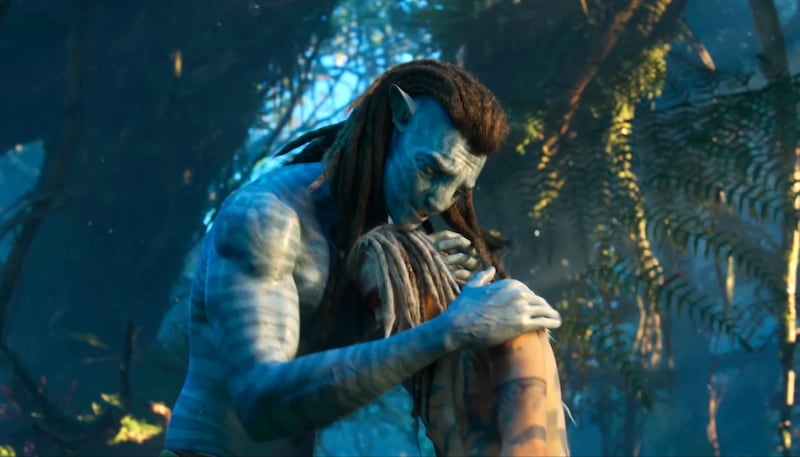
Darkening the sequence even further is how it follows up on the most uncomfortable scene of The Way of Water, the one where Neytiri holds a knife to Spider’s throat to stop Quaritch (Stephen Lang) from hurting her daughter.
That scene stung because it wasn’t clear how much Neytiri was bluffing, nor was it certain whether Spider was taking any of this personally. How does Spider feel knowing that Neytiri, the closest thing he has to a mother, is so willing to end his life?
It was thrilling for The Way of Water to give Neytiri such a cold moment, one she never clarifies or apologizes for. Cameron let the horrifying implications of this scene linger with audiences for three full years between movies.
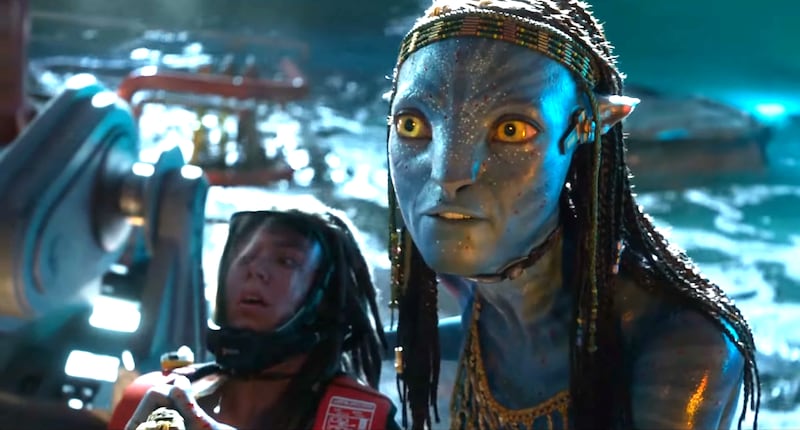
The beginning of Fire and Ash builds on that scene, with Neytiri declaring early on that Spider will never be a part of her family.
The line stings because of how calmly Spider accepts it. As unfair as it is for Spider to bear the weight of all of humanity’s sins, he loves the Sullys and this planet enough to take on that burden anyway.
This is the central appeal of Spider: He is a boy placed in an impossible situation who nevertheless approaches life with an unflinchingly Zen attitude. He should be perpetually stressed; instead, he’s happily swimming with the whales and flirting with Kiri. He’s not just the most important character in this movie’s plot, but the embodiment of every value these movies want humans to embrace.
Based on how much the franchise had established Neytiri’s dislike of Spider, it’s a stroke of genius to have it be Jake who nearly takes Spider out instead.
Jake concedes to Neytiri’s worldview, only for Neytiri to realize she doesn’t hate the sky people as much as she thought. As she struggles with Jake’s decision she wipes her red face paint off in the river, and the paint washing off looks like blood on her hands.
After two movies of holding Spider at arm’s length, of resenting him for the human status he never asked for, Neytiri realizes the logical endpoint of her attitude and is horrified by what she sees. It’s a powerful bit of near-wordless storytelling; no wonder fans are talking about it so much.
The scene is brilliant not merely because it finally lets Neytiri learn to love Spider, or because it reaffirms the series’ theme of refusing to let imperialists compromise your values. No, what elevates the scene is the subtle implication that Spider knew this moment would come.
“Do you love me?” is all Spider wants to know before he dies. It feels like he’s done the moral calculus himself and has reached a similar conclusion. He wants to live, but much like Isaac, he doesn’t begrudge his father at all for the near-homicide.
Perhaps most important about this sequence is how fresh it feels. A common (and understandable) complaint about Fire and Ash is that it’s too much of a retread of the previous films, but you can’t possibly say that about this scene. Spider’s near-death is a clear step forward in the story. It reveals Spider and Neytiri’s true characters in a powerful, surprising way. The two will never be the same after this sequence, and thank Eywa for that.
And as to what the scene reveals about the series’ troubled hero, Jake Sully? It shows that he hasn’t hardened himself to the realities of war as much as he thought he had, and that’s not a bad thing. It’s a continuation of an idea Cameron’s explored often throughout his film career, most notably in Terminator 2: Judgment Day.
Speaking in a 1991 interview about Sarah Connor’s character, Cameron said, “She has systemically dehumanized herself in order to do something very, very important to the future of the world. But what’s the point of survival if you lose that which you’re trying to protect?”
Cameron explained, in a line that can so easily be used to explain Jake’s change of mind about Spider, “Why win the struggle against the machines at the expense of your humanity?”