In the 2010 British satire Four Lions, Riz Ahmed plays Omar, a wannabe suicide bomber who, despite coveting the role of jihadist, is clearly in over his head. In the film, Omar believes he is a hero, that he is doing his Muslim community a favor by conspiring to blow up the London Marathon.
This theme of self-grandeur and self-worth is one Ahmed revisits in his latest project, Bait, streaming now on Prime Video. This time, however, our protagonist’s goal isn’t to delineate himself from Western society, but the exact opposite. He wants to become the quintessential British icon: James Bond.
Bait follows the story of Shah Latif, a washed-up British-Pakistani actor who is desperate to get his career back on track. After tanking his audition to play 007, he purposely gets caught by the paparazzi, leading the internet to spiral over the implications of a brown James Bond. The six-episode series follows Shah across four days, as he’s thrust into the spotlight and the pressure to perform causes him to unravel through wild, outlandish scenarios.
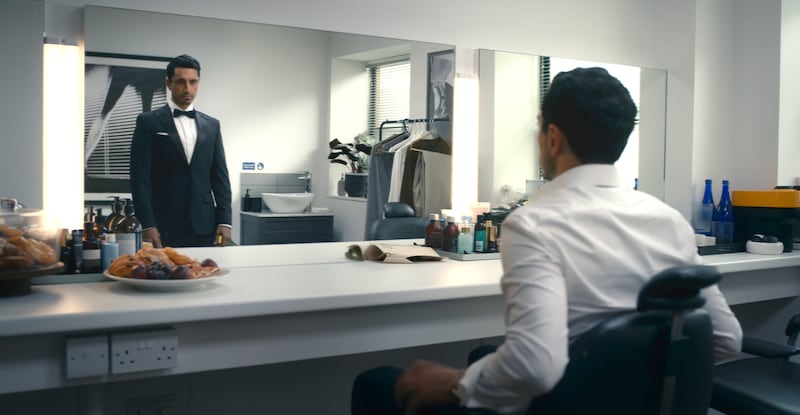
After word gets out of Shah’s audition, his family soon becomes victims of a stereotypical hate crime: a pig’s head is chucked through his parents’ window. This incident introduces us to the Latifs, a zainy and endearing immigrant family, who perfectly encapsulate what it means to be desi, including aunties fighting over who gets to host the dawat, and uncles watching Pakistani news channels that report absurd headlines.
Bait is set in the final days of Ramadan, the Muslim holy month of fasting from dusk to dawn, just before the Eid al-Fitr celebration, firmly grounding the series in its South Asian roots.
This family dynamic is a standout feature of the show, supported by wonderful performances all around, including from Guz Khan as Zulfi, Shah’s business-savvy cousin, who was raised as his brother. Zulfi’s main goal is to expand his business, Muber, short for Muslim Uber. He also makes it his mission to bring Shah back down to Earth.
But it’s Ahmed, who created and co-wrote the series, who steals the show as the insecure actor struggling to find his voice both on and off stage. Shah moves with such frenetic, chaotic energy that when he begins to confide in the pig’s head (voiced, incredibly, by Patrick Stewart) that desecrated his family’s home, it’s somehow the most at ease his character appears.
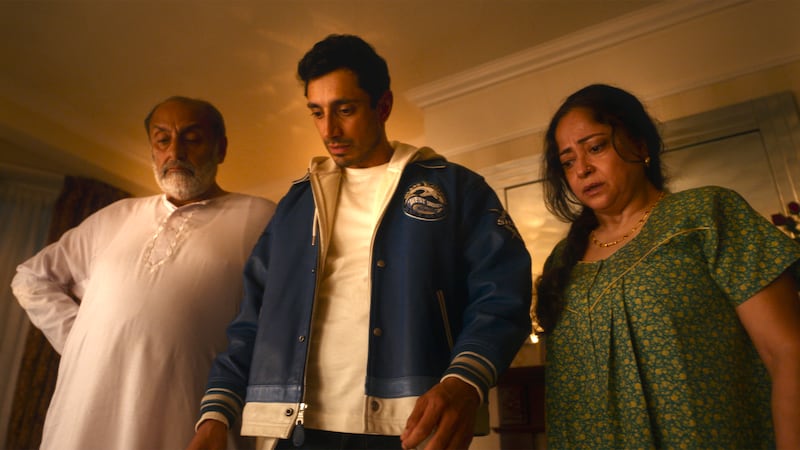
As Shah begins this inner dialogue, we start to see his suave demeanor crack. Initially, when questioned about those who are skeptical of a Gujarati James Bond, the actor claims he is confident in both his ability and his identity: “Proving those voices wrong is my life’s mission. To show people that this is what a hero looks like. To show them that this, too, is what British looks like.”
But it soon becomes evident that the Shah has no sense of self or community. When he attends a museum gala that is being protested for its colonial roots, he ignores a South Asian demonstrator camped outside, arguing he can make more of a difference by being inside the room. He chooses not to fast for Ramadan, drinking sips of apple juice in between takes of his Bond audition. And when Shah visits a mosque, his inner voice, disguised as Patrick Stewart, retorts, “Why are we at Taliban HQ?”
Shah’s sense of self-hatred is all-consuming. In a particularly telling scene, he berates himself: “You’re just a dumb f---ing Paki,” he says with tears in his eyes.
It’s no surprise that the creators of Four Lions are thanked in Bait’s credits. Just as that movie is a masterclass in weaving humor with adept political commentary, Bait uses comedy to dissect the complexities and traumas of being othered.
Shah’s identity crisis is evident from the very opening of the series, when he stumbles over one particular line during his audition: When it’s just you, by yourself, how do you live with yourself? Do you even know who you are?
It’s a question our hero cannot answer, no matter how many times he’s rehearsed.

Bait doesn’t linger on the heavier moments. Instead, we’re given a quick succession of scenes of a younger Shah, bloodied and beaten up by bullies. Discussions around mental illness and familial trauma are presented without details or in-depth conversations. The show manages to weave in these diasporic themes without being heavy-handed.
In this sense, Bait joins a strong lineup of narratives like Hulu’s Ramy that explore the isolating experience of being a brown Muslim living in a Western society (which is fitting, considering both shows share a writer in Azam Mahmood). But Bait builds upon Ramy Youssef’s and others’ works on identity in a fresh, innovative take by presenting the conundrum of the Muslim James Bond, a notion that feels so irreconcilable.
The contradiction comes to a head when Shah’s ex-girlfriend, Yasmin, a journalist and documentarian (played by Ritu Arya), pens a scathing piece on the matter, calling out the hypocrisy behind the casting.
“By so desperately pursuing the role of Bond, an icon of the White establishment, Shah Latif is exchanging his political art for vanilla distraction,” she writes. “And so he joins a long line of Brown men who think that by becoming our oppressor, he is somehow liberating all of us.”
But this sharp criticism is juxtaposed against Shah’s mother, Tahira’s, reaction. “My son is going to be the next James Bond; we all couldn’t be more proud,” she says with a sincerity in her voice.
There’s a sense that the sacrifice she’s made in leaving her home country is perhaps worth it if Shah nabs the role. But is it?
One of the more poignant scenes in the series occurs when our protagonist isolates himself during the Eid celebration to film an apology video for his erratic behavior. Scenes of Shah’s family praying the Eid al-Fitr namaz—arguably the most important congregational prayer for Muslims all year—are intercut with a bleary-eyed Shah spiraling as he records and deletes the TikTok over and over again, cursing the camera and still unable to find the right words. The night ends with Shah ruining everyone’s Eid as he lashes out at Zulfi and spirals deeper into self-despair.
As a protagonist, Shah is not always likable. But thanks to Ahmed’s visceral performance and compelling script, it’s hard not to empathize with and even root for Shah in his quest to be James Bond. The question that the show skillfully asks, however, is at what cost?
While Ahmed’s industry track record speaks for itself, Bait proves that after two decades, the multitalented entertainer clearly has a lot more to offer. Here’s hoping for a Season 2.