What if Barney Was Your Child’s Worst Nightmare?
Sundance thriller “Buddy” reimagines children’s television as a deranged hellscape.
Worry Well Productions
Barney the purple dinosaur was everywhere in the 1990s and aughts, courtesy of the children’s TV series Barney & Friends. Nonetheless, while that show’s target audience adored the affable and educational T. rex, anyone over the age of 12 couldn’t help but be creeped out by his indefatigable cheer, gratingly goofy laugh, and bouncy physicality. Perpetually huggy, sing-song-y, and over-the-moon optimistic, he exuded the sort of radiant happiness that suggests derangement.
Premiering at the Sundance Film Festival, Buddy shares the same opinion of the beloved character, eviscerating him as a demented predator whose aww-shucks charm and positivity are part of a façade masking his ulterior motives. The brainchild of Too Many Cooks mastermind Casper Kelly, it’s a horror-comedy that takes a scalpel—or, more accurately, several weapons—to its jaunty protagonist, all while reveling in his darkly disturbed spirit.
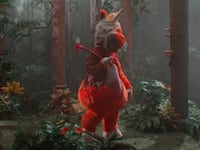
As demonstrated by his viral short, Kelly is fascinated by the creepy underbelly of classic TV fictions and formats, imagining their bright, colorful settings, incessantly smiling inhabitants, and sunshiny vibes as less adorable than maniacal. Whereas Too Many Cooks was a parody of ’80s and ’90s sitcom opening credit sequences, Buddy situates itself in 1999 kids’ TV—in particular, the clubhouse of Buddy (Keegan-Michael Key), an orange unicorn whose stomach features a giant heart and whose neck is decorated with a red bandana.
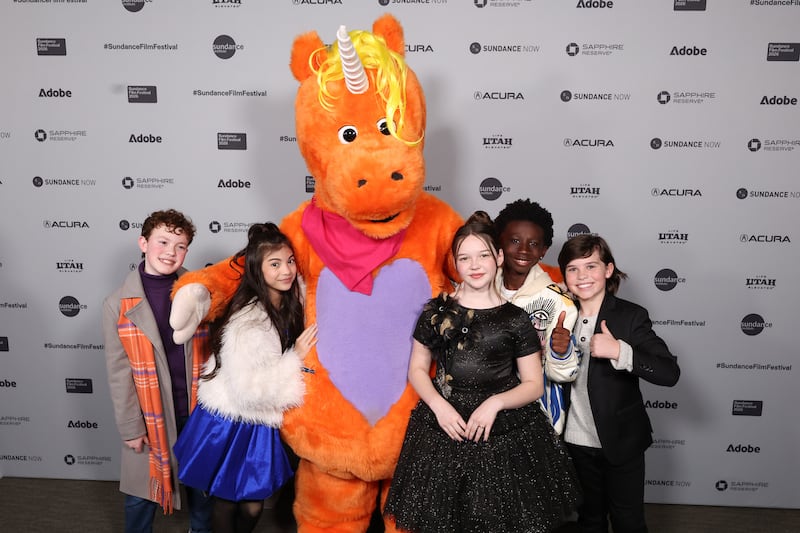
Delaney Quinn, Tristan Borders, Madison Skyy Polan, Caleb “CJ” Williams and Luke Speakman attend the premiere of “Buddy” by Casper Kelly.
Stephen Speckman./Sundance Institute
With a splash of wavy hair brushing up against his horn, Buddy is a good-natured facsimile of Barney, and he’s surrounded by a host of adolescents to whom he teaches valuable lessons that are, in theory, intended for his program’s pint-sized viewers.
Except that, as far as anyone can tell, there aren’t any viewers to speak of.
Sign Up for Our Obsessed Newsletter
By clicking “SUBSCRIBE” you agree to our Terms of Use and Privacy Policy.
Embracing his surrealistic impulses, Kelly posits the unicorn’s series It’s Buddy as a self-contained weirdo reality, regardless of the fact that each story invariably ends with closing credits as he croons an “I Love You, You Love Me”-style lullaby and cuddles his friends.
Working with co-writer Jamie King, the director fully immerses us in this small-screen universe, where Freddy (Delaney Quinn), Wade (Caleb Williams), Oliver (Tristan Borders) and Josh (Luke Speakman) aren’t actors on a show but literal inhabitants of a bizarro world populated by fellow humans such as Mailman Miles (Bennie Taylor) and Nurse Nancy (Phuong Kubacki), and anthropomorphic objects and animals like talking backpack Strappy (Patton Oswalt), gregarious Mr. Mailbox (Rachel Appelbaum), and furry humanoid rabbit Betty (Cedwan Hooks).
It’s Buddy is a Barney & Friends riff that’s also indebted to Pee-Wee’s Playhouse, and its tone is over-the-top, innocuous, and upbeat.
Buddy dives headfirst into this space, where Buddy—a stuffed animal who comes to life whenever his name is uttered—is planning on throwing a dance party. To quell young Freddy’s nerves about performing, Buddy sings her a song that preaches, “you have to be scared to be brave,” thereby getting her on board with the festivities. He has less success, however, with Josh, who’d rather read his book Wrinkle in Reality than participate.

Even in its initial straightforward passages, something is clearly wrong with Buddy, and he proves it by scuffling violently off-screen with Josh, after which he tells the others that the boy went away to Diamond City. This lie doesn’t convince Freddy, who spies Josh’s book, covered in blood, in the trash.
After informing Wade about her discovery, the two witness Buddy doing even worse things to other clubhouse residents. In short order, they’re trying to convince Oliver and Hannah (Madison Skyy Polan)—Josh’s out-of-the-blue replacement in the crew—that Buddy isn’t jolly; he’s psychotic and must be fled before any future infractions or disobedience puts them in his crosshairs.
Spoofing the phoniness of Barney & Friends isn’t new; Danny DeVito, Robin Williams, and Edward Norton were ridiculing the character as far back as 2002 with Death to Smoochy. Still, Kelly has a gift for recasting TV make-believe in sadistic and sinister terms, and the schizoid transitions that bridge It’s Buddy episodes are one of many instances in which he hints at the madness lurking beneath the surface.
Eventually, the director goes a step further by exiting this plane of existence to travel to the real world, where wife and mother Grace (Cristin Milioti) isn’t feeling quite herself. Mistakenly remembering that her son owned a fish, and staring and screaming at an empty dinner table chair, she appears to be losing her mind, much to the annoyance of her husband Ben (Topher Grace).
Whereas It’s Buddy boasts a boxy 4:3 visual frame, Grace’s tale is shot in traditional widescreen, and by film’s conclusion, Kelly will venture into a third realm that gets the expansive 2.35:1 treatment—a multi-dimensional tack that reflects this clash of the real and unreal.
Between Buddy ripping apart Charlie the Train and Grace hiring a psychic to help her get to the bottom of her mysterious feelings, Buddy is destined to go haywire, and it does in ways that are gruesomely unhinged. Axes, fire, and other carnage are soon the norm, as is sexual perversity, courtesy of Buddy and also cowboy marionette Willy (Michael Shannon) and his flesh-and-blood partner George (Clint Howard), whose relationship is anything but PBS-friendly.
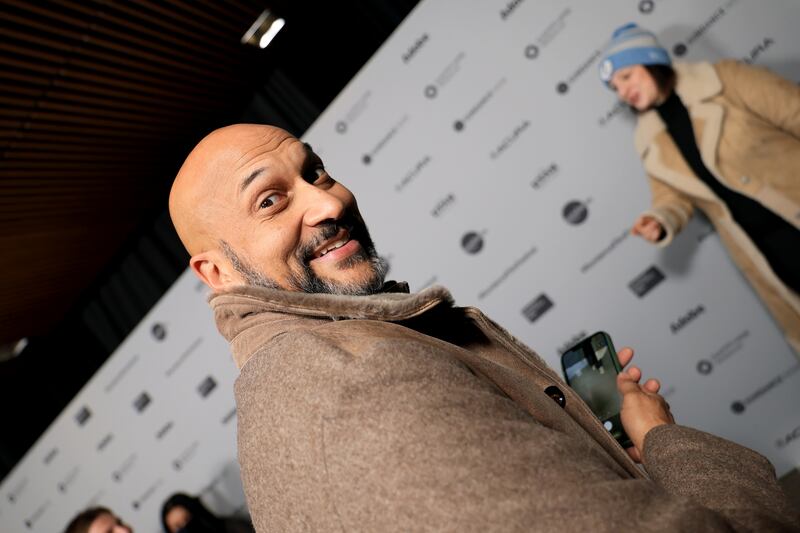
Keegan-Michael Key attends the “Buddy” Premiere during the 2026 Sundance Film Festival.
Dia Dipasupil/Getty Images
Once it establishes its deviant atmosphere and Buddy as an unholy fiend, Buddy can be a tad monotonous. Yet by rigorously attuning itself to the rhythms of the programs it’s parodying, the action becomes hypnotic. It’s as if everything is taking place in some recognizable, if crazily warped, dominion, and the proceedings’ illusory eeriness carries it over its less-than-terrifying rough patches, including a finale that’s short on suspense—if, ultimately, ends on a suitably gory-funny note.
There are times when Buddy feels like a short stretched a tad too thin. Its satire, though, remains pointed, with the film carving up children’s television as not just intolerably affected, but as a villainous vehicle designed to ensnare, brainwash, and twist kids into obedient and merry robots.
As relevant to today’s Ms. Rachel-dominated era as it is to the turn of the millennium, the film’s message is clear: Don’t leave raising your kids to TV.
Obsessed with pop culture and entertainment? Follow us on Substack and YouTube for even more coverage.

Got a tip? Send it to The Daily Beast here.
Register below to read this article for free or subscribe
to unlock unlimited access to The Daily Beast.
Monthly
$1
First month then $5.99/month
Annual
$35
First year then $59.99/year
Premium
$79
First year then $119.99/year
*Substack access provided by the next business day, using your subscription email. Choosing the Premium plan constitutes your permission to share your subscription email with Substack and your agreement to Substack’s Privacy Policy.
Already have an account? Sign In
Looks like you already have a subscription!
You're all set!
Thanks for subscribing.
Sign in or create an account
Login dialog
Loading comments…