Robert De Niro’s Heat thief Neil McCauley famously proclaimed, “The action is the juice.”
And for genre filmmakers, replicating the thrills of Michael Mann’s 1995 crime masterpiece has likewise been a vital objective, spawning a robust subgenre of knockoffs led by Ben Affleck’s superb The Town and Christian Gudegast’s first-rate Den of Thieves.
To that loyal crew, one can now add Crime 101, an underworld epic cast in a decidedly Mann-sian mold, with Chris Hemsworth (a vet of the auteur’s 2015 Blackhat) as an ace crook whose daring robberies have put him in the crosshairs of numerous adversaries, and a terrific Halle Berry as one of his potential accomplices. Adapted from Don Winslow’s 2020 novella of the same name, it’s a film that lives up to its title by being, in every way, basic—and, in the process, confirms that there’s a reason some clichés endure.
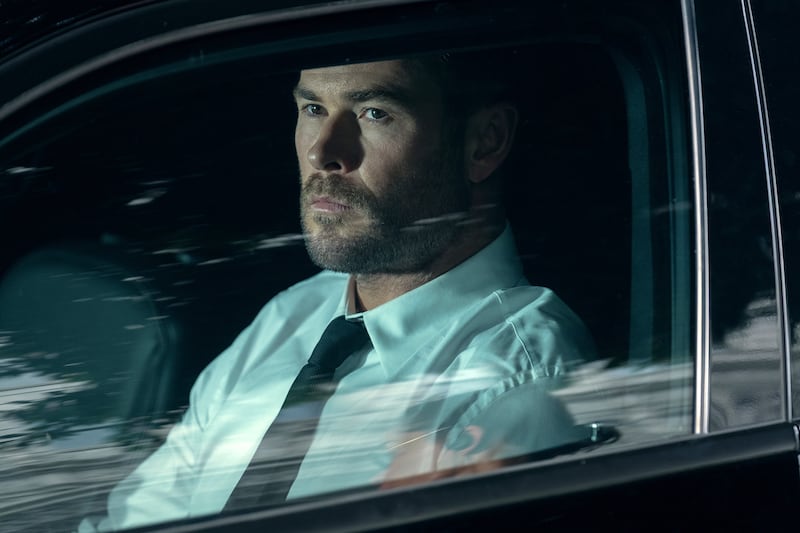
Tell me if you’ve heard this one before: Mike Davis (Hemsworth) is a dapper lawbreaker who has no family, friends, attachments, or anything else that he’s not willing to walk out on in thirty seconds flat. What he does possess—aside from a collection of vintage and modern muscle cars that he uses in his illicit vocation—is a stern loner disposition (to the point that he can’t maintain eye contact) and a professional code that involves expertly researching his marks and casing his targets, leaving behind not a shred of DNA, avoiding violence, and making his getaway on Los Angeles’ 101 freeway.
Crime 101 shifts into high gear with an opening job in which Mike hunts a pair of low-level couriers in possession of $3 million in diamonds—a mission that writer/director Bart Layton dramatizes with the seductive horizontal visual lines, pulsating score (via Blanck Mass), and striking widescreen framing (courtesy of cinematographer Erik Wilson) that will define the rest of the action.
Mike succeeds in this undertaking, albeit only after an insanely close call. In response, he tells his long-time handler Money (Nick Nolte, his voice now so raspy that it sounds like he’s been chewing broken glass) that this bad omen has put him off his already planned next heist.

Determining that Mike has lost his nerve, Money turns to Ormon, a low-rent hood played by Barry Keoghan with a familiar brand of squirrely, psychotic volatility.
Although Mike doesn’t immediately know it, Ormon—who wants to make a name for himself and isn’t shy about using brutality to do so—is a mortal threat. So too is Detective Lou Lubesnick (Mark Ruffalo), a scruffy, down-in-the-dumps cop who’s going through a divorce.
Lou is convinced that many of the city’s prominent robberies are being pulled off by the same culprit, and while his partner Detective Tillman (Corey Hawkins) and his jerky boss don’t agree (and think his hard-headedness is why he’s never risen up the ranks), he sticks to his proverbial guns, searching for the clue that’ll validate his theory.
Clocking in at a hefty 140 minutes, Crime 101 aims for sprawling majesty, and to that end, its story zooms in on Sharon Coombs (Berry), an insurance broker to the billionaire class who’s less than fully appreciated at a firm that’s yet to fulfill its promise of making her a partner. Unbeknownst to her, Sharon crosses paths in traffic with both Mike and Lou at the outset of the film, foreshadowing their intertwined fates.

If Layton isn’t subtle about these connections, he slathers on the sleek style, including multiple gorgeous panoramas of the glittering nighttime L.A. skyline, two of which rotate 180 degrees to suggest the topsy-turvy, paradigm-upending nature of Mike and company’s enterprises.
Crime 101 takes its time threading together its protagonists, who also include Maya (A Complete Unknown’s Monica Barbaro), an entertainment-industry nobody who accidentally rear-ends Mike and, then, agrees to go on a date with him. Unfortunately for Maya, her new beau is intensely guarded, withholding so many details about his past that he comes across as an obvious rogue.
Yet because her main purpose in this schematic narrative is to extract hints about his backstory and to give him the chance to change (and to seize a future that’s not just about ruthless crime and money), she sticks around long enough to complicate his upcoming heist.
Crime 101 hinges, predictably, on one last score that’ll net Mike “walk away money” and requires him to strike up a rapport with Sharon, whose dissatisfaction with her lot in life makes her susceptible to his entreaties. There’s nothing particularly stunning about how this all plays out, but Layton has a feel for the propulsive rhythms of crime fiction and the seductive allure of Los Angeles and its mixture of ostentatious wealth and down-and-dirty grit. Moreover, he has a cast capable of imbuing archetypes with, if not novel flair, then at least engaging personality.
As characters that have been seen a thousand times prior, Hemsworth and Ruffalo make for reasonably magnetic centers of attention, and Keoghan’s live-wire intensity gives the proceedings a jagged edge.

It’s Berry, however, who comes out on top in Crime 101, infusing Sharon with a fierceness that’s underscored by bitter fury at a misogynistic power structure that keeps the haves and the have-nots in their respective places. Despite her insurance broker being denigrated as over the hill at 53, the Oscar winner proves as commanding as ever; even her corniest moment—a kiss-off speech that doubles as a declaration of feminist independence—resounds with you-go-girl vigor.
Crime 101 is such a conventional macho affair that it’s almost surprising it’s debuting in theaters rather than going straight to TNT—or, as an Amazon MGM Studios production, to Prime Video as part of its dad-core line-up, with which it shares a competent genre craftsmanship, no-nonsense muscularity, and general lack of originality.
A cat-and-mouse saga embellished with pedal-to-the-medal car chases, vicious skirmishes, and unexpected romances, Crime 101 doesn’t aim to rewrite the rules of its time-honored game so much as just sturdily adhere to them. That, it turns out, is more than enough to energize this competent thriller, which, like its characters, knows that when faced with a choice between something or nothing, you take what you can get.