
According to Fallout, war never changes. Thankfully, Prime Video’s adaptation of Bethesda Game Studios’ video game franchise likewise maintains a steady course in its second season, building thrillingly on its wild, weird, and bada-- first outing.
The sprawling saga of a post-apocalyptic wasteland where bottle caps are cash, radioactivity is the norm, and cutthroat cruelty, carnage and chaos are king, Graham Wagner and Geneva Robertson-Dworet’s series (December 17) is an amusingly grim tale of survival set in a hellscape of retro-futuristic ruins, mutant creatures, and ruthless raiders, rebels, nomads, and militiamen, all of them struggling to endure by any treacherous means necessary.
In this sprawling, sinister sci-fi opus, it’s the end of the world as we know it, and everyone feels perfectly fine with killing, maiming, exploiting, and betraying their fellow man for a chance to live to fight another day.
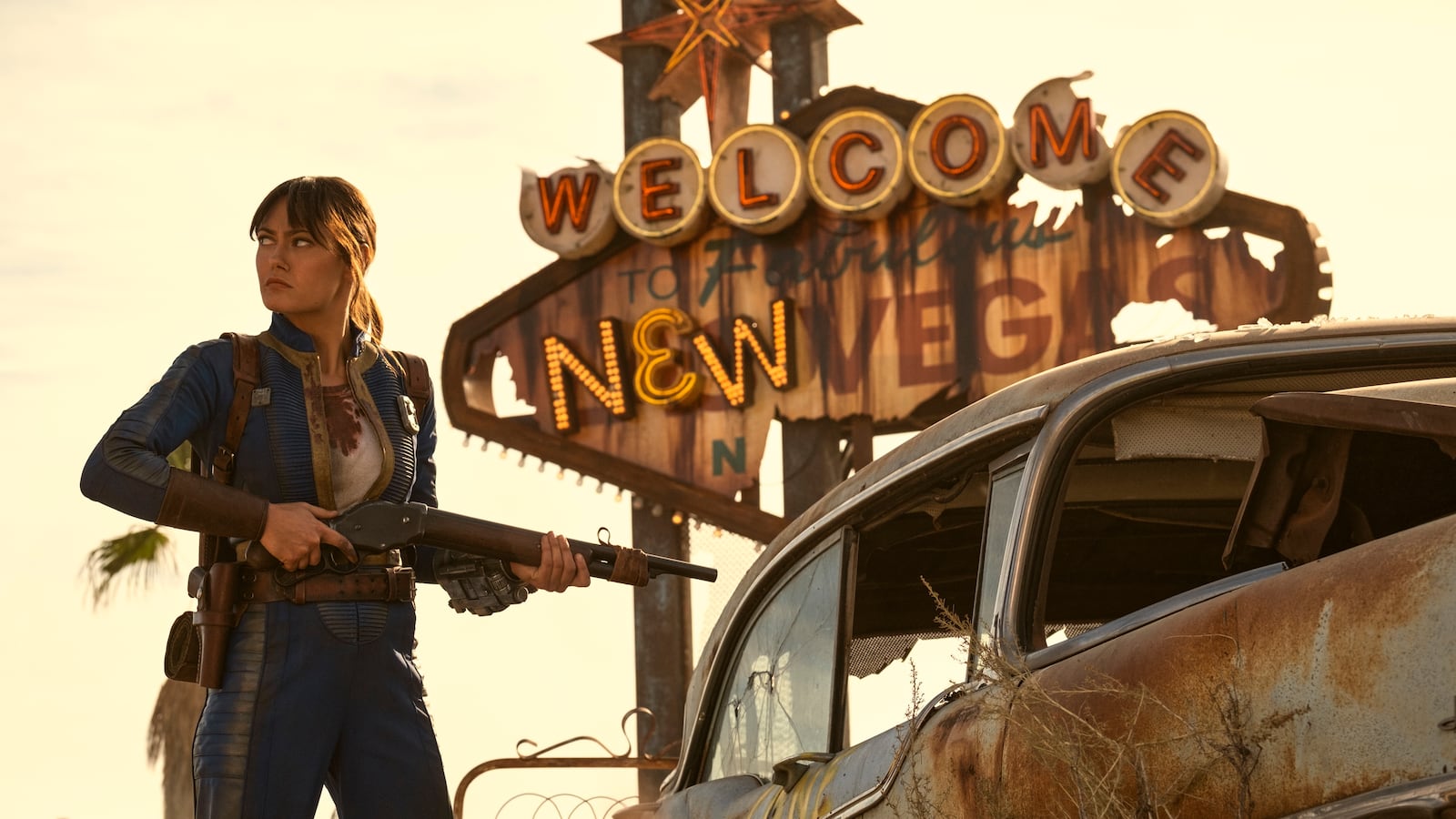
Wagner and Robertson-Dworet’s show once again accurately recreates its irradiated gone-to-seed milieu, be it the scattered settlements of the idealistic California New Republic, the titanic airships of the zealous militaristic order the Brotherhood of Steel, or the random dilapidated and abandoned hospitals, convenience stores, and homes of the nuke-decimated American West, through which Lucy (Ella Purnell) and the Ghoul (Walton Goggins) are trudging at the start of the premiere.
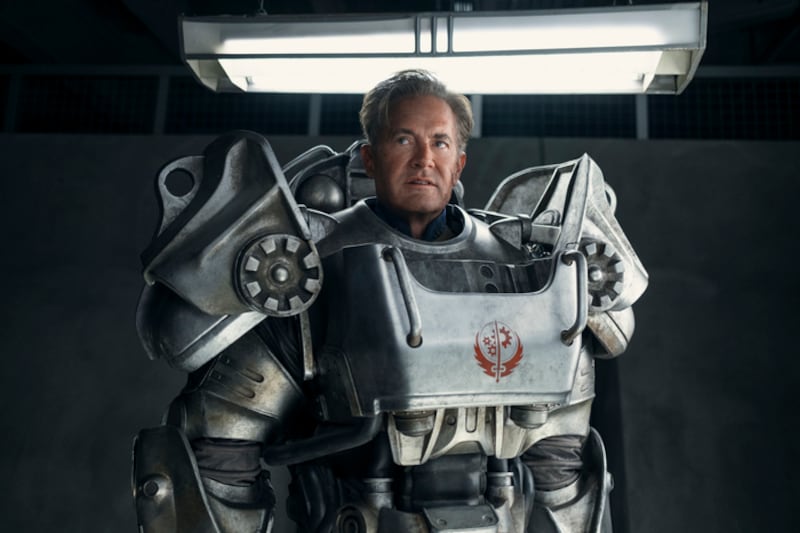
Their terminus is New Vegas, a high-rolling mecca in the desert, but their goals are different: Lucy is in search of her father Hank MacLean (Kyle MacLachlan), who was outed as a traitorous fiend during last season’s finale; and the Ghoul, a disfigured undying gunslinger, seeks answers about the fate of his wife and daughter, whom he believes didn’t perish in the atomic holocaust that leveled the country 219 years earlier.
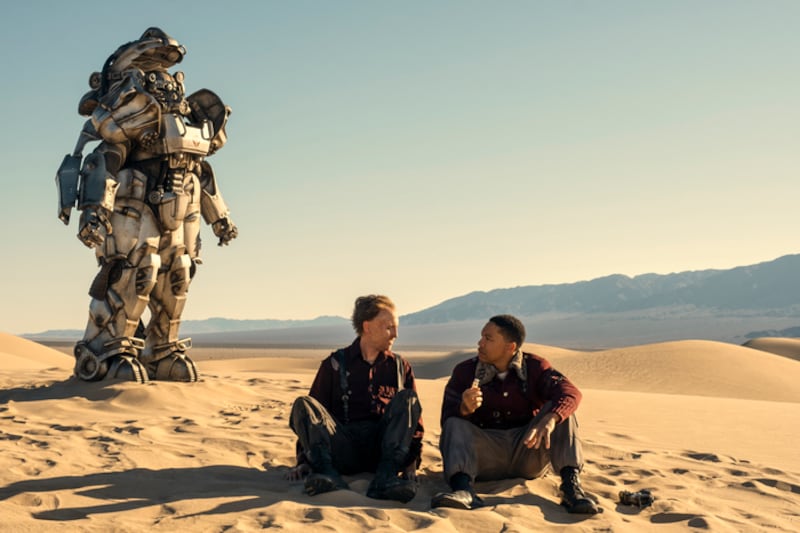
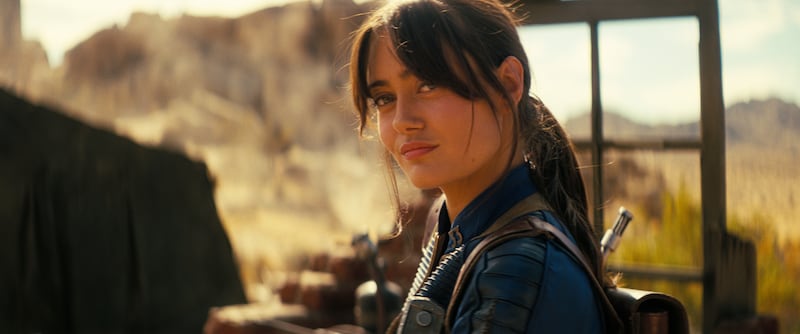
Lucy is still acclimating to 2296 at the start of this follow-up eight-episode run, her chipper “okie dokey” demeanor—the byproduct of having spent most of her life in one of America’s numerous subterranean Vaults under the stewardship of overseer Hank—holding strong despite the wasteland’s brutal nature. She’s thus an unlikely partner for the Ghoul, whom Goggins continues to play as a desperado who’s so hard-bitten, single-minded, and pitiless that he’d make Clint Eastwood cower in his cowboy boots.

Fallout pairs the duo for much of its initial episodes, thereby lacing its action with an even greater degree of bickering buddy-comedy humor. Their dynamic, however, isn’t just for laughs; it also encapsulates the show’s overarching tension between humanity’s noblest and basest instincts, with Lucy convinced that decency and justice (which she wants for her dad) are the bedrocks of society—she’s a big proponent of the golden rule (“Do unto others as you’d have done to you”)—and the Ghoul certain that the law of the land is simply kill or be killed.
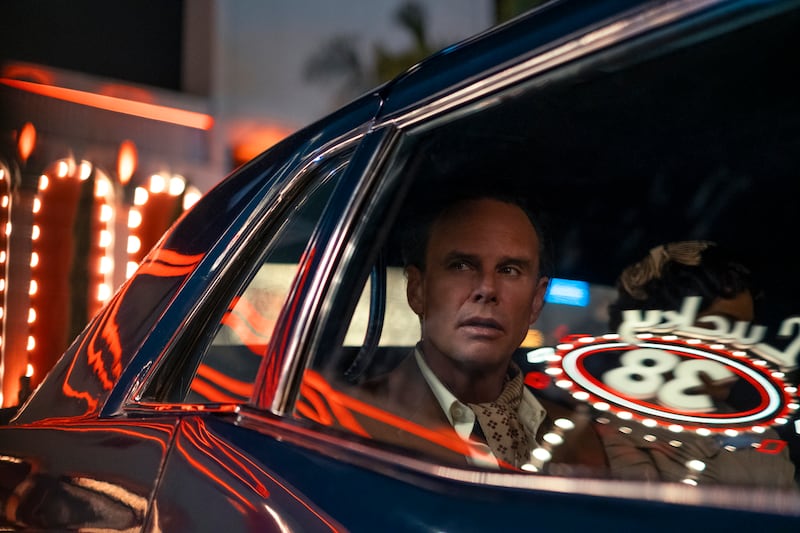
Lucy and the Ghoul’s destination is expertly modeled on Bethesda’s Fallout: New Vegas, and its kingpin, Robert House (Justin Theroux), will be a familiar face to gamers. In a sharp suit, meticulously combed black hair, and a pencil-thin mustache, House—the richest man on Earth, CEO of robot manufacturer RobCo Industries, and de facto ruler of the New Vegas strip—is a suave villain. The embodiment of Fallout’s villainous mega-corporations, whose nefariousness, it turns out, is even greater than originally assumed.

Theroux makes for a fine ‘60s-style baddie, his old-timey vocal inflections as weird as his confidence is discomfiting. He looms large over the primary proceedings, as well as the series’ recurring flashbacks to the pre-apocalypse, when military vet-turned-movie star-turned-Vault-Tec spokesman Cooper Howard (Goggins)—destined to one day become the Ghoul—sought to understand his wife’s role in orchestrating the End Times for profit.
Cooper’s backstory, which has him partaking in spy business for Lee Moldaver (Sarita Choudhury), lends great, conflicted insight into the Ghoul’s present furious disposition, and helps flesh out this fantastically detailed world, whose myriad details—from the Starlight Drive In and the Lucky 38 Casino to archaic terminals, Sugar Bombs cereal, and vicious rad roaches and scorpions—are authentic and specific.
Fallout isn’t, however, just concerned with Lucy and the Ghoul, as its splintered narrative additionally focuses on Brotherhood of Steel knight Maximus (Aaron Moten), whose loyalty to his clan is put to the test by Elder Cleric Quintus’ (Michael Cristofer) questionable designs for the Cold Fusion relic he’s attained. It also concentrates on Lucy’s brother Norm (Moisés Arias), who at the outset is trapped in a Vault 31 cryochamber with Brain-on-a-Roomba Bud Askins (Michael Esper) and desperate to figure out the true creepy-experiment purpose of his Vault-Tec home.
Between Vault-Tec’s clandestine mission, Hank’s shady reasons for traveling to New Vegas, and the question of who killed the world, mysteries are everywhere in Fallout, whose game-faithful goofy wit, grotesque violence, slow-motion kill shots, and branching story structure—in which the heroes encounter disparate stragglers and factions who want them to complete side quests—contributes to a lived-in sense of this devastated and deviant universe.
Even more than before, Wagner and Robertson-Dworet’s tale is about ubiquitous civil war, with comrades, brothers, children, and parents all turning on each other for selfish ends. Whether it’s fixated on fraught daddy issues, uneasy family reunions, or far-reaching conspiracies, the show presents a vision of man as an inherently untrustworthy beast prone, in the absence of a constraining and mollifying society, to resort to savagery at the drop of a dime. Its outlook is bleak, although in Lucy and the Ghoul, it nonetheless keeps hope alive that our better angels might, against all odds, find a way to prevail in the end.

Fallout is more streamlined than the titles upon which it’s based. Yet it’s still grand and expansive, with surprises around every corner that suggest the enormity and diversity of this unsparing landscape of tomorrow. Like Goggins’ noseless rider on the storm, its America is a scarred, twisted version of its former iconic self, and Wagner and Robertson-Dworet fashion it as a merciless arena in which men and women are battling to the death for a shot at making it to another unforgiving sunrise.
Alternately cynical and optimistic, suspenseful and funny, and interested in character drama and world-building, it’s an epic about civilization at a post-catastrophe crossroads and the motley individuals destined to forge its future. Moreover, it’s a superior dystopian adventure—the most purely entertaining sci-fi series on TV—which recognizes that this great nation provides endless opportunities for success, should one be cold-blooded enough to seize them.