AI is a plagiarism machine that can only create by reconfiguring preexisting materials. So it only makes sense that director Gore Verbinski uses the same tactic to skewer the technology taking over our world in Good Luck, Have Fun, Don’t Die (Feb. 13, in theaters).
A biting sci-fi adventure that interjects a handful of Black Mirror-esque vignettes into a narrative indebted to the works of Terry Gilliam (12 Monkeys, The Fisher King, Brazil), Night of the Living Dead, Village of the Damned, Ready Player One, and Groundhog Day—the last of which it overtly references—the new film is a caustic call to arms against our artificial-intelligence future.
Verbinski has long been one of Hollywood’s most inventive directors, bringing elastic, cartoony verve and imagination to films such as Mouse Hunt, Pirates of the Caribbean: The Curse of the Black Pearl (and its first two sequels), Rango, and The Lone Ranger.
Nine years after his last film (A Cure for Wellness), he proves that he’s lost little madcap inspiration with Good Luck, Have Fun, Don’t Die, whose Frankenstein-ian construction is an inherent expression of its witty censure. His camera imbued with Looney Tunes-like vitality, and his whiplash pacing attuned to his frantic characters, the director rarely lets his foot off the gas, careening wildly from hostile confrontations and do-or-die chases to flashbacks to the recent past.
As with much of his previous output, his latest goes on too long, sabotaging some of its climactic oomph. Yet with Oscar-winner Sam Rockwell as its tempestuous engine, it’s a captivatingly silly saga about the pitfalls of our modern techno-obsessiveness.
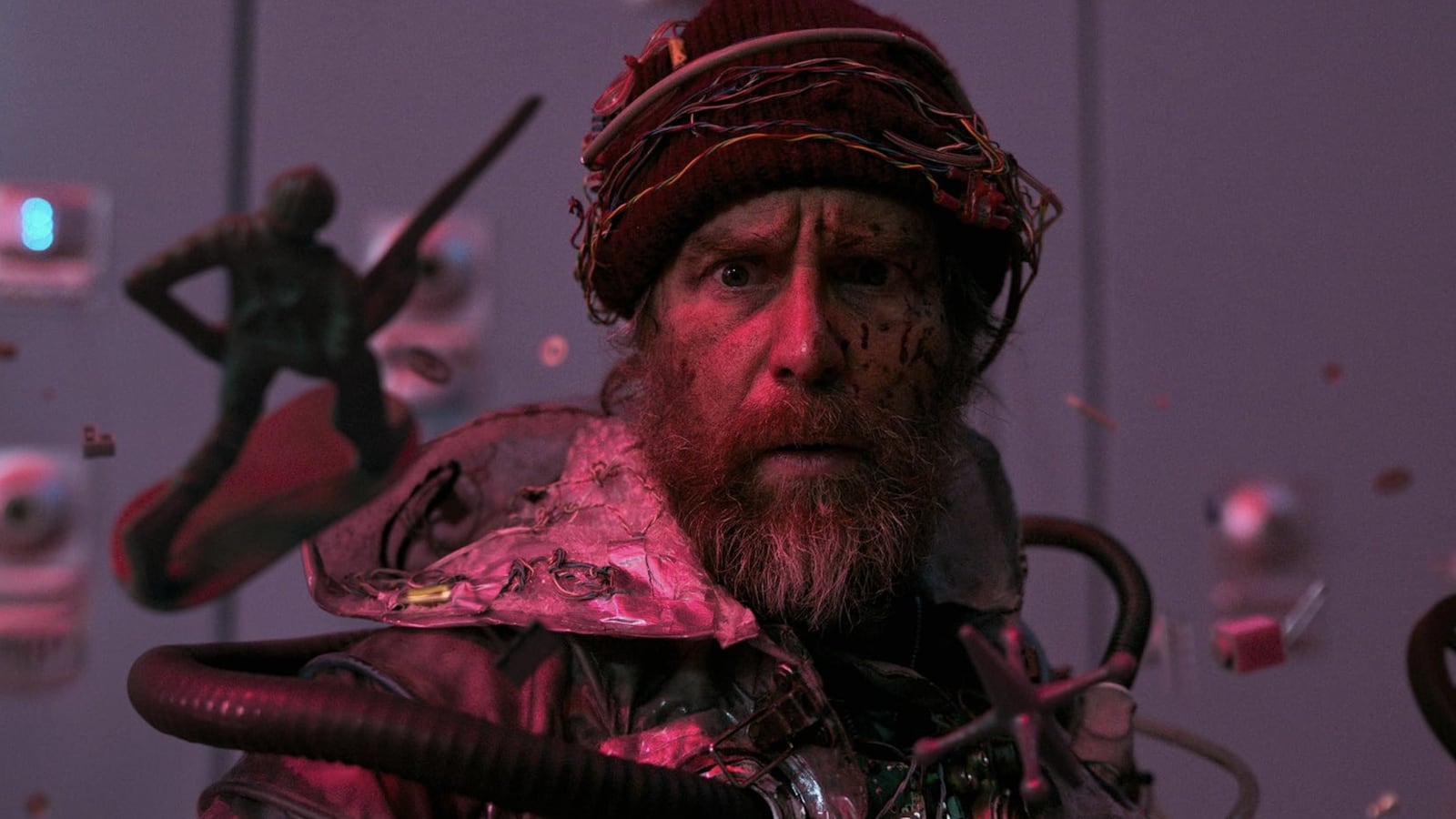
At Norm’s diner, 47 patrons have their dinners rudely interrupted by the appearance of an unnamed Man From the Future (Rockwell), whose transparent raincoat, wool hat decorated with messy wires, children’s backpack (upgraded with hoses and cables), and scruffy goatee all suggest he’s an unstable vagrant. He’s not, or so he says, claiming that he’s actually from a not-too-distant tomorrow in which AI has destroyed the world.
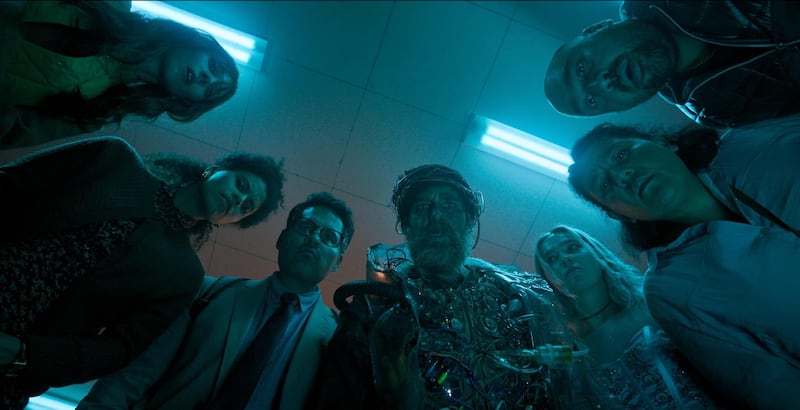
Unsurprisingly, nobody takes him seriously, and most are pretty annoyed by this intrusion. Nonetheless, with rapid-fire belligerence, Rockwell’s stranger, racing around booths and stomping across tables, demonstrates that he knows everyone in the place—a consequence of this being his 117th attempt at trying to save humanity via a trip back in time to this very diner.
To keep his captives compliant, the Man reveals that his torso is wrapped in explosives and he’s not averse to sending them all to kingdom come with a press of the trigger button in his hand. What he prefers, however, is these diners’ help, believing that if he can find the correct combination of individuals from this group, he can avert the forthcoming AI disaster.
Thus, he selects a motley crew of seven accomplices to aid him in his quest, including schoolteacher couple Mark (Michael Peña) and Janet (Zazie Beetz), single mom Susan (Juno Temple), and princess dress-wearing depressive Ingrid (Haley Lu Richardson). No sooner have they been chosen than things go to hell, forcing the Man to determine the most advantageous means of exiting the diner—the problem being that, thanks to his prior experiences, he knows that all three options invariably lead to failure.
As it charts these disparate souls’ confused and harried attempts to escape their confines, Good Luck, Have Fun, Don’t Die looks back on the days-earlier exploits of its main players. This begins with Mark and Janet at a high school where she’s a staffer, he’s a new substitute, and the kids are all rude, entitled cretins with their faces permanently in their screens. The bedlam that ensues speaks amusingly to the way technology saps us of our humanity. That notion is furthered by a second rewind focused on Janet, who loses her son in a school shooting and, in the midst of grieving, is granted a second chance, albeit with more than one glaring catch.
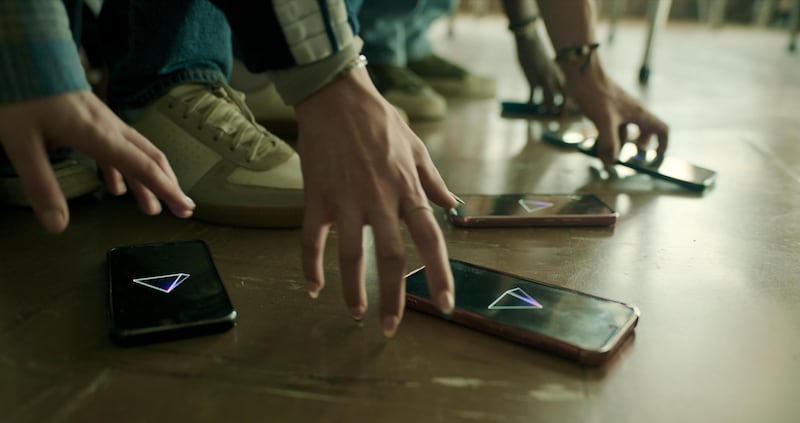
With a little additional development, both these tales might have served as cheeky Black Mirror episodes (one even shares direct similarities to last year’s “Common People”). And Verbinski smoothly threads them into his big picture, as he also does with Ingrid’s backstory: a young woman whose bizarre nosebleed-y allergy to technology marks her as a societal black sheep.
Verbinski keeps the momentum brisk. His camerawork is dynamic and ingenious, and he stages one elaborate sequence—in which his protagonists flee gun-toting villains in pig masks—with the Rube Goldberg-ish ingenuity that has long been his trademark.
Good Luck, Have Fun, Don’t Die never quite feels like it’s breaking new ground, but the more it channels its ancestors, the less accidental that feels. Instead, it resonates as a sly poke at AI’s own mix-and-match regurgitation.
Rockwell’s performance as the crusading Man From the Future is so humorously shambolic that it rarely matters that much of this has been done before. Plus, despite its finale boasting trace elements of myriad predecessors’ DNA (including Ghostbusters and The Matrix), it still concocts a few memorable out-there sights, all while keeping its urgent anti-AI fervor at a fever pitch.
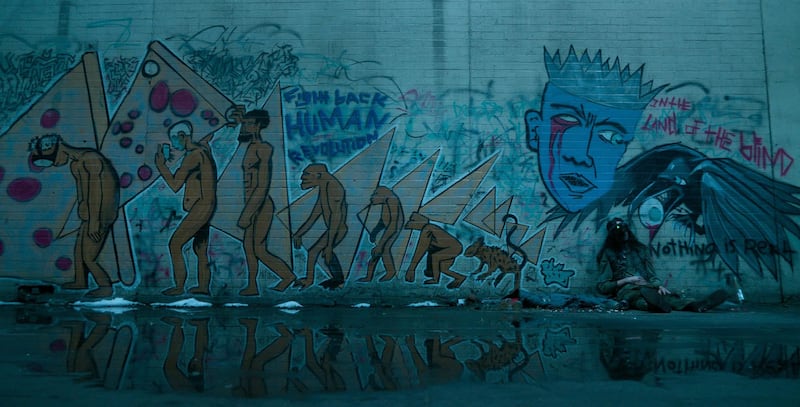
Good Luck, Have Fun, Don’t Die recognizes the tantalizing allure of artificial intelligence but posits it as a fundamentally false promise. And in its chaotic close, its critique extends, subtly, to cinema itself, whose placating truths and comforting happily-ever-afters are viewed with a wary eye.
Verbinski undercuts his wrap-up’s wild forward thrust by distending things almost past their breaking point. Even so, there are enough comical details scattered throughout the conclusion (the best: a meat thermometer reading 98.6 degrees after being jabbed in a man’s head) that the proceedings’ energy never totally flags.
Moreover, the director largely pulls off a last-second detour into poignancy, delivering a sneaky emotional punch that ends his rambling odyssey on a sweet note.
Since 1984’s The Terminator, the movies have envisioned technological innovation as a one-way ticket to the apocalypse, and Good Luck, Have Fun, Don’t Die doesn’t deviate from that worldview. If that means Verbinski’s feature is merely covering well-worn ground, however, it’s also an indication that, perhaps, people have yet to heed such warnings—thus making them all the more urgent.