


Some Christmas movies are merry and bright, and others are melancholy and touching, tackling hardship, loss, and tragedy to underscore the importance of family, togetherness, love, and appreciating what you have while you still have it.
Goodbye June, premiering Dec. 24 on Netflix, falls into the latter category, assembling an all-star cast for the tale of a London clan coping with the impending death of their matriarch in the weeks before Christmas.
The directorial debut of Kate Winslet, who co-stars alongside Helen Mirren, Andrea Riseborough, Johnny Flynn, and Timothy Spall, Goodbye June is a movie manufactured to tug at the heartstrings. That it does so this gracefully and movingly is a testament to Winslet’s understated stewardship and a script by her son, Joe Anders, whose manipulations are as gentle as they are affecting.

In the wee hours of a snowy December morning, June (Helen Mirren) collapses to the kitchen floor, her tea kettle’s whistle alerting her son Connor (Johnny Flynn)—who still lives at home, and whose scratched-up cuticles indicate that he has a severe anxiety problem—that something is amiss. Once the paramedics arrive, Connor and his dad, Bernie (Timothy Spall), follow June to the hospital, where Connor phones two of his three sisters to report the calamitous news.
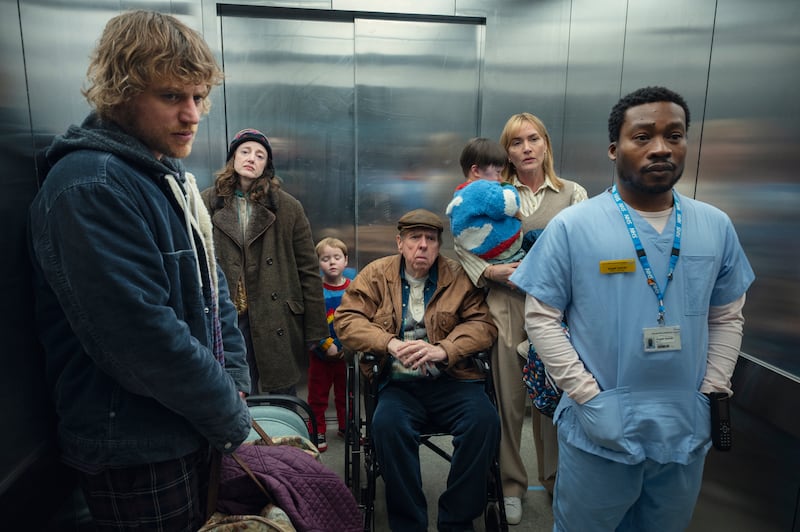
Julia (Winslet) is a put-together businesswoman juggling work and raising her three children, Ella (Flora Jacoby Richardson), Alfie (James Trevelyan Buckle), and Benji (Benjamin Shortland), the last of whom has Down syndrome. Molly (Riseborough) is similarly harried, albeit in a different way, as she’s a homemaker dealing with her own brood (which includes an infant) and a good-natured, if bumbling, husband, Jerry (Stephen Merchant), whose forgetfulness drives her crazy.
June’s accident is an outgrowth of a three-year cancer battle that doctors now believe is all but lost; with the disease having rapidly spread throughout her abdomen and pelvis, further treatment options are off the table. This is a crushing blow, especially during the holiday season, and it exacerbates tensions between Julia and Molly, whose mutual antipathy runs so deep that the two can barely acknowledge each other in the hospital.

On multiple occasions in the immediate aftermath of this dire prognosis, the sisters snipe at each other with the sort of vitriol reserved for close relatives, and though Goodbye June takes its time revealing the source of their conflict, it’s clear from the outset that it’s rooted in Molly’s bitterness over Julia’s success (and apparent condescending arrogance about it) and Julia’s frustration with Molly’s nastiness.

There’s a third sister in this family, Helen (Toni Collette), who earns a living running incense-permeated holistic yoga classes, and who shows up at the hospital with a surprise: She’s pregnant. June is exceedingly happy about this announcement, just as she’s pleased with having her offspring around her at this delicate time.
Goodbye June authentically captures the unique atmosphere of her medical environment, where chats with visitors are interrupted by difficult trips to the bathroom, blood pressure tests and morphine-drip sessions, and struggles with the room’s television. There’s an inescapable sadness lurking beneath this milieu’s cheery conversations and bustling activity, and Winslet honors that without overdoing it, locating the right measure of moroseness and (forced) mirth.
Unlike 2005’s The Family Stone, a Yuletide predecessor that covered similar dying-mom territory, Goodbye June is charming yet never strives to be wackily funny, its characters envisioned as merely ever-so-slightly exaggerated types grappling with decidedly humorless circumstances.

On a couple of occasions, Anders’ tale indulges in the brand of cutesiness typical of such affairs—most glaringly, a ruse perpetrated by June to get Julia and Molly in the same room so she might scold them for their hostilities and guilt-trip them into a détente.

However, even in that instance, the film doesn’t push harder than is necessary. Winslet refrains from orchestrating chuckle-worthy hijinks in order to keep things bubbly, and she likewise refuses to slather on the weepiness. It’s not that her calculations aren’t apparent; it’s that they’re handled with a light touch that doesn’t just make them go down smoother, but allows them to speak sincerely to the material’s core ideas.
Goodbye June is about priorities, cherishing loved ones, and unity as a bulwark against the unpleasantness that life inevitably throws at you, and Winslet navigates it all with compassion and poise. In that quest, she’s aided by a collection of accomplished players, each of whom avoids the cartoonishness that might render everything facile.
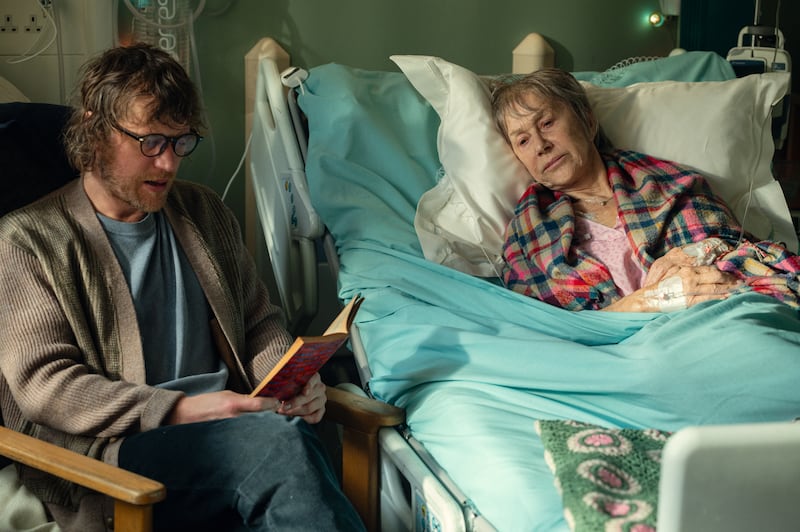
From Flynn’s frazzled terror to Spall’s blustery avoidance tactics to Collette’s flighty Earth Mother weirdness, the film’s stars maintain enough believable humanity to make their characters seem like relatable, living, breathing people. Riseborough, in particular, is great as the resentful and hurt Molly, whose friction with Julia is the story’s main subplot. And, as with the rest of her cast, Winslet proves a generous director, routinely ceding the spotlight so everyone gets a moment or two to shine.
Mirren can only do so much with a role that asks her to suffer and die both realistically and elegantly, but she’s as unfussy as her screen partners, and as with all the action, the film gives her space to breathe.
Collaborating with cinematographer Alwin H. Küchler, Winslet draws almost no attention to her direction, her visuals at once evocative and unobtrusive, as when she uses the back of Connor’s head to separate Julia and Molly in the frame, or her camera tellingly swings back and forth between the estranged siblings. Rather than trying to gussy up her melodrama, she keeps things on an even keel, the better to tenderly, and frankly, confront the complex awfulness of losing a mother, particularly at a fraught (or celebratory) moment in life.
Whether it’s via the presence of Julia and Molly’s children in and around the hospital, or a climax involving an impromptu Nativity play, Goodbye June juxtaposes youth and age, and birth and death, in a way that feels joyously and heartbreakingly true. It’s a film that earns the tears it elicits, and if its lack of jokey comedy prevents it from becoming a Christmas movie staple, it nonetheless has more to say—and finds a smarter way to say it—than most of its tinsel and garland-decorated genre mates.